Effectiveness of traditional, artificial intelligence-assisted, and virtual reality training modalities for focused cardiac ultrasound skill acquisition: a randomised controlled study
Keywords:
Artificial intelligence, Virtual reality, UltrasoundAbstract
Background: Focused cardiac ultrasound (FCU) is increasingly used as an extension of physical examination to aid diagnosis and clinical decision-making. Emerging educational technologies such as artificial intelligence (AI)-enabled ultrasound devices and virtual reality (VR) simulators offer novel, cost-effective and self-directed approaches for FCU skill acquisition training. Prior studies suggest that VR-based training may be non-inferior to traditional teaching, while AI offers real-time feedback to enhance learning.
Objective: This study aimed to evaluate the effectiveness and non-inferiority of AI and VR-assisted training compared to Traditional in-person instruction in achieving competency in FCU image acquisition. Secondary outcomes included time to acquire an optimal apical 4 chamber (A4C) view and self-reported confidence in image acquisition, assessed immediately post-training and at 3-month follow up.
Methods: In this single-blind, randomized controlled pilot trial, 66 local medical students with no prior FCU experience were randomised into 3 arms: (1) AI-enabled ultrasound training using the Kosmos system, (2) VR-based stimulator (Vimedix), and (3) Traditional instructor-led teaching. All sessions were 60 min long. Image acquisition of 5 standard FCU views was assessed by blinded evaluators using the Rapid Assessment of Competency in Echocardiography (RACE) score at both time points.
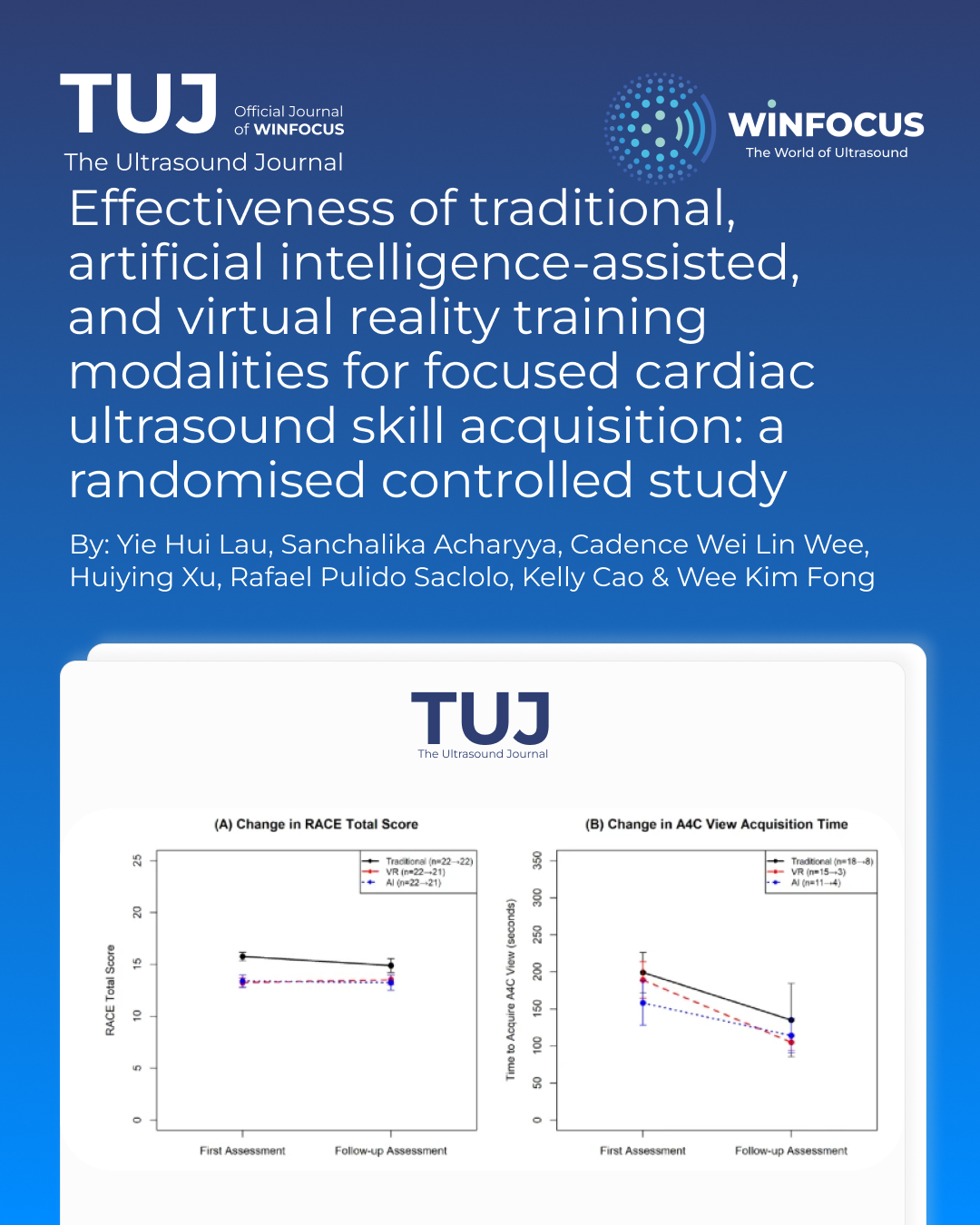
Results: Two participants were lost to follow-up (one each from the AI and VR groups). In the first assessment, the Traditional group achieved the highest mean RACE score (15.77), followed by AI (13.39) and VR (13.23). Non-inferiority testing confirmed that both AI (95% CI −∞ to 3.60; p < 0.001) and VR (95% CI −∞ to 3.58; p < 0.001) methods were non-inferior to Traditional instruction. The AI group achieved the shortest mean time to acquire an optimal A4C view (158 ± 99.1 s), followed by the VR (189 ± 94.7 s), and traditional (199 ± 115.1 s), though differences were not statistically significant (p = 0.591). Confidence levels were initially highest in the Traditional group, while the VR group showed higher confidence at 3-month follow-up, particularly in parasternal long-axis view acquisition.
Conclusions: AI and VR-based training methods were non-inferior to traditional instruction for FCU skill acquisition. Both modalities show promise as scalable, technology-enabled alternatives in ultrasound education.
Trial registration This trial was registered on Clinicaltrials.gov (NCT06355557).
References
1. Spencer KT, Flachskampf FA (2019) Focused cardiac ultrasonography. JACC Cardiovasc Imaging 12(7 Pt 1):1243–1253
2. Huang W, Koh T, Tromp J, Chandramouli C, Ewe SH, Ng CT et al (2024) Point-of-care AI-enhanced novice echocardiography for screening heart failure (PANES-HF). Sci Rep 14(1):13503
3. Khoo C, Sharma S, Jefree RA, Chee D, Koh ZN, Lee EXY et al. Self-directed virtual reality-based training versus traditional physician-led teaching for point-of-care cardiac ultrasound: a randomized controlled study. J Cardiothorac Vasc Anesth. 2024;39:95–103.
4. Gat T, Galante O, Sadeh R, Kobal SL, Fuchs L (2024) Self-learning of cardiac ultrasound by medical students: can augmented online training improve and maintain manual POCUS skills over time? J Ultrasound 27(1):73–80
5. Millington SJ, Arntfield RT, Hewak M, Hamstra SJ, Beaulieu Y, Hibbert B et al (2016) The rapid assessment of competency in echocardiography scale: validation of a tool for Point-of-Care ultrasound. J Ultrasound Med 35(7):1457–1463
6. Prenner SB, Ambrose M, Gopal DJ et al (2022) Pragmatic assessment of resident performed cardiac point of care ultrasound using a validated scoring metric. Int J Cardiol Heart Vasc 39:100993 Published 2022. https://doi.org/10.1016/j.ijcha.2022.100993
Downloads
Published
Issue
Section
License
Copyright (c) 2025 Yie Hui Lau, Sanchalika Acharyya, Cadence Wei Lin Wee, Huiying Xu, Rafael Pulido Saclolo, Kelly Cao, Wee Kim Fong (Author)

This work is licensed under a Creative Commons Attribution-NonCommercial 4.0 International License.
This is an Open Access article distributed under the terms of the Creative Commons Attribution License (https://creativecommons.org/licenses/by-nc/4.0) which permits unrestricted use, distribution, and reproduction in any medium, provided the original work is properly cited.
Authors retain the copyright for their published work. No formal permission will be required to reproduce parts (tables or illustrations) of published papers, provided the source is quoted appropriately and reproduction has no commercial intent.
How to Cite