Feasibility of point-of-care ultrasound during the emergency department triage: a prospective cohort study
Keywords:
Point-of-care ultrasound, Nursing, Emergency department, TriageAbstract
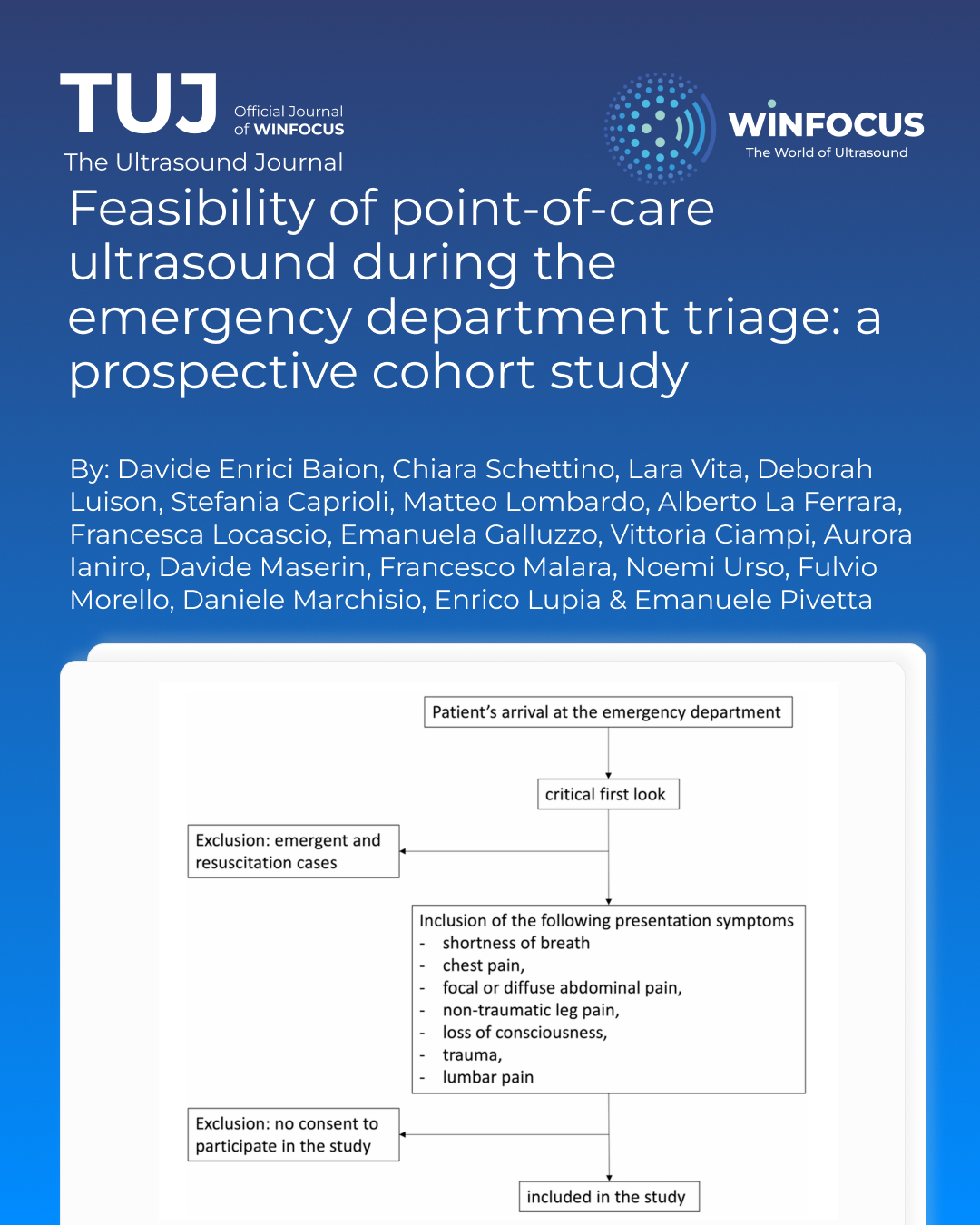
Background: The primary aim of this study was to evaluate the feasibility of adding point-of-care ultrasound (POCUS) during the Emergency Department (ED) triage process. This prospective study enrolled two cohorts of adult patients presenting to the ED for a selected group of acute symptoms, previously selected on the basis of the presumed utility of POCUS during triage evaluation. The ED triage process was performed as recommended by the hospital guidelines or by including a nurse-performed POCUS evaluation. Only urgent or less codes were considered eligible for the study. The timing of all evaluations was recorded along with the opinion of the nurses involved in the study on the impact of POCUS results on the triage process. After ED discharge, the most appropriate triage code was determined by independent review of the triage data.
Results: A total of 312 patients were enrolled, 101 of whom were evaluated with the hospital standard triage process. Nine nurses with expertise in both ED triage and POCUS were involved in the study. The majority of the enrolled patients were deferrable or minor urgency (about 60% in both groups). The median time needed for the triage evaluation was 180 seconds (range 540), 90 seconds longer in the POCUS group than in the standard triage group (p < 0.01). Net reclassification index of POCUS-implemented compared with standard triage protocol was 8% and 5% for urgent and less urgent cases.
Conclusions: This small single site study suggests that POCUS is feasible during the ED triage and it is potentially useful by triage nurses. However, future studies are needed to confirm POCUS potential usefulness for a more accurate triage process.
References
1. Cooke MW, Jinks S (1999) Does the Manchester triage system detect the critically ill? J Accid Emerg Med 16(3):179–181. https://doi.org/10.1136/emj.16.3.179
2. Van Gerven R, Delooz H, Sermeus W (2001) Systematic triage in the emergency department using the Australian National triage scale: a pilot project. Eur J Emerg Med Off J Eur Soc Emerg Med 8(1):3–7. https://doi.org/10.1097/00063110-200103000-00002
3. Beveridge R, Ducharme J, Janes L, Beaulieu S, Walter S (1999) Reliability of the Canadian emergency department triage and acuity scale: interrater agreement. Ann Emerg Med 34(2):155–159. https://doi.org/10.1016/s0196-0644(99)70223-4
5. Worster A, Gilboy N, Fernandes CM et al (2004) Assessment of inter-observer reliability of two five-level triage and acuity scales: a randomized controlled trial. CJEM 6(4):240–245. https://doi.org/10.1017/s1481803500009192
6. National Hospital Ambulatory Medical Care Survey: 2020 emergency department summary Table (2022) https://stacks.cdc.gov/view/cdc/121911. Accessed 4 Jul 2024
7. Presidential decree of the Italian Republic of March 27th (1992) https://www.gazzettaufficiale.it/atto/serie_generale/caricaDettaglioAtto/originario%3Fatto.dataPubblicazioneGazzetta=1992-03-31%26atto.codiceRedazionale=092A1471%26elenco30giorni=false
8. Italian national guidelines for the in-hospital triage. https://www.salute.gov.it/imgs/C_17_pubblicazioni_3145_allegato.pdf
9. Christ M, Grossmann F, Winter D, Bingisser R, Platz E (2010) Modern triage in the emergency department. Dtsch Ärztebl Int Dec. https://doi.org/10.3238/arztebl.2010.0892
10. Australasian College for Emergency Medicine, Policy on the Australasian Triage Scale Version 5 - November 2023. https://acem.org.au/getmedia/484b39f1-7c99-427b-b46e-005b0cd6ac64/Policy_on_the_Australasian_Triage_Scale
11. Ibanez B, James S, Agewall S et al (2018) 2017 ESC guidelines for the management of acute myocardial infarction in patients presenting with ST-segment elevation. Eur Heart J 39(2):119–177. https://doi.org/10.1093/eurheartj/ehx393
12. Byrne RA, Rossello X, Coughlan JJ et al (2023) 2023 ESC guidelines for the management of acute coronary syndromes. Eur Heart J 44(38):3720–3826. https://doi.org/10.1093/eurheartj/ehad191
13. Narula J, Chandrashekhar Y, Braunwald E (2018) Time to add a fifth pillar to bedside physical examination: Inspection, Palpation, Percussion, Auscultation, and insonation. JAMA Cardiol 3(4):346–350. https://doi.org/10.1001/jamacardio.2018.0001
14. Oto B, Baeten R, Chen L et al (2024) Best practices for point of care ultrasound: an interdisciplinary expert consensus. POCUS J 9(1):95–108. https://doi.org/10.24908/pocus.v9i1.17240
15. Mizubuti GB, Maxwell S, Shatenko S et al (2024) Competencies for proficiency in basic point-of-care ultrasound in anesthesiology: National expert recommendations using Delphi methodology. Can J Anaesth J Can Anesth 71(7):967–977. https://doi.org/10.1007/s12630-024-02746-w
16. Gargani L, Girerd N, Platz E et al (2023) Lung ultrasound in acute and chronic heart failure: a clinical consensus statement of the European association of cardiovascular imaging (EACVI). Eur Heart J - Cardiovasc Imaging 24(12):1569–1582. https://doi.org/10.1093/ehjci/jead169
17. Nassar SM, Almubrik SA, Alyahya L, Alshalan M, Alhashem HM, Perception (2024) Knowledge, Indications, and future prospects of Point-of-Care ultrasound among medical students in Saudi Arabia. Cureus 16(4):e57704. https://doi.org/10.7759/cureus.57704
18. Popat A, Harikrishnan S, Seby N et al (2024) Utilization of Point-of-Care ultrasound as an imaging modality in the emergency department: A systematic review and Meta-Analysis. Cureus 16(1):e52371. https://doi.org/10.7759/cureus.52371
19. Liu K, Yao YL, Wang YX et al (2022) A cross-sectional survey on the lung ultrasound training and practice of respiratory therapists in Mainland China. BMC Pulm Med 22(1):425. https://doi.org/10.1186/s12890-022-02213-6
20. Hoppmann RA, Mladenovic J, Melniker L et al (2022) International consensus conference recommendations on ultrasound education for undergraduate medical students. Ultrasound J 14(1):31. https://doi.org/10.1186/s13089-022-00279-1
21. Schmidt GA, Blaivas M, Conrad SA et al (2019) Ultrasound-guided vascular access in critical illness. Intensive Care Med 45(4):434–446. https://doi.org/10.1007/s00134-019-05564-7
22. Duran-Gehring P, Bryant L, Reynolds JA, Aldridge P, Kalynych CJ, Guirgis FW (2016) Ultrasound-Guided peripheral intravenous catheter training results in Physician-Level success for emergency department technicians. J Ultrasound Med Off J Am Inst Ultrasound Med 35(11):2343–2352. https://doi.org/10.7863/ultra.15.11059
23. Tada M, Yamada N, Matsumoto T, Takeda C, Furukawa TA, Watanabe N (2022) Ultrasound guidance versus landmark method for peripheral venous cannulation in adults. Cochrane Database Syst Rev 12(12):CD013434. https://doi.org/10.1002/14651858.CD013434.pub2
24. Baion DE, La Ferrara A, Maserin D et al (2023) Mono- and bi-plane sonographic approach for difficult accesses in the emergency department - A randomized trial. Am J Emerg Med 74:49–56. https://doi.org/10.1016/j.ajem.2023.09.018
25. Boling B, Solis A (2023) Point-of-Care ultrasonography in the critical care setting: abdominal POCUS. AACN Adv Crit Care 34(3):216–227. https://doi.org/10.4037/aacnacc2023298
26. Kalam S, Selden N, Haycock K, Lowe T, Skaggs H, Dinh VA (2023) Evaluating the effect of Nursing-Performed Point-of-Care ultrasound on septic emergency department patients. Cureus 15(6):e40519. https://doi.org/10.7759/cureus.40519
27. Matsumoto M, Tamai N, Miura Y et al (2021) Evaluation of a Point-of-Care ultrasound educational program for nurse educators. J Contin Educ Nurs 52(8):375–381. https://doi.org/10.3928/00220124-20210714-07
28. Schallom M, Prentice D, Sona C et al (2020) Accuracy of measuring bladder volumes with ultrasound and bladder scanning. Am J Crit Care Off Publ Am Assoc Crit-Care Nurses 29(6):458–467. https://doi.org/10.4037/ajcc2020741
29. Laastad Sørensen M, Oterhals K, Pönitz V, Morken IM (2023) Point-of-care examinations using handheld ultrasound devices performed by intensive care nurses in a cardiac intensive care unit. Eur J Cardiovasc Nurs 22(5):482–488. https://doi.org/10.1093/eurjcn/zvac089
30. Wiley BM, Borlaug BA, Kane GC (2022) Lung ultrasound in heart failure: envisioning handheld ultrasound to empower nurses and transform health care. J Am Coll Cardiol 80(5):524–526. https://doi.org/10.1016/j.jacc.2022.05.021
31. Zisis G, Yang Y, Huynh Q et al (2022) Nurse-Provided lung and inferior Vena Cava assessment in patients with heart failure. J Am Coll Cardiol 80(5):513–523. https://doi.org/10.1016/j.jacc.2022.04.064
32. Pencina MJ, D’ Agostino RB, D’ Agostino RB, Vasan RS (2008) Evaluating the added predictive ability of a new marker: from area under the ROC curve to reclassification and beyond. Stat Med 27(2):157–172. https://doi.org/10.1002/sim.2929
33. Reay G, Smith-MacDonald L, Then KL, Hall M, Rankin JA (2020) Triage emergency nurse decision-making: incidental findings from a focus group study. Int Emerg Nurs 48:100791. https://doi.org/10.1016/j.ienj.2019.100791
34. Triage Qualifications and Competency (2017) J Emerg Nurs 43(6):571–574. https://doi.org/10.1016/j.jen.2017.08.008
35. Cotton R, Drew R, Douma M et al (2021) An analysis of individual and department triage variances to identify, quantify, and improve markers of triage nurse accuracy. Can J Emerg Nurs 44(2):19–20. https://doi.org/10.29173/cjen130
36. Gruppo Formazione Triage - Nurse Triage (2019) Vol 1. IV. McGraw-Hill
37. Rykkje A, Carlsen JF, Nielsen MB (2019) Hand-Held ultrasound devices compared with High-End ultrasound systems: A systematic review. Diagnostics 9(2):61. https://doi.org/10.3390/diagnostics9020061
38. Merkel D, Züllich TF, Schneider C et al (2023) Prospective comparison of handheld ultrasound devices from different manufacturers with respect to B-Scan quality and clinical significance for various abdominal sonography questions. Diagnostics 13(24):3622. https://doi.org/10.3390/diagnostics13243622
Downloads
Published
Issue
Section
License
Copyright (c) 2025 Davide Enrici Baion, Chiara Schettino, Lara Vita, Deborah Luison, Stefania Caprioli, Matteo Lombardo, Alberto La Ferrara, Francesca Locascio, Emanuela Galluzzo, Vittoria Ciampi, Aurora Ianiro, Davide Maserin, Francesco Malara, Noemi Urso, Fulvio Morello, Daniele Marchisio, Enrico Lupia, Emanuele Pivetta (Author)

This work is licensed under a Creative Commons Attribution-NonCommercial 4.0 International License.
This is an Open Access article distributed under the terms of the Creative Commons Attribution License (https://creativecommons.org/licenses/by-nc/4.0) which permits unrestricted use, distribution, and reproduction in any medium, provided the original work is properly cited.
Authors retain the copyright for their published work. No formal permission will be required to reproduce parts (tables or illustrations) of published papers, provided the source is quoted appropriately and reproduction has no commercial intent.
How to Cite