The effect of Peyton’s four-step method for teaching point-of-care ultrasound psychomotor skills: an experimental study
Keywords:
Point-of-care ultrasound, POCUS, Bedside ultrasound, Psychomotor skills, Medical education, Physician assistant, CompetencyAbstract
Background: Medical education commonly utilizes the “see one, do one” two-step approach for teaching psychomotor skills; however, recent evidence suggests that Peyton’s four-step method leads to superior learning. There is limited evidence, and almost no high-quality studies, specifically evaluating the effect of Peyton’s Four‑Step method on long-term retention of ultrasound/POCUS procedural skills. The purpose of this research project was to evaluate the effectiveness of Peyton’s four-step method on teaching the POCUS psychomotor skills of image acquisition to novice learners. Additionally, this research project assessed the influence of Peyton’s four-step method at three different points in time during the skill acquisition phase, in the setting of ongoing deliberate skill practice.
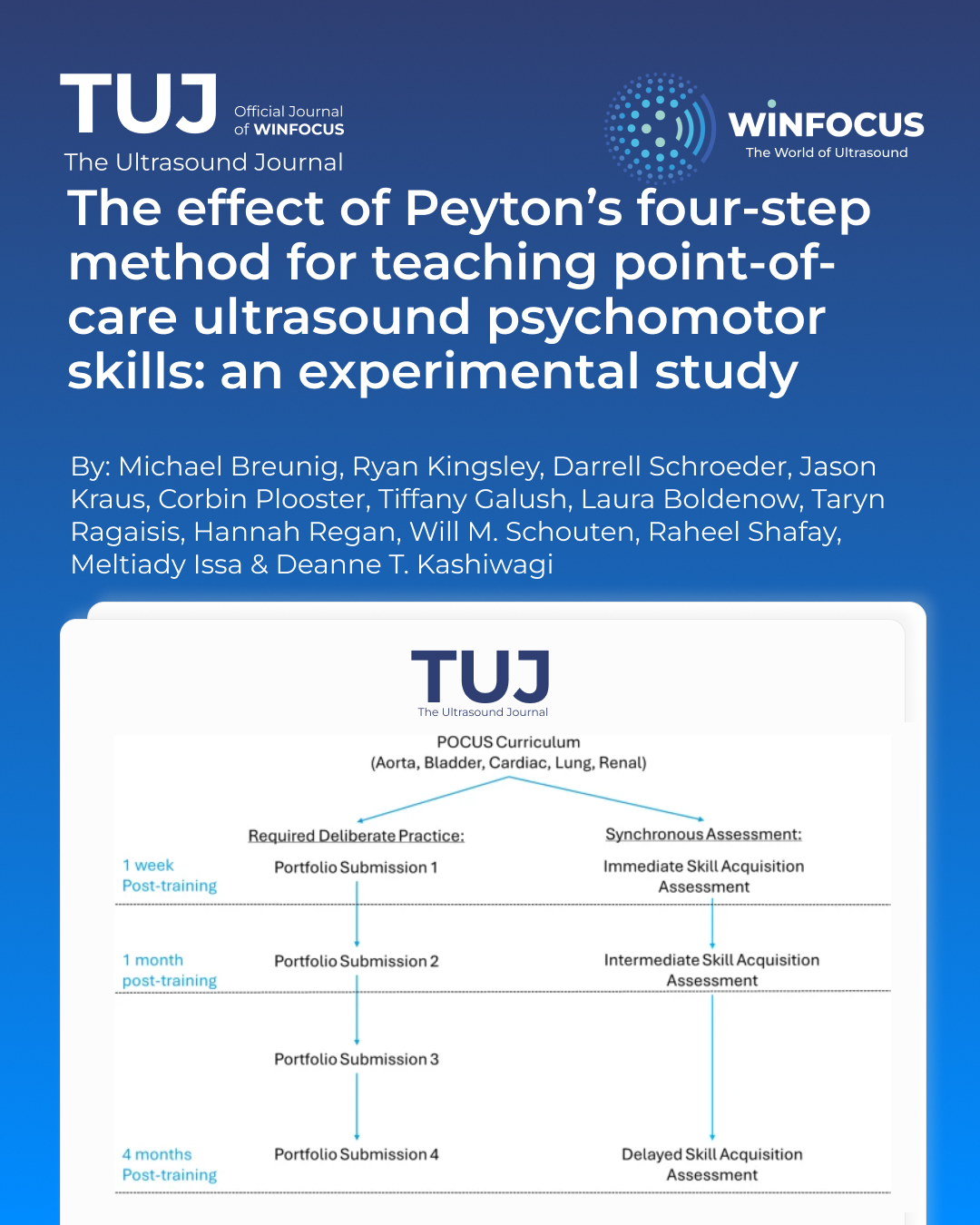
Methods: A single-blinded, repeated measures interventional study based on experimental design was completed. Physician Assistant students from one large academic medical center were randomized into a control group (using the two-step method) and intervention group (using Peyton’s four-step method). Students were taught POCUS of the aorta, bladder, heart, lungs, and kidneys. Students’ POCUS skills were assessed during the immediate, intermediate, and delayed learning phases. At each assessment, an organ-specific score and a total score were obtained. Scores were compared using a Wilcoxon rank sum test. An ordinal logistic regression analysis was performed using a generalized linear mixed model with a multinomial distribution and cumulative logit link function to assess the overall effect of Peyton’s four-step method.
Results: Students who were taught using Peyton’s method were found to have an increased likelihood of higher total scores compared to those taught using usual instruction (OR = 4.2, p = 0.003). Peyton’s method was found to have increased likelihood of higher scores for cardiac (OR = 2.3, p = 0.032), lung (OR = 2.5, p = 0.034), and kidney (OR = 3.0, p = 0.015). Student performance statistically improved with Peyton’s four-step method during the immediate (p = 0.031) and delayed (p = 0.011) skill acquisition phases, but not in the intermediate phase.
Conclusion: Peyton’s four-step method improves overall psychomotor skill acquisition for POCUS. Peyton’s four-step method specifically improved psychomotor skills in the immediate skill acquisition phase and the delayed skill acquisition phase. The benefit of Peyton’s four-step method was more prominent in POCUS applications with higher complexity.
References
1. Breunig M, Huckabee M, Rieck KM (2022) An integrated point-of-care ultrasound curriculum: an evidence-based approach. J Physician Assist Educ. 2022;33(1):41–46. https://doi.org/10.1097/JPA.0000000000000402
2. Soni NJ, Arntfield R, & Kory P . (2019) . Point of Care Ultrasound (2 ed.). Elsevier.
3. Herrero C, Colon Y, Nagapurkar A, Castañeda P (2021) Point-of-care ultrasound reduces visit time and cost of care for infants with developmental dysplasia of the hip. Indian J Orthop. 2021;55(6):1529–1534. https://doi.org/10.1007/s43465-021-00541-z
4. Zanobetti M, Scorpiniti M, Gigli C , et al. (2017). Point-of-care ultrasonography for evaluation of acute dyspnea in the ED. Chest. 151(6), 1295-1301.
5. Breunig M, Kashiwagi D (2018) Using point-of-care ultrasound: heart. JAAPA 31(12):45. https://doi.org/10.1097/01.JAA.0000545081.24591.2f
6. Breunig M, Kashiwagi D (2018) Using point-of-care ultrasound: lungs. JAAPA 31(8):48. https://doi.org/10.1097/01.JAA.0000541492.33526.a9
7. Breunig M, Kashiwagi D (2019) Using point-of-care ultrasound: shock. JAAPA 32(8):43. https://doi.org/10.1097/01.JAA.0000569796.06694.e3
8. Breunig M, Kashiwagi D (2019) Using point-of-care ultrasound: kidneys. JAAPA 2019;32(2):44. https://doi.org/10.1097/01.JAA.0000552733.26305.77
9. Gertner E, Breunig M (2024) Imaging options for patients with abdominal aortic aneurysms. JAAPA 37(8):36. https://doi.org/10.1097/01.JAA.0000000000000009. 2024/08/
10. Guidelines U (2023) Emergency, Point-of-Care, and clinical ultrasound guidelines in medicine. Ann Emerg Med 82(3):e115–e155. https://doi.org/10.1016/j.annemergmed.2023.06.005
11. Soni NJ, Schnobrich D, Mathews BK et al (2019) Point-of-Care ultrasound for hospitalists: A position statement of the society of hospital medicine. J Hosp Med 14:E1–E6 2019/01/02/. https://doi.org/10.12788/jhm.3079
12. Adams JA (1971) A closed-loop theory of motor learning. J Motor Behav 3(2):111–150 https://doi.org/10.1080/00222895.1971.10734898
13. Breunig M, Chelf C, Kashiwagi D (2024) Point-of-care ultrasound psychomotor learning curves: a systematic review of the literature. J Ultrasound Med 43(8):1363–1373. https://doi.org/10.1002/jum.16477
14. Breunig M, Hanson A, Huckabee M (2023) Learning curves for point-of-care ultrasound image acquisition for novice learners in a longitudinal curriculum. Ultrasound J 15(1):31. https://doi.org/10.1186/s13089-023-00329-2
15. Ericsson KA, Krampe RT, Tesch-Römer C (1993) The role of deliberate practice in the acquisition of expert performance. Psychol Rev 100(3):363–406. https://doi.org/10.1037/0033-295X.100.3.363
16. Fitts PM, Posner MI (1967) Human performance. Brooks/Cole Pub. Co, Calif, p 182. Belmont
17. Schmidt RA (1975) A schema theory of discrete motor skill learning. Psychol Rev 82(4):225–260. https://doi.org/10.1037/h0076770
18. Halsted W, Royal College of Surgeons of E (1904) The training of the surgeon: the annual address in medicine delivered at Yale University, June 27, 1904. Johns Hopkins Press, Baltimore, p 30
19. Giacomino K, Caliesch R, Sattelmayer KM (2020) The effectiveness of the Peyton’s 4-step teaching approach on skill acquisition of procedures in health professions education: a systematic review and meta-analysis with integrated meta-regression. PeerJ 8:e10129. https://doi.org/10.7717/peerj.10129
20. Peyton J (1998) Teaching & learning in medical practice. Heronsgate Rickmansworth, Herts.: Manticore Europe Ltd., p 226
21. Jeannerod M (1995) Mental imagery in the motor context. Neuropsychologia 33(11):1419–1432. https://doi.org/10.1016/0028-3932(95)00073-C
22. Jeannerod M (2001) Neural simulation of action: a unifying mechanism for motor cognition. Neuroimage 14(1 Pt 2):S103–109. https://doi.org/10.1006/nimg.2001.0832
23. Münster T, Stosch C, Hindrichs N, Franklin J, Matthes J (2016) Peyton’s 4-Steps-Approach in comparison: Medium-term effects on learning external chest compression - a pilot study. GMS J Med Educ 2016 33(4):Doc60. https://doi.org/10.3205/zma001059
24. Wang J, Zhan Y, Sun B et al (2024) Flipped classroom-based application of peyton’s four-step approach in standardized training of ultrasound residents for thyroid and cervical lymph node zoning. PeerJ 12:e18633. https://doi.org/10.7717/peerj.18633
25. Gradl-Dietsch G, Hitpaß L, Gueorguiev B, Nebelung S, Schrading S, Knobe M (2019) Undergraduate curricular training in musculoskeletal ultrasound by student teachers: the impact of peyton’s Four-Step approach. Z Orthop Unfall 157(3):270–278. https://doi.org/10.1055/a-0715-2435
26. Gradl-Dietsch G, Menon AK, Gürsel A et al (2018) Basic echocardiography for undergraduate students: a comparison of different peer-teaching approaches. Eur J Trauma Emerg Surg 44(1):143–152. https://doi.org/10.1007/s00068-017-0819-1
27. Breunig M, Kingsley R, Galush T et al (2025) Validity and Reliability of the Observed Structured Point of Care Ultrasound Readiness Examination (OSPRE): A Pilot Study. Preprint at https://doi.org/10.21203/rs.3.rs-7011397/v1
28. Gradl-Dietsch G, Lübke C, Horst K et al (2016) Peyton’s four-step approach for teaching complex spinal manipulation techniques - a prospective randomized trial. BMC Med Educ 2016/11/03(1):284. https://doi.org/10.1186/s12909-016-0804-0
29. Herrmann-Werner A, Nikendei C, Fau - Keifenheim K, Keifenheim K, Fau - Bosse HM et al (2013) Best practice skills lab training vs. a see one, do one approach in undergraduate medical education: an RCT on students’ long-term ability to perform procedural clinical skills. PLoS ONE 8(9):e76354
30. Orde S, Celenza A, Fau - Pinder M, Pinder M (2010) A randomised trial comparing a 4-stage to 2-stage teaching technique for laryngeal mask insertion. Resuscitation 81(12):1687–1691
31. Rossettini G, Rondoni A, Palese A et al (2017) Effective teaching of manual skills to physiotherapy students: a randomised clinical trial. Med Educ 51(8):826–838
32. Bouthors CA-O, Veil R, Auregan JC et al (2023) Deconstructing forearm casting task by videos with step-by-step simulation teaching improved performance of medical students: is making working student’s memory work better similar to a process of artificial intelligence or just an improvement of the prefrontal cortex homunculus? Int Orthop 47(2):467–477
Downloads
Published
Issue
Section
License
Copyright (c) 2025 Michael Breunig, Ryan Kingsley, Darrell Schroeder, Jason Kraus, Corbin Plooster, Tiffany Galush, Laura Boldenow, Taryn Ragaisis, Hannah Regan, Will M. Schouten, Raheel Shafay, Meltiady Issa, Deanne T. Kashiwagi (Author)

This work is licensed under a Creative Commons Attribution-NonCommercial 4.0 International License.
This is an Open Access article distributed under the terms of the Creative Commons Attribution License (https://creativecommons.org/licenses/by-nc/4.0) which permits unrestricted use, distribution, and reproduction in any medium, provided the original work is properly cited.
Authors retain the copyright for their published work. No formal permission will be required to reproduce parts (tables or illustrations) of published papers, provided the source is quoted appropriately and reproduction has no commercial intent.
How to Cite