Erector spinae plane block for acute pain management of pancreatic cancer at the emergency department
Keywords:
Acute pain in the emergency department, Pancreatic cancer, Regional anesthesia, Erector spinae plane blockAbstract
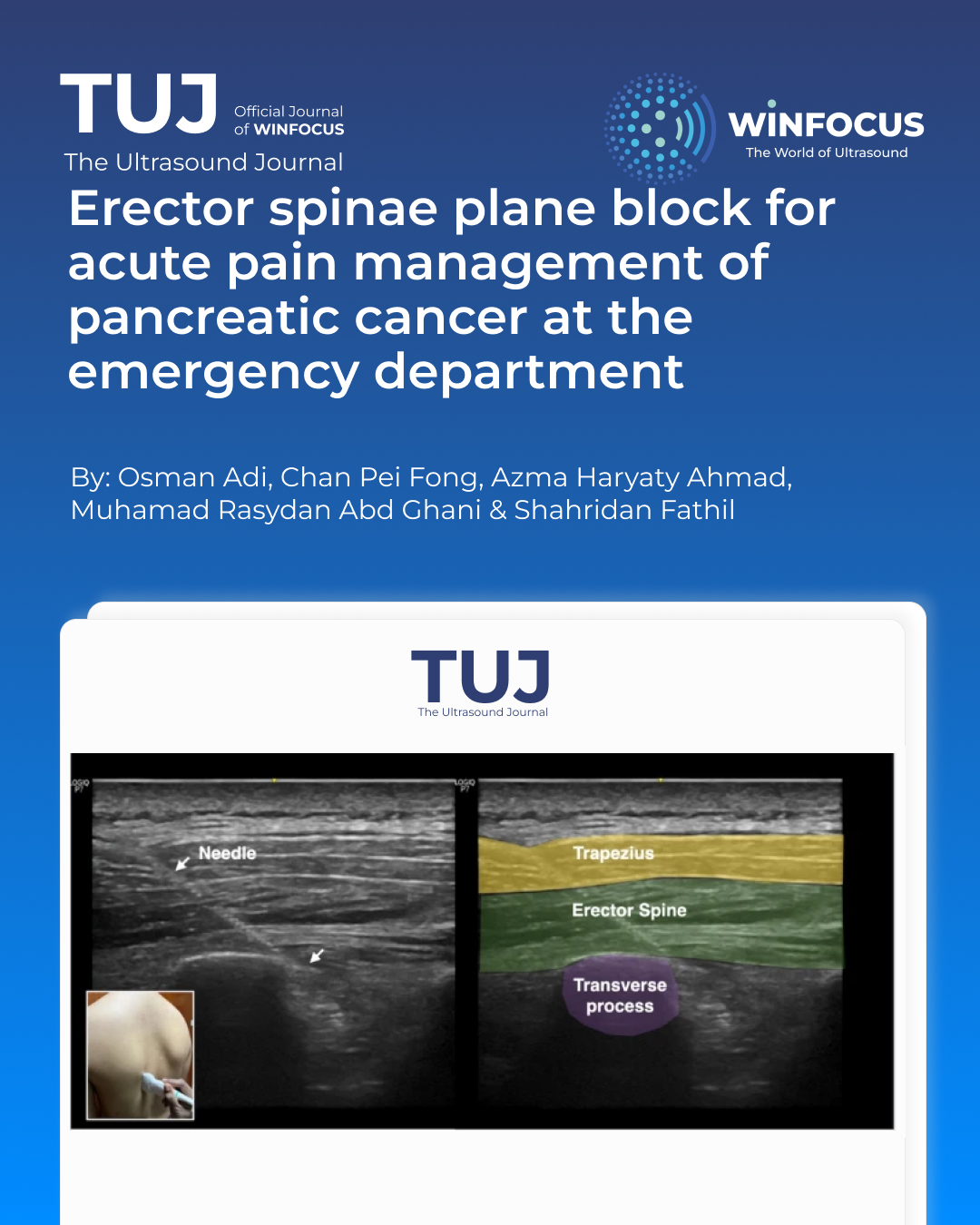
Pancreatic cancer is often associated with intractable pain due to tumor invasion of surrounding neural structures and visceral organs. Conventional pain management strategies, including opioids, are often insufficient and associated with significant side effects. The erector spinae plane block (ESPB) is an inter-fascial regional anesthesia technique that can be considered in managing abdominal pain. Besides being a simple block performed, ESPB is also very effective because it provides visceral, somatic and neuropathic pain coverage. This case series highlights the potential role of ESPB as an adjunctive therapy for acute pain management of pancreatic cancer patients at the emergency department, with discussion on its technical aspect, advantages and limitations.
References
1. Hu JX, Zhao CF, Chen WB, Liu QC, Li QW, Lin YY, Gao F (2021) Pancreatic cancer: A review of epidemiology, trend, and risk factors. World J Gastroenterol 27(27):4298–4321. https://doi.org/10.3748/wjg.v27.i27.4298
2. Koulouris AI, Banim P, Hart AR (2017) Pain in patients with pancreatic cancer: prevalence, mechanisms, management and future developments. Dig Dis Sci 62(4):861–870. https://doi.org/10.1007/s10620-017-4488-z
3. Lu Z, Zhang N, Giordano SH, Zhao H (2022) Opioid use and associated factors among pancreatic cancer patients diagnosed between 2007 and 2015. Cancer Med 11(11):2296–2307. https://doi.org/10.1002/cam4.4610
4. Mercadante S, Arcuri E, Santoni A (2019) Opioid-Induced tolerance and hyperalgesia. CNS Drugs 33(10):943–955. https://doi.org/10.1007/s40263-019-00660-0
5. Forero M, Adhikary SD, Lopez H, Tsui C, Chin KJ (2016) The erector spinae plane block: a novel analgesic technique in thoracic neuropathic pain. Reg Anesth Pain Med. 41(5):621–7. https://doi.org/10.1097/AAP.0000000000000451
6. Aydın T, Balaban O, Demir L (2019) Ultrasound-guided erector spinae plane block for pain management in pancreatic cancer: A case report. Pankreas Kanserinde ağrı Tedavisi için ultrason eşliğinde erektor spina plan bloğu: Olgu Sunumu. Agri 31(4):218–219. https://doi.org/10.14744/agri.2019.09815
7. Gawel RJ, Kramer JA, Shalaby M (2025) Ultrasound-Guided erector spinae plane block for breakthrough pancreatic and hepatobiliary malignancy pain in the emergency department: A case series. Clin Pract Cases Emerg Med 9(2):129–133. https://doi.org/10.5811/cpcem.39723
8. Cui Y, Wang Y, Yang J et al (2022) The effect of Single-Shot erector spinae plane block (ESPB) on opioid consumption for various surgeries: A Meta-Analysis of randomized controlled trials. J Pain Res 15:683–699. https://doi.org/10.2147/JPR.S346809
9. Wu S, Zhang XY, Deng ST et al (2024) Efficacy and safety of bilateral Ultrasound-Guided erector spinae plane block for postoperative analgesia in spine surgery: A systematic review and Meta-Analysis of randomized controlled trials. World Neurosurg 181:e655–e677. https://doi.org/10.1016/j.wneu.2023.10.111
10. Pawa A, King C, Thang C, White L (2023) Erector spinae plane block: the ultimate ‘plan A’ block? Br J Anaesth 130(5):497–502. https://doi.org/10.1016/j.bja.2023.01.012
11. Lauque D, Khalemsky A, Boudi Z et al (2022) Length-of-Stay in the emergency department and In-Hospital mortality: A systematic review and Meta-Analysis. J Clin Med 12(1):32. https://doi.org/10.3390/jcm12010032
12. Lahoud MJ, Kourie HR, Antoun J, El Osta L, Ghosn M (2016) Road map for pain management in pancreatic cancer: A review. World J Gastrointest Oncol 8(8):599–606. https://doi.org/10.4251/wjgo.v8.i8.599
13. De Cassai A, Tonetti T (2018) Local anesthetic spread during erector spinae plane block. J Clin Anesth 48:60–61. https://doi.org/10.1016/j.jclinane.2018.05.003
14. Kurita GP, Sjøgren P, Klepstad P, Mercadante S (2019) Interventional techniques to management of Cancer-Related pain: clinical and critical aspects. Cancers (Basel) 11(4):443. https://doi.org/10.3390/cancers11040443
15. Koulouris AI, Alexandre L, Hart AR, Clark A (2021) Endoscopic ultrasoundguided Celiac plexus neurolysis (EUS-CPN) technique and analgesic efficacy in patients with pancreatic cancer: A systematic review and meta-analysis. Pancreatology 21(2):434–442. https://doi.org/10.1016/j.pan.2020.12.016
16. Kwon HM, Kim DH, Jeong SM et al (2020) Does erector spinae plane block have a visceral analgesic effect?: a randomized controlled trial. Sci Rep 10(1):8389. https://doi.org/10.1038/s41598-020-65172-0
17. Gowda PK, Prasad V, Mustari N, Bhaire VS, Taha MA, Fultambkar G (2024) A study comparing the efficacy of single shot versus continuous infusion in erector spinae plane block in spine surgeries: a prospective randomized control study. Res J Med Sci 18:357–362. https://doi.org/10.59218/makrjms.2024.4.357.362
18. Gao Z, Xiao Y, Wang Q, Li Y (2019) Comparison of Dexmedetomidine and dexamethasone as adjuvant for ropivacaine in ultrasound-guided erector spinae plane block for video-assisted thoracoscopic lobectomy surgery: a randomized, double-blind, placebo-controlled trial. Ann Transl Med 7(22):668. https://doi.org/10.21037/atm.2019.10.74
19. Hochberg U, Brill S, Ofir D, Salame K, Lidar Z, Regev G, Khashan M (2022) Is the erector spinae plane block effective for more than perioperative pain? A retrospective analysis. J Clin Med 11(16):4902. https://doi.org/10.3390/jcm11164902
20. Capuano P, Alongi A, Burgio G, Martucci G, Arcadipane A, Cortegiani A (2024) Erector spinae plane block for cancer pain relief: a systematic review. J Anesth Analg Crit Care 4(1):76. https://doi.org/10.1186/s44158-024-00213-y
Downloads
Published
Issue
Section
License
Copyright (c) 2025 Osman Adi, Chan Pei Fong, Azma Haryaty Ahmad, Muhamad Rasydan Abd Ghani, Shahridan Fathil (Author)

This work is licensed under a Creative Commons Attribution-NonCommercial 4.0 International License.
This is an Open Access article distributed under the terms of the Creative Commons Attribution License (https://creativecommons.org/licenses/by-nc/4.0) which permits unrestricted use, distribution, and reproduction in any medium, provided the original work is properly cited.
Authors retain the copyright for their published work. No formal permission will be required to reproduce parts (tables or illustrations) of published papers, provided the source is quoted appropriately and reproduction has no commercial intent.
How to Cite