Contrast enhanced ultrasound - a useful method for diagnosing tubal ectopic pregnancy with low level β-HCG
Keywords:
Ultrasonography, Contrast media, Pregnancy, Ectopic, Fallopian tubesAbstract
Background: In patients presenting with atypical symptoms or low plasma β-HCG levels, the presence of an adnexal mass without a yolk sac or embryo on ultrasound often provides insufficient confidence for a definitive diagnosis of ectopic pregnancy(EP). Consequently, most such cases can only be classified as suspected EP. This study aimed to evaluate the diagnostic value of contrast enhanced ultrasound (CEUS) for tubal EP (tEP). We retrospectively analyzed 21 patients with suspected EP who underwent CEUS between August 2017 and August 2024. All patients had plasma β-HCG levels below 3500 mIU/mL. Among them, 20 underwent laparoscopic surgery, and all underwent curettage. The diagnostic performance of CEUS for tEP was assessed.
Results: A total of 21 patients were included: 19 with tEP, 1 with ovarian pregnancy, and 1 with intrauterine pregnancy. The sensitivity, specificity, and accuracy of transvaginal ultrasound (TVUS) for diagnosing tubal dilation were 15.8%, 100%, and 23.8%, respectively. For CEUS, these values were 94.7%, 100%, and 95.2%, respectively. Statistically significant differences were observed between CEUS and TVUS in sensitivity and accuracy (P = 0.000).
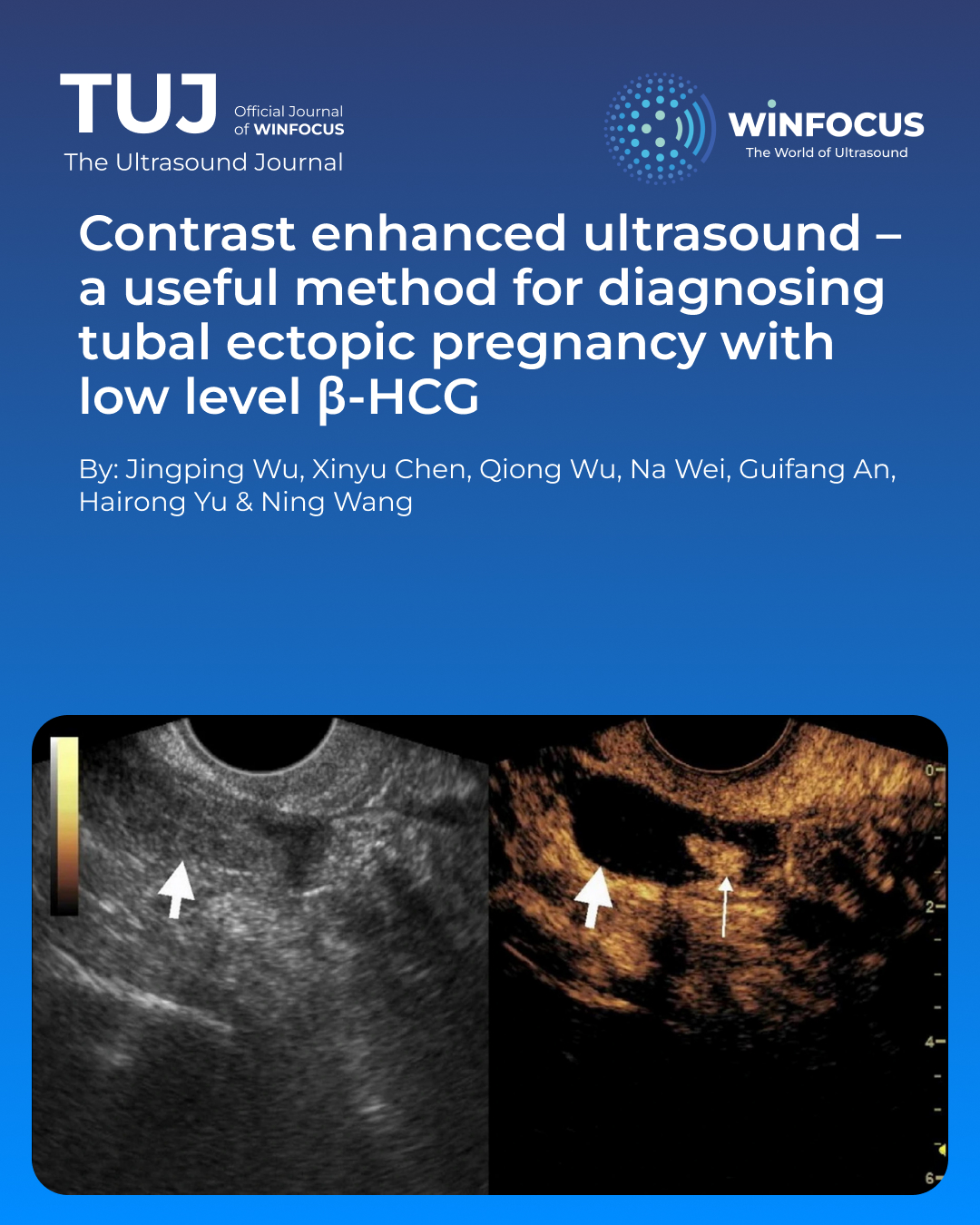
The enhancement pattern of villous tissue was categorized as either circular or non-circular. Among the tEP cases, 2 exhibited circular enhancement and 17 showed non-circular enhancement. Based on positive β-HCG, absence of an intrauterine gestational sac, and sonographic visualization of a dilated fallopian tube containing either circular or non-circular enhancement internally, CEUS demonstrated high diagnostic accuracy for tEP diagnosis in cases with low β-HCG levels. CEUS correctly diagnosed 18 of 19 tEP cases. One tEP case was diagnosed as a mass of uncertain significance. The intrauterine pregnancy case was misdiagnosed as an EP. The ovarian pregnancy case was diagnosed as EP, though CEUS indicated a relatively high possibility of ovarian origin.
Conclusion: In conclusion, CEUS holds significant diagnostic value for tEP. It is particularly useful in diagnostically unclear cases and provides a more detailed assessment of the internal structure of adnexal masses.
References
1. Al Naimi A, Moore P, Brüggmann D, Krysa L, Louwen F Bahlmann F (2021) Ectopic pregnancy: a single-center experience over ten years. Reprod Biol Endocrinol 19:79
2. Centers for Disease Control and Prevention (CDC) (1995) Ectopic pregnancy– United states, 1990–1992. MMWR Morb Mortal Wkly Rep 44:46-48
3. Rouse CE, Eckert LO, Babarinsa I et al (2017) Global alignment of immunization safety in pregnancy (GAIA) abortion work group; Brighton collaboration abortion working group. Spontaneous abortion and ectopic pregnancy: case definition & guidelines for data collection, analysis, and presentation of maternal immunization safety data, vol 35. Vaccine, pp 6563–6574
4. Creanga AA, Shapiro-Mendoza CK, Bish CL, Zane S, Berg CJ, Callaghan WM (2011) Trends in ectopic pregnancy mortality in the united states: 1980–2007. Obstet Gynecol 117:837–843
5. Berg CJ, Callaghan WM, Syverson C, Henderson Z (2010) Pregnancy-related mortality in the united states, 1998 to 2005. Obstet Gynecol 116:1302–1309
6. Panelli DM, Phillips CH, Brady PC (2015) Incidence, diagnosis and management of tubal and nontubal ectopic pregnancies: a review. Fertil Res Pract 1:15
7. (2016) Diagnosis and management of ectopic pregnancy: Green-top guideline 21. BJOG 123:e15–e55
8. Webster K, Eadon H, Fishburn S, Kumar G Guideline Committee (2019) Ectopic pregnancy and miscarriage: diagnosis and initial management: summary of updated NICE guidance. BMJ 367:l6283
9. Kirk E (2012) Ultrasound in the diagnosis of ectopic pregnancy. Clin Obstet Gynecol 55:395–401
10. Kirk E, Papageorghiou AT, Condous G, Tan L, Bora S, Bourne T (2007) The diagnostic effectiveness of an initial transvaginal scan in detecting ectopic pregnancy. Hum Reprod 22:2824–2828
11. Condous G, Okaro E, Khalid A et al (2005) The accuracy of transvaginal ultrasonography for the diagnosis of ectopic pregnancy prior to surgery. Hum Reprod 20:1404–1409
12. Atri M, Valenti DA, Bret PM, Gillett P (2003) Effect of transvaginal sonography on the use of invasive procedures for evaluating patients with a clinical diagnosis of ectopic pregnancy. J Clin Ultrasound 31:1–8
13. Shalev E, Yarom I, Bustan M, Weiner E, Ben-Shlomo I (1998) Transvaginal sonography as the ultimate diagnostic tool for the management of ectopic pregnancy: experience with 840 cases. Fertil Steril 69:62–65
14. Kirk E, Daemen A, Papageorghiou AT et al (2008) Why are some ectopic pregnancies characterized as pregnancies of unknown location at the initial transvaginal ultrasound examination? Acta Obstet Gynecol Scand 87:1150–1154
15. Lipscomb GH, Gomez IG, Givens VM, Meyer NL, Bran DF (2009) Yolk sac on transvaginal ultrasound as a prognostic indicator in the treatment of ectopic pregnancy with single-dose methotrexate. Am J Obstet Gynecol 200:338e1–338e4
16. Barnhart K, van Mello NM, Bourne T et al (2011) Pregnancy of unknown location: a consensus statement of nomenclature, definitions, and outcome. Fertil Steril 95:857–866
17. Barnhart KT, Fay CA, Suescum M et al (2011) Clinical factors affecting the accuracy of ultrasonography in symptomatic first-trimester pregnancy. Obstet Gynecol 117:299–306
18. American College of Obstetricians and Gynecologists’ Committee on Practice Bulletins—Gynecology (2018) ACOG practice bulletin 193: tubal ectopic pregnancy. Obstet Gynecol 131:e91–e103
19. Doubilet PM, Benson CB, Bourne T et al (2013) Diagnostic criteria for nonviable pregnancy early in the first trimester. N Engl J Med 369:1443–1451
20. Connolly A, Ryan DH, Stuebe AM, Wolfe HM (2013) Reevaluation of discriminatory and threshold levels for serum β-hCG in early pregnancy. Obstet Gynecol 121:65–70
21. Hahn SA, Lavonas EJ, Mace SE, Napoli AM, Fesmire FM, American College of Emergency Physicians Clinical Policies Subcommittee on Early Pregnancy (2012) Clinical policy: critical issues in the initial evaluation and management of patients presenting to the emergency department in early pregnancy. Ann Emerg Med 60:381–390e28
22. Galstyan K, Kurzel RB (2006) Serum beta-hCG titers do not predict ruptured ectopic pregnancy. Int J Fertil Womens Med 51:14–16
23. Masselli G, Derme M, Piccioni MG et al (2018) To evaluate the feasibility of magnetic resonance imaging in predicting unusual site ectopic pregnancy: a retrospective cohort study. Eur Radiol 28:2444–2454
24. Tsafrir A, Rojansky N, Sela HY, Gomori JM, Nadjari M (2005) Rudimentary Horn pregnancy: first-trimester prerupture sonographic diagnosis and confirmation by magnetic resonance imaging. J Ultrasound Med 24:219–223
25. Liu X, Song L, Wang J, Liu Q, Liu Y, Zhang X (2018) Diagnostic utility of CT in differentiating between ruptured ovarian corpus luteal cyst and ruptured ectopic pregnancy with hemorrhage. J Ovarian Res 11:5
26. Li H, Chen L (2023) The role of contrast-enhanced ultrasound in the diagnosis and guiding therapy of early cervical ectopic pregnancy. J Clin Ultrasound 51:665–673
27. Mai ZS, Chen YQ, Liao M, Ma C, Han YB (2022) Early detection of a Cesarean Scar pregnancy with placenta increta by contrast-enhanced ultrasound in the first trimester: A case report and literature review. J Obstet Gynaecol Res 48:251–255
28. Li H, Liu X, Xie L, Ye Z, Gan L (2020) Diagnostic accuracy and cut-off of contrast-enhanced ultrasound in caesarean Scar pregnancy. Eur J Obstet Gynecol Reprod Biol 246:117–122
29. Liu D, Gu X, Liu F, Shi F, Yang M, Wu Q (2019) Application of contrastenhanced ultrasound for Scar pregnancy cases misdiagnosed as other diseases. Clin Chim Acta 496:134–139
30. Chen X, Wu Q, Wei N et al (2024) Evaluation of clinical efficacy of ContrastEnhanced ultrasound in the diagnosis of ectopic tubal pregnancy. Altern Ther Health Med 30:122–128
31. Craig LB, Khan S (2012) Expectant management of ectopic pregnancy. Clin Obstet Gynecol 55:461–470
32. Tonick S Conageski C (2022) Ectopic pregnancy. Obstet Gynecol Clin North Am 49:537–549
33. Doubilet PM, Benson CB (2011) Further evidence against the reliability of the human chorionic gonadotropin discriminatory level. J Ultrasound Med 30:1637–1642
34. Mehta TS, Levine D, Beckwith B (1997) Treatment of ectopic pregnancy: is a human chorionic gonadotropin level of 2,000 mIU/mL a reasonable threshold? Radiology 205:569–573
35. Bateman BG, Nunley WC Jr, Kolp LA, Kitchin JD 3 rd, Felder R (1990) Vaginal sonography findings and hCG dynamics of early intrauterine and tubal pregnancies. Obstet Gynecol 75:421–427
36. Schwarze V, Marschner C, Negrão de Figueiredo G, Rübenthaler J Clevert DA (2020) Single-Center study: evaluating the diagnostic performance and safety of Contrast-Enhanced ultrasound (CEUS) in pregnant women to assess hepatic lesions. Ultraschall Med 41:29–35
Downloads
Published
Issue
Section
License
Copyright (c) 2025 Jingping Wu, Xinyu Chen, Qiong Wu, Na Wei, Guifang An, Hairong Yu, Ning Wang (Author)

This work is licensed under a Creative Commons Attribution-NonCommercial 4.0 International License.
This is an Open Access article distributed under the terms of the Creative Commons Attribution License (https://creativecommons.org/licenses/by-nc/4.0) which permits unrestricted use, distribution, and reproduction in any medium, provided the original work is properly cited.
Authors retain the copyright for their published work. No formal permission will be required to reproduce parts (tables or illustrations) of published papers, provided the source is quoted appropriately and reproduction has no commercial intent.
How to Cite