Clinical obstacles to machine-learning POCUS adoption and system-wide AI implementation (The COMPASS-AI survey)
Keywords:
Point-of-care ultrasound (PoCUS), Artificial intelligence (AI), Machine learning (ML), Healthcare technology implementationAbstract
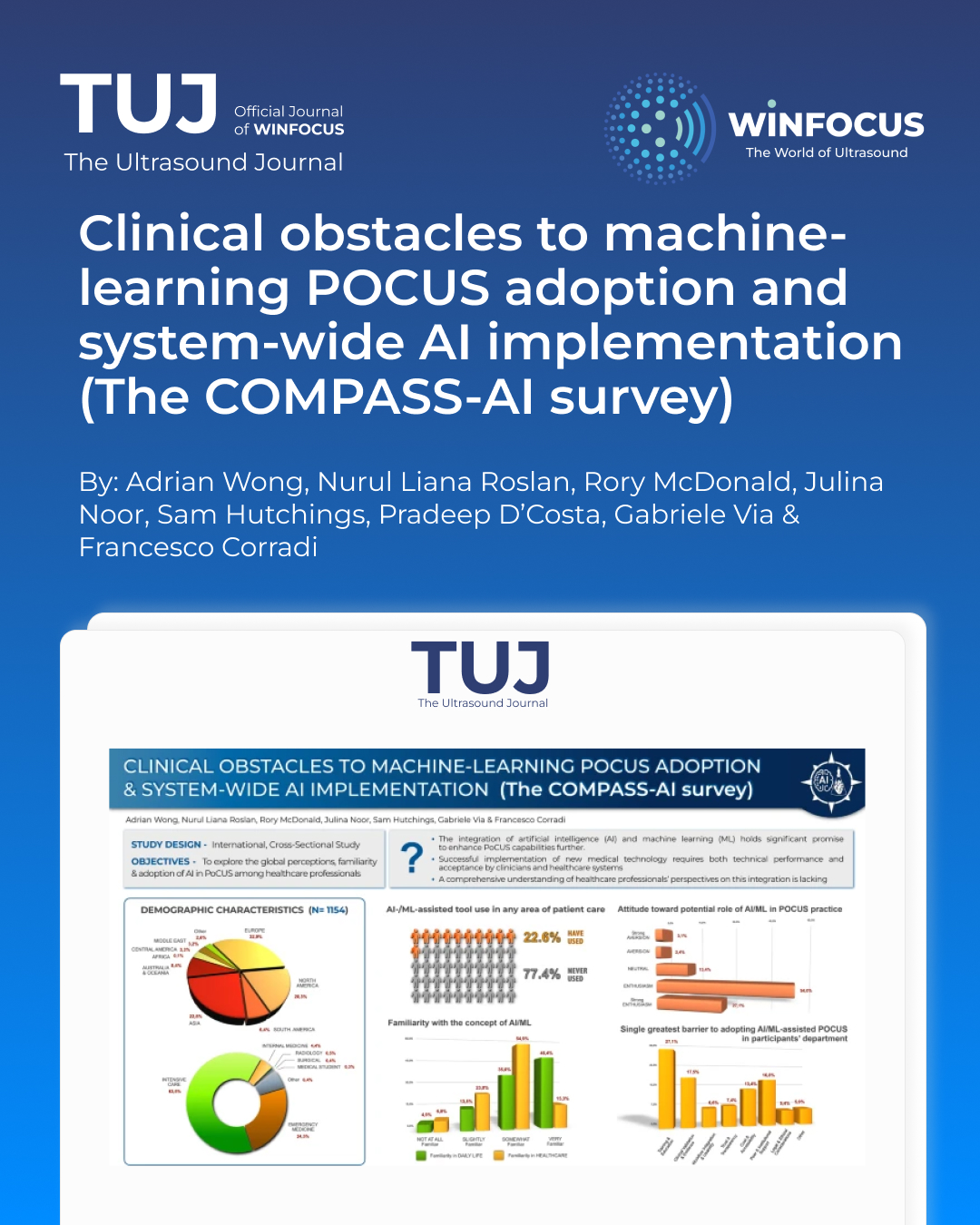
Background: Point-of-care ultrasound (POCUS) has become indispensable in various medical specialties. The integration of artificial intelligence (AI) and machine learning (ML) holds significant promise to enhance POCUS capabilities further. However, a comprehensive understanding of healthcare professionals’ perspectives on this integration is lacking.
Objective; This study aimed to investigate the global perceptions, familiarity, and adoption of AI in POCUS among healthcare professionals.
Methods: An international, web-based survey was conducted among healthcare professionals involved in POCUS. The survey instrument included sections on demographics, familiarity with AI, perceived utility, barriers (technological, training, trust, workflow, legal/ethical), and overall perceptions regarding AI-assisted POCUS. The data was analysed by descriptive statistics, frequency distributions, and group comparisons (using chi-square/Fisher’s exact test and t-test/ Mann-Whitney U test).
Results: This study surveyed 1154 healthcare professionals on perceived barriers to implementing AI in point-of-care ultrasound. Despite general enthusiasm, with 81.1% of respondents expressing agreement or strong agreement, significant barriers were identified. The most frequently cited single greatest barriers were Training & Education (27.1%) and Clinical Validation & Evidence (17.5%). Analysis also revealed that perceptions of specific barriers vary significantly based on demographic factors, including region of practice, medical specialty, and years of healthcare experience.
Conclusion: This novel global survey provides critical insights into the perceptions and adoption of AI in POCUS. Findings highlight considerable enthusiasm alongside crucial challenges, primarily concerning training, validation, guidelines, and support. Addressing these barriers is essential for the responsible and effective implementation of AI in POCUS.
References
1. Cheema BS, Walter J, Narang A, Thomas JD (2021) Artificial IntelligenceEnabled POCUS in the COVID-19 ICU: A new spin on cardiac ultrasound. JACC Case Rep 3:258–263
2. Lin X, Yang F, Chen Y, Chen X, Wang W, Li W et al (2023) Echocardiographybased AI for detection and quantification of atrial septal defect. Front Cardiovasc Med 10:985657
3. Darwich F, Devaraj S, Liebe J-D (2024) AI-Supported echocardiography for the detection of heart Diseases - A scoping review. Stud Health Technol Inf 317:219–227
4. Sahashi Y, Takeshita R, Watanabe T, Ishihara T, Sekine A, Watanabe D et al (2024) Development of artificial intelligence-based slow-motion echocardiography and clinical usefulness for evaluating regional wall motion abnormalities. Int J Cardiovasc Imaging 40:385–395
5. Huang L, Lin Y, Cao P, Zou X, Qin Q, Lin Z et al (2024) Automated detection and segmentation of pleural effusion on ultrasound images using an attention U-net. J Appl Clin Med Phys 25:e14231
6. Arntfield R, Wu D, Tschirhart J, VanBerlo B, Ford A, Ho J et al (2021) Automation of lung ultrasound interpretation via deep learning for the classification of normal versus abnormal lung parenchyma: A multicenter study. Diagnostics (Basel) 11:2049
7. Goldsmith AJ, Jin M, Lucassen R, Duggan NM, Harrison NE, Wells W et al (2023) Comparison of pulmonary congestion severity using artificial intelligence-assisted scoring versus clinical experts: A secondary analysis of BLUSHED-AHF. Eur J Heart Fail 25:1166–1169
8. Nhat PTH, Van Hao N, Tho PV, Kerdegari H, Pisani L, Thu LNM et al (2023) Clinical benefit of AI-assisted lung ultrasound in a resource-limited intensive care unit. Crit Care 27:257
9. Papadopoulou S-L, Dionysopoulos D, Mentesidou V, Loga K, Michalopoulou S, Koukoutzeli C et al (2024) Artificial intelligence-assisted evaluation of cardiac function by oncology staff in chemotherapy patients. Eur Heart J Digit Health 5:278–287
10. Nti B, Lehmann AS, Haddad A, Kennedy SK, Russell FM (2022) Artificial Intelligence-Augmented pediatric lung POCUS: A pilot study of novice learners. J Ultrasound Med 41:2965–2972
11. Karni O, Shitrit IB, Perlin A, Jedwab R, Wacht O, Fuchs L (2025) AI-enhanced guidance demonstrated improvement in novices’ Apical-4-chamber and Apical-5-chamber views. BMC Med Educ 25:558
12. Slivnick JA, Gessert NT, Cotella JI, Oliveira L, Pezzotti N, Eslami P et al (2024) Echocardiographic detection of regional wall motion abnormalities using artificial intelligence compared to human readers. J Am Soc Echocardiogr 37:655–663
13. Kim J, Maranna S, Watson C, Parange N (2025) A scoping review on the integration of artificial intelligence in point-of-care ultrasound: current clinical applications. Am J Emerg Med 92:172–181
14. Smith H, Downer J, Ives J (2024) Clinicians and AI use: where is the professional guidance? J Med Ethics 50:437–441
15. Ahmed MI, Spooner B, Isherwood J, Lane M, Orrock E, Dennison A (2023) A systematic review of the barriers to the implementation of artificial intelligence in healthcare. Cureus 15(10):e46454. https://doi.org/10.7759/cureus.46454PMID: 37927664; PMCID: PMC10623210
16. Petersson L, Larsson I, Nygren JM et al (2022) Challenges to implementing artificial intelligence in healthcare: a qualitative interview study with healthcare leaders in Sweden. BMC Health Serv Res 22:850. https://doi.org/10.1186/s12913-022-08215-8
17. Ramwala OA, Lowry KP, Cross NM, Hsu W, Austin CC, Mooney SD et al (2024) Establishing a validation infrastructure for Imaging-Based artificial intelligence algorithms before clinical implementation. J Am Coll Radiol 21:1569–1574
18. Vega R, Dehghan M, Nagdev A, Buchanan B, Kapur J, Jaremko JL et al (2025) Overcoming barriers in the use of artificial intelligence in point of care ultrasound. NPJ Digit Med 8:213
19. Mennella C, Maniscalco U, De Pietro G, Esposito M (2024) Ethical and regulatory challenges of AI technologies in healthcare: A narrative review. Heliyon 10:e26297
20. Kondylakis H, Kalokyri V, Sfakianakis S, Marias K, Tsiknakis M, Jimenez-Pastor A et al (2023) Data infrastructures for AI in medical imaging: a report on the experiences of five EU projects. Eur Radiol Exp 7:20
21. Blaivas M, Blaivas LN, Tsung JW (2022) Deep learning pitfall: impact of novel ultrasound equipment introduction on algorithm performance and the realities of domain adaptation. J Ultrasound Med 41:855–863
22. Poon AIF, Sung JJY (2021) Opening the black box of AI-Medicine. J Gastroenterol Hepatol 36:581–584
23. Korfiatis P, Kline TL, Meyer HM, Khalid S, Leiner T, Loufek BT et al (2025) Implementing Artificial Intelligence Algorithms in the Radiology Workflow: Challenges and Considerations. Mayo Clinic Proceedings: Digital Health.; 3: 100188
24. Apell P, Eriksson H (2023) Artificial intelligence (AI) healthcare technology innovations: the current state and challenges from a life science industry perspective. Technol Anal Strateg Manag 35:179–193
25. Godala MC, Toh Seong Kuan JS, Ming L, Chengzhe L (2024) Application of artificial intelligence in healthcare industry: A criticalreview. https://doi.org/10.61453/jobss-v2024no35. jobss 2024
26. Venkatesh V, Morris MG, Davis GB, Davis FD (2003) User acceptance of information technology: toward a unified view. MIS Q 27(3):425–478. https://doi.org/10.2307/30036540
27. Tran TT, Yun G, Kim S (2024) Artificial intelligence and predictive models for early detection of acute kidney injury: transforming clinical practice. BMC Nephrol 25:353
28. Baum E, Tandel MD, Ren C, Weng Y, Pascucci M, Kugler J et al (2023) Acquisition of cardiac Point-of-Care ultrasound images with deep learning. CHEST Pulmonary 1:100023
29. Narang A, Bae R, Hong H, Thomas Y, Surette S, Cadieu C et al (2021) Utility of a Deep-Learning algorithm to guide novices to acquire echocardiograms for limited diagnostic use. JAMA Cardiol 6:624–632
30. Gollangi HK, Bauskar SR, Madhavaram CR, Galla EP, Sunkara JR, Reddy MS (2020) Unveiling the hidden patterns: AI-driven innovations in image processing and acoustic signal detection. J Recent Trends Comput Sci Eng 8:25–45
31. Marchi G, Mercier M, Cefalo J, Salerni C, Ferioli M, Candoli P et al (2025) Advanced imaging techniques and artificial intelligence in pleural diseases: a narrative review. Eur Respir Rev 34:240263
32. Custode LL, Mento F, Tursi F, Smargiassi A, Inchingolo R, Perrone T et al (2023) Multi-objective automatic analysis of lung ultrasound data from COVID-19 patients by means of deep learning and decision trees. Appl Soft Comput 133:109926
33. Hong D, Choi H, Hong W, Kim Y, Kim TJ, Choi J et al (2024) Deep-learning model accurately classifies multi-label lung ultrasound findings, enhancing diagnostic accuracy and inter-reader agreement. Sci Rep 14:22228
34. Chen Q, Keenan TDL, Agron E, Allot A, Guan E, Elsawy A et al (2024) Towards accountable AI-Assisted eye disease diagnosis: Workflow Design, External Validation, and Continual Learning.
35. Hirata Y, Nomura Y, Saijo Y, Sata M, Kusunose K (2024) Reducing echocardiographic examination time through routine use of fully automated software: a comparative study of measurement and report creation time. J Echocardiogr 22:162–170
36. Bhandari A, Revolutionizing (2024) Radiol Artif Intell Cureus 16:e72646
37. Alanazi MMF, Almutairi SFM, Alarjani NO, Alghaylan MYA, Aljawhari MSM, Alkhulaifi AAS (2024) Advancements in AI-driven diagnostic radiology: Enhancing accuracy and efficiency. ijhs.; 8: 737–749
Downloads
Published
Issue
Section
License
Copyright (c) 2025 Adrian Wong, Nurul Liana Roslan, Rory McDonald, Julina Noor, Sam Hutchings, Pradeep D'Costa, Gabriele Via, Francesco Corradi (Author)

This work is licensed under a Creative Commons Attribution-NonCommercial 4.0 International License.
This is an Open Access article distributed under the terms of the Creative Commons Attribution License (https://creativecommons.org/licenses/by-nc/4.0) which permits unrestricted use, distribution, and reproduction in any medium, provided the original work is properly cited.
Authors retain the copyright for their published work. No formal permission will be required to reproduce parts (tables or illustrations) of published papers, provided the source is quoted appropriately and reproduction has no commercial intent.
How to Cite