The brain shock index: repurposing the Lindegaard ratio for detecting cerebral hypoperfusion in children with cerebral malaria
Keywords:
Transcranial doppler ultrasound, TCD, Brain shock, Brain shock index, BSI, POCUSAbstract
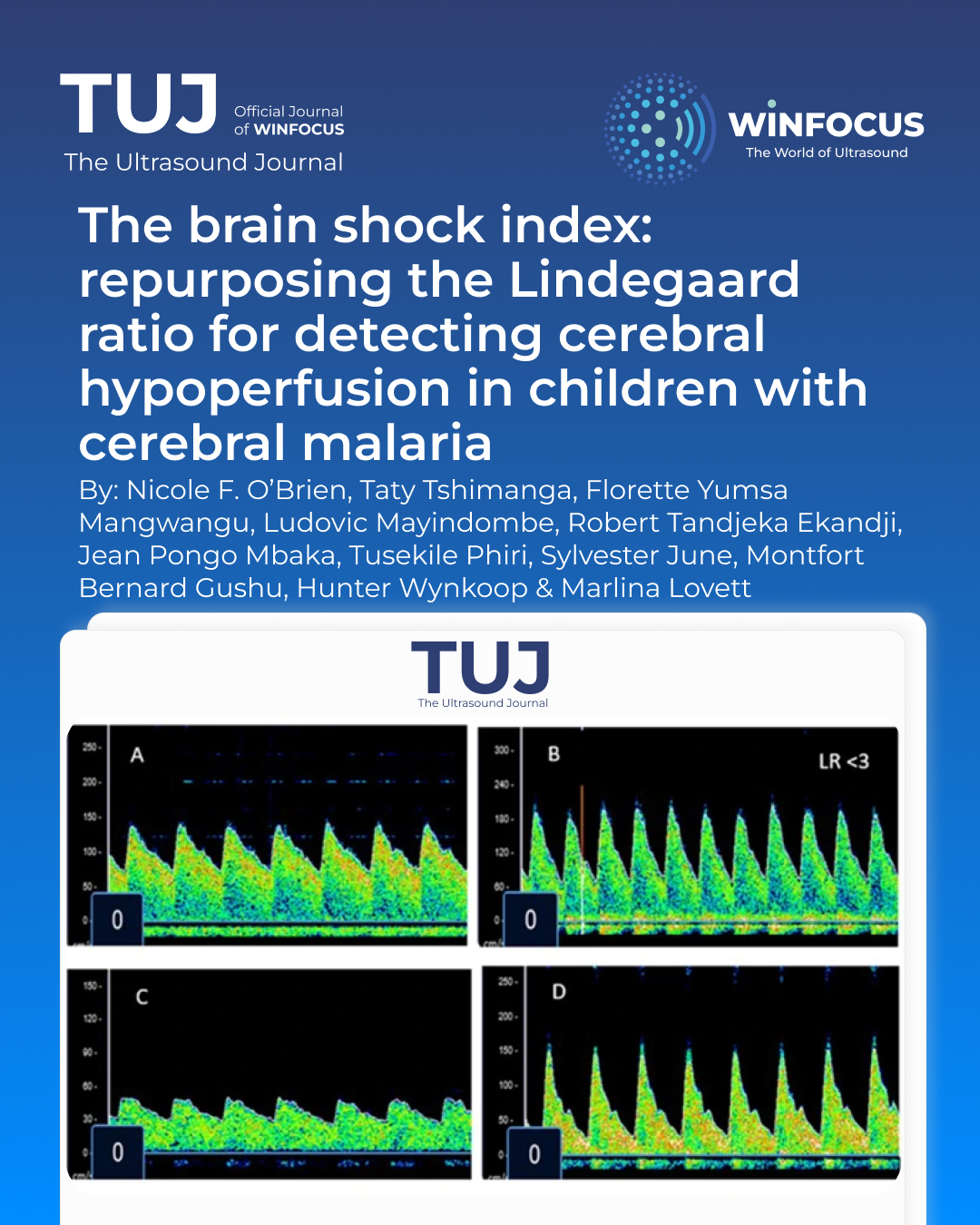
Background: Transcranial doppler ultrasound (TCD) allows for the assessment of the cerebrovascular hemodynamics in critically ill children. Given the increasing availability of machines equipped with TCD capabilities globally, it may be a useful approach to detect cerebral hypoperfusion and guide neurologic resuscitation for pediatric patients in resource limited settings where other neuromonitoring techniques are unavailable. However, the current need to evaluate waveform characteristics and to age correct values to determine if a study is abnormal decreases the feasibility of using point of care TCD in this way. The brain shock index (BSI), a repurposing of the Lindegaard Ratio, overcomes these limitations.
Methods: We performed a prospective study of children with cerebral malaria (CM). On admission and daily thereafter, TCD was used to evaluate the middle cerebral (MCA) and extra-cranial carotid arteries (Ex-ICA), and the BSI was calculated bilaterally (MCA mean flow velocity ((Vm))/Ex-ICA Vm). Neurologic outcome at discharge was assessed.
Results: A cohort of 291 children with CM were evaluated. BSI calculation was successful in all of them. The mean time to perform TCD and calculate the BSI was 4 ± 2 min. Overall, 222 participants (76%) had a good outcome and 69 (24%) a poor outcome. The BSI had an AUC of 0.98 (95% CI 0.97–0.99, p < 0.0001) to predict death or moderate to severe disability. The highest sensitivity and specificity of the BSI to predict adverse outcomes occurred at a cut off value ≤ 1.1. The adjusted odds ratio of poor outcome was 3.2 (95% CI 1.6–6.1, p = 0.001) if any BSI measurement during hospitalization fell below this threshold. No intracranial pressure monitoring was available to determine the relationship between the BSIs and an invasively measured cerebral perfusion pressure.
Conclusion: The BSI is a rapid, feasible point of care ultrasound measurement of cerebral hypoperfusion, with values ≤ 1.1 strongly correlating with poor neurologic outcomes in children with CM. Future studies should be performed to assess the utility of BSI to detect the presence and measure the severity of reduced cerebral perfusion pressure in other populations of critically ill children.
References
1. Aaslid R, Markwalder TM, Nornes H (1982) Noninvasive transcranial doppler ultrasound recording of flow velocity in basal cerebral arteries. J Neurosurg 57:769–774
2. Aaslid R, Lindegaard KF, Sorteberg W, Nornes H (1989) Cerebral autoregulation dynamics in humans. Stroke 20:45–52
3. O’Brien NF, Buttram SDW, Maa T et al (2019) Cerebrovascular physiology during pediatric extracorporeal membrane oxygenation: A multicenter study using transcranial doppler ultrasonography. Pediatr Crit Care Med 20:178–186
4. O’Brien NF, Maa T, Reuter-Rice K (2015) Noninvasive screening for intracranial hypertension in children with acute, severe traumatic brain injury. J Neurosurg Pediatr 16:420–425
5. LaRovere KL, O’Brien NF, Tasker RC (2016) Current opinion and use of transcranial doppler ultrasonography in traumatic brain injury in the pediatric intensive care unit. J Neurotrauma 33:2105–2114
6. Lovett ME, Maa T, Chung MG, O’Brien NF (2018) Cerebral blood flow velocity and autoregulation in paediatric patients following a global hypoxic-ischaemic insult. Resuscitation 126:191–196
7. Lovett ME, O’brien NF (2022) Transcranial doppler ultrasound, a review for the pediatric intensivist. Children 9:727
8. Rollet-Cohen V, Sachs P, Léger P-L et al (2021) Transcranial doppler use in non-traumatic critically ill children: a multicentre descriptive study. Front Pead 9:609175
9. LaRovere KL, Tasker RC, Wainwright M et al (2020) Transcranial doppler ultrasound during critical illness in children: survey of practices in pediatric neurocritical care centers. Pediatr Crit Care Med 21:67–74
10. Vinci F, Tiseo M, Colosimo D, Calandrino A, Ramenghi LA, Biasucci DG (2024) Point-of-care brain ultrasound and transcranial doppler or color-coded doppler in critically ill neonates and children. Eur J Pediatrics 183:1059–1072
11. Ajoku U, Hawryluk G, Kullmann M (2024) Intracranial pressure monitoring and treatment practices in severe traumatic brain injury between low-and middle-income countries and high-income countries: data or dogma? Surg Neurol Int 15:368
12. Wooldridge G, Hansmann A, Aziz O, O’Brien N (2020) Survey of resources available to implement severe pediatric traumatic brain injury management guidelines in low and middle-income countries. Child’s Nerv Syst 36:2647–2655
13. Fonseca Y, Tshimanga T, Ray S et al Transcranial doppler ultrasonographic evaluation of cerebrovascular abnormalities in children with acute bacterial meningitis. Frontiers in Neurology 2021;11.
14. Galadanci AA, Galadanci NA, Jibir BW et al (2019) Approximately 40 000 children with sickle cell anemia require screening with TCD and treating with hydroxyurea for stroke prevention in three States in Northern Nigeria. Am J Hematol 94:E305–E307
15. Kija EN, Saunders DE, Munubhi E et al (2019) Transcranial doppler and magnetic resonance in Tanzanian children with sickle cell disease. Stroke 50:1719–1726
16. Venkatesan P (2024) The 2023 WHO world malaria report. The Lancet Microbe
17. Tshimangani T, Pongo J, Bodi Mabiala J, Yotebieng M, O’Brien NF (2018) Pediatric acute severe neurologic illness and injury in an urban and a rural hospital in the Democratic Republic of the congo. Am J Trop Med Hyg 98:1534–1540
18. Seydel KB, Kampondeni SD, Valim C et al (2015) Brain swelling and death in children with cerebral malaria. N Engl J Med 372:1126–1137
19. Idro R, Jenkins NE, Newton CR (2005) Pathogenesis, clinical features, and neurological outcome of cerebral malaria. Lancet Neurol 4:827–840
20. Brim R, Mboma S, Semrud-Clikeman M et al (2017) Cognitive outcomes and psychiatric symptoms of Retinopathy-Positive cerebral malaria: cohort description and baseline results. Am J Trop Med Hyg 97:225–231
21. Boubour A, Mboma S, Vo T et al (2020) We can’t handle things we don’t know about: perceived neurorehabilitation challenges for Malawian paediatric cerebral malaria survivors. BMC Pediatr 20:503
22. Birbeck GL, Molyneux ME, Kaplan PW et al (2010) Blantyre malaria project epilepsy study (BMPES) of neurological outcomes in retinopathy-positive paediatric cerebral malaria survivors: a prospective cohort study. Lancet Neurol 9:1173–1181
23. O’Brien NF, Mutatshi Taty T, Moore-Clingenpeel M et al (2018) Transcranial doppler ultrasonography provides insights into neurovascular changes in children with cerebral malaria. J Pediatr 203:116–124e113
24. O’Brien NF, Fonseca Y, Johnson HC et al (2022) Mechanisms of transcranial doppler ultrasound phenotypes in paediatric cerebral malaria remain elusive. Malar J 21:1–13
25. O’Brien NF, Reuter-Rice K, Wainwright MS et al (2021) Practice recommendations for transcranial doppler ultrasonography in critically ill children in the pediatric intensive care unit: A multidisciplinary expert consensus statement. J Pediatr Intensive Care 10:133–142
26. Lindegaard KF, Bakke SJ, Aaslid R, Nornes H (1986) Doppler diagnosis of intracranial artery occlusive disorders. J Neurol Neurosurg Psychiatry 49:510–518
27. Farrar J Jr, Roach MR (1973) The effects of increased intracranial pressure on flow through major cerebral arteries in vitro. Stroke 4:795–806
28. Ogoh S, Washio T, Paton JF, Fisher JP, Petersen LG (2020) Gravitational effects on intracranial pressure and blood flow regulation in young men: a potential shunting role for the external carotid artery. J Appl Physiol 129:901–908
29. Deeg K, Wolf A (2001) Doppler ultrasound diagnosis of increased intracranial pressure by comparison of 2 blood flow velocities in the extra-and intracranial segment of the internal carotid artery. 2: findings in children with increased intracranial pressure. Ultraschall Der Medizin (Stuttgart Germany: 1980) 22:66–74
30. O’Brien NF, Johnson HC, Musungufu DA et al (2023) Transcranial doppler velocities in a large healthy population of African children. Heliyon
31. Fiser DH (1992) Assessing the outcome of pediatric intensive care. J Pediatr 121:68–74
32. Fiser DH, Tilford JM, Roberson PK (2000) Relationship of illness severity and length of stay to functional outcomes in the pediatric intensive care unit: a multi-institutional study. Crit Care Med 28:1173–1179
33. Allen J, Graziadio S, Power M (2017) A Shiny tool to explore prevalence, sensitivity, and specificity on Tp, Fp, Fn, and Tn. NIHR Diagnostic Evidence Co-operative, Newcastle upon Tyne, United Kingdom
34. Newton CR, Marsh K, Peshu N, Kirkham FJ (1996) Perturbations of cerebral hemodynamics in Kenyans with cerebral malaria. Pediatr Neurol 15:41–49
35. O’Brien NF, Tshimanga T (2024) Revising the interpretation of transcranial doppler ultrasound examinations in pediatric cerebral malaria. Am J Trop Med Hyg 111:780
36. O’Brien NF, Chetcuti K, Fonseca Y et al (2021) Cerebral metabolic crisis in pediatric cerebral malaria. J Pediatr Intensive Care
37. Birbeck G, Molyneux M, Seydel P, Chimalizeni Y, Kawaza K, Taylor T (2010) The Blantyre malaria project epilepsy study (BMPES): neurologic outcomes in a prospective exposure-control study of retinopathy-positive pediatric cerebral malaria survivors. Lancet Neurol 9:1173–1181
38. O’Brien NF (2015) Reference values for cerebral blood flow velocities in critically ill, sedated children. Childs Nerv Syst 31:2269–2276
39. Gilkes C, Whitfield P (2009) Intracranial pressure and cerebral blood flow. A pathophysiological and clinical perspective. Surg (Oxford) 27:139–144
40. Ammar MA, Abdelmoneim W, Abdalla W (2023) Correlation of transcranial doppler based parameters with computed tomography assessed cerebral oedema score in patients with traumatic brain injury: A prospective observational study. Indian J Anaesth 67:180–185
41. Mayer SA, Thomas CE, Diamond BE (1996) Asymmetry of intracranial hemodynamics as an indicator of mass effect in acute intracerebral hemorrhage: a transcranial doppler study. Stroke 27:1788–1792
42. Silverman A, Petersen NH, Physiology Cerebral Autoregulation. StatPearls. Treasure Island (FL)2022
Downloads
Published
Issue
Section
License
Copyright (c) 2025 Nicole F. O’Brien, Taty Tshimanga, Florette Yumsa Mangwangu, Ludovic Mayindombe, Robert Tandjeka Ekandji, Jean Pongo Mbaka, Tusekile Phiri, Sylvester June, Montfort Bernard Gushu, Hunter Wynkoop, Marlina Lovett (Author)

This work is licensed under a Creative Commons Attribution-NonCommercial 4.0 International License.
This is an Open Access article distributed under the terms of the Creative Commons Attribution License (https://creativecommons.org/licenses/by-nc/4.0) which permits unrestricted use, distribution, and reproduction in any medium, provided the original work is properly cited.
Authors retain the copyright for their published work. No formal permission will be required to reproduce parts (tables or illustrations) of published papers, provided the source is quoted appropriately and reproduction has no commercial intent.
How to Cite