Multispecialty comparison of point-of-care-ultrasound use, training, and barriers: a national survey of VA medical centers
Keywords:
Point of care ultrasound, POCUS, Barriers, Training, Survey, VA, Veterans AffairsAbstract
Background: As more specialties have begun to use Point-of-Care Ultrasound (POCUS) in patient care, hospitals and healthcare systems have been investing increasing resources in POCUS infrastructure (training, equipment, and administration). Since each specialty uses different POCUS applications, healthcare systems seek to identify commonalities and differences between specialties to make thoughtful investments in POCUS infrastructure to support each specialty’s use of POCUS while minimizing redundancies. Historically, past studies have focused on POCUS use in individual specialties, primarily emergency medicine and critical care, but comparative studies of different specialties are needed to guide investment in POCUS infrastructure and bolster POCUS implementation across healthcare systems. We conducted a cross-sectional survey of all Veterans Affairs (VA) medical centers in the United States and compared data from 5 different specialties on current usage, training needs, and barriers to POCUS implementation.
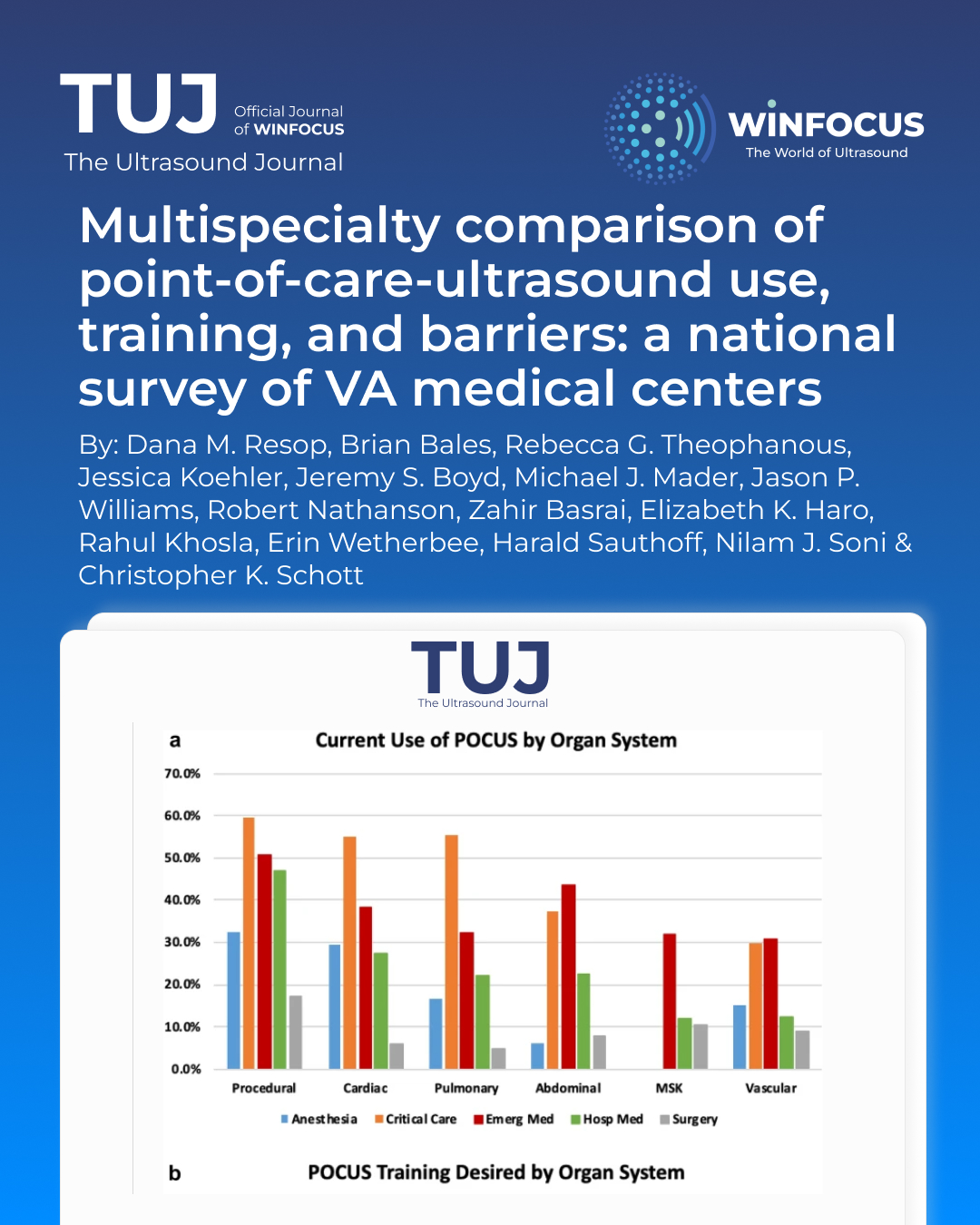
Results: Data were collected from facility chiefs of staff (n = 130; 100% response rate) and chiefs of emergency medicine (n = 101; 92% response rate), critical care (n = 93; 83% response rate), hospital medicine (n = 105; 90% response rate), anesthesiology (n = 96; 77% response rate), and surgery (n = 104; 95% response rate). All specialties surveyed reported current POCUS use (surgery 54%, hospital medicine 64%, anesthesiology 83%, emergency medicine 90%, and critical care 93%) but more importantly, a greater desire for training was seen. Procedural POCUS applications were most often used by all specialties, despite decreased procedural POCUS use since 2015 for all specialties except critical care. Diagnostic POCUS use generally increased from 2015 to 2020, although use of specific POCUS applications varied significantly between specialties. Barriers limiting POCUS use included lack of training (53–80%), access to ultrasound equipment (25–57%), and POCUS infrastructure (36–65%).
Conclusions: From 2015 to 2020, POCUS use increased significantly in emergency medicine, critical care, internal medicine, anesthesiology, and surgery, although use of specific applications varied significantly between specialties. Lack of training and POCUS infrastructure were common barriers to POCUS use across specialties. Desire for training exceeded current use for several POCUS applications. These findings can guide implementation and standardization of POCUS use in hospitals and healthcare systems.
References
1. Ollerton JE, Sugrue M, Balogh Z, D’Amours SK, Giles A, Wyllie P (2006) Prospective study to evaluate the influence of FAST on trauma patient management. J Trauma 60(4):785–791
2. Guidelines U (2023) Emergency, Point-of-Care, and Clinical Ultrasound Guidelines in Medicine. Ann Emerg Med 82(3):e115–e155
3. Soni NJ, Schnobrich D, Matthews BK et al (2019) Point-of-care ultrasound for hospitalists: a position statement of the society of hospital medicine. J Hosp Med 14:E1–E6
4. Mayo PH, Beaulieu Y, Doelken P et al (2009) American College of Chest Physicians/La Societe de Reanimation de Langue Francaise statement on competence in critical care ultrasonography. Chest 135(4):1050–1060
5. Frankel HL, Kirkpatrick AW, Elbarbary M et al (2015) Guidelines for the appropriate use of bedside general and cardiac ultrasonography in the evaluation of critically ill patients-part i: general ultrasonography. Crit Care Med 43(11):2479–2502
6. Levitov A, Frankel HL, Blaivas M et al (2016) Guidelines for the appropriate use of bedside general and cardiac ultrasonography in the evaluation of critically ill patients-part ii: cardiac ultrasonography. Crit Care Med 44(6):1206–1227
7. Spencer KT, Kimura BJ, Korcarz CE, Pellikka PA, Rahko PS, Siegel RJ (2013) Focused cardiac ultrasound: recommendations from the American Society of Echocardiography. J Am Soc Echocardiogr 26(6):567–581
8. Via G, Hussain A, Wells M et al (2014) International evidence-based recommendations for focused cardiac ultrasound. J Am Soc Echocardiogr 27(7):683.e681-683.e633
9. Arntfield R, Millington S, Ainsworth C et al (2014) Canadian recommendations for critical care ultrasound training and competency. Can Resp J 21(6):341–345
10. Atkinson P, Bowra J, Milne J et al (2017) International Federation for Emergency Medicine Consensus Statement: Sonography in hypotension and cardiac arrest (SHoC): An international consensus on the use of point of care ultrasound for undifferentiated hypotension and during cardiac arrest. CJEM 19(6):459–470
11. Fair J, Mallin M, Mallemat H et al (2018) Transesophageal echocardiography: guidelines for point-of-care applications in cardiac arrest resuscitation. Ann Emerg Med 71(2):201–207
12. Expert Round Table on Ultrasound in ICU (2011) International expert statement on training standards for critical care ultrasonography. Intensive Care Med 37(7):1077–1083
13. Vieira RL, Hsu D, Nagler J, Chen L, Gallagher R, Levy JA (2013) Pediatric emergency medicine fellow training in ultrasound: consensus educational guidelines. Acad Emerg Med 20(3):300–306
14. Marin JR, Lewiss RE (2015) American Academy of Pediatrics CoPEM, Society for Academic Emergency Medicine AoEU, American College of Emergency Physicians PEMC, World Interactive Network Focused on Critical U Point-of-care ultrasonography by pediatric emergency medicine physicians. Pediatrics. 135(4):e1113-1122
15. Fodor D, Rodriguez-Garcia SC, Cantisani V, et al. The EFSUMB Guidelines and Recommendations for Musculoskeletal Ultrasound - Part I: Extraarticular Pathologies. Ultraschall in der Medizin (Stuttgart, Germany : 1980). 2022;43(1):34–57.
16. Naredo E, Rodriguez-Garcia SC, Terslev L et al (2022) The EFSUMB guidelines and recommendations for musculoskeletal ultrasound - Part II: joint pathologies, pediatric applications, and guided procedures. Ultraschall in der Medizin. 43(3):252–273
17. Abo AM, Alade KH, Rempell RG, et al. Credentialing Pediatric Emergency Medicine Faculty in Point-of-Care Ultrasound: Expert Guidelines. Pediatric emergency care. 2019.
18. Kalagara H, Coker B, Gerstein NS et al (2022) Point-of-Care Ultrasound (POCUS) for the Cardiothoracic Anesthesiologist. J Cardiothorac Vasc Anesth 36(4):1132–1147
19. Brass P, Hellmich M, Kolodziej L, Schick G, Smith AF. Ultrasound guidance versus anatomical landmarks for internal jugular vein catheterization. Cochrane Database Syst Rev. 2015;1:CD006962.
20. Qaseem A, Etxeandia-Ikobaltzeta I, Mustafa RA et al (2021) Appropriate use of point-of-care ultrasonography in patients with acute dyspnea in emergency department or inpatient settings: a clinical guideline from the American College of Physicians. Ann Intern Med 174(7):985–993
21. Szabó GV, Szigetváry C, Szabó L et al (2023) Point-of-care ultrasound improves clinical outcomes in patients with acute onset dyspnea: a systematic review and meta-analysis. Intern Emerg Med 18(2):639–653
22. Melniker LA, Leibner E, McKenney MG, Lopez P, Briggs WM, Mancuso CA (2006) Randomized controlled clinical trial of point-of-care, limited ultrasonography for trauma in the emergency department: the first sonography outcomes assessment program trial. Ann Emerg Med 48(3):227–235
23. Nti BK, Phillips W, Sarmiento E, Russell F (2022) Effect of a point-of-care ultrasound (POCUS) curriculum on emergency department soft tissue management. Ultrasound J 14(1):41
24. Brower CH, Baugh CW, Shokoohi H et al (2022) Point-of-care ultrasoundfirst for the evaluation of small bowel obstruction: National cost savings, length of stay reduction, and preventable radiation exposure. Acad Emerg Med 29(7):824–834
25. Bahner DP, Goldman E, Way D, Royall NA, Liu YT (2014) The state of ultrasound education in U.S. medical schools: results of a national survey. Acad Med. 89(12):1681–1686
26. Tarique U, Tang B, Singh M, Kulasegaram KM, Ailon J (2018) Ultrasound curricula in undergraduate medical education: a scoping review. J Ultrasound Med 37(1):69–82
27. ACGME. ACGME Program Requirements for Graduate Medical Education in Emergency Medicine. 2023.
28. ACGME. ACGME Program Requirements for Graduate Medical Education in Critical Care Medicine. https:// www. acgme. org/ globa lasse ts/ pfass ets/ progr amreq uirem ents/ 2024- prs/ 142_- critic alca remed icine_ 2024. pdf. Published 2023. Accessed January 8, 2024.
29. ACGME. ACGME Program Requirements for Graduate Medical Education in Anesthesiology. https:// www. acgme. org/ globa lasse ts/ pfass ets/ progr amreq uirem ents/ 040_ anest hesio logy_ 2023. pdf. Published 2023. Accessed January 8, 2024.
30. Smith CJ, Barron K, Shope RJ, Beam E, Piro K (2022) Motivations, barriers, and professional engagement: a multisite qualitative study of internal medicine faculty’s experiences learning and teaching point-of-care ultrasound. BMC Med Educ 22(1):171
31. Pulton D, Feinman J (2019) Hocus POCUS: Making Barriers to Perioperative Point-of-Care Ultrasound Disappear. J Cardiothorac Vasc Anesth 33(9):2419–2420
32. Beggs AD, Thomas PR (2013) Point of use ultrasound by general surgeons: review of the literature and suggestions for future practice. Int J Surg 11(1):12–17
33. Wong J, Montague S, Wallace P et al (2020) Barriers to learning and using point-of-care ultrasound: a survey of practicing internists in six North American institutions. Ultrasound J 12(1):19
34. Williams JP, Nathanson R, LoPresti CM et al (2022) Current use, training, and barriers in point-of-care ultrasound in hospital medicine: a national survey of VA hospitals. J Hosp Med 17(8):601–608
35. Resop DM, Basrai Z, Boyd JS et al (2023) Current use, training, and barriers in point-of-care ultrasound in emergency departments in 2020: a National Survey of VA hospitals. Am J Emerg Med 63:142–146
36. Nathanson R, Williams JP, Gupta N, et al. Current Use and Barriers to Point-of-Care Ultrasound in Primary Care: A National Survey of VA Medical Centers. Am J Med. 2023.
37. Gogtay M, Choudhury RS, Williams JP et al (2023) Point-of-care ultrasound in geriatrics: a national survey of VA medical centers. BMC Geriatr 23(1):605
38. Schott CK, Wetherbee E, Khosla R et al (2023) Current use, training, and barriers to point-of-care ultrasound use in ICUs in the department of veterans affairs. CHEST Crit Care 1(2):100012
39. Remskar MH, Theophanous R, Bowman A et al (2023) Current use, training, and barriers of point-of-care ultrasound in anesthesiology: a national survey of veterans affairs hospitals. J Cardiothorac Vasc Anesth 37(8):1390–1396
40. Moore CL, Molina AA, Lin H (2006) Ultrasonography in community emergency departments in the United States: access to ultrasonography performed by consultants and status of emergency physician-performed ultrasonography. Ann Emerg Med 47(2):147–153
41. Schott CK, Kode KR, Mader MJ (2020) Teaching vs learning: Impact of deliberate practice and formative feedback on developing point of care ultrasound skills. J Clin Ultrasound 48(8):437–442
42. Schott CK, LoPresti CM, Boyd JS et al (2021) Retention of point-of-care ultrasound skills among practicing physicians: findings of the VA national POCUS training program. Am J Med 134(3):391-399.e398 43. ACGME. http:// www. acgme. org/ acgme web/. Accessed January 8, 2024.
44. Thomas MK, Conner SM, Maw A, Soni NJ (2023) Point-counterpoint: Should point-of-care ultrasound be a required skill of hospitalists? J Hosp Med 18(12):1150–1155
45. Strony R, Marin JR, Bailitz J et al (2018) Systemwide clinical ultrasound program development: an expert consensus model. West J Emerg Med 19(4):649–653
46. Saati A, Au A, Chu T et al (2020) Creating an efficient point-of-care ultrasound workflow. Pocus j 5(2):31–32
47. Mathews BK, Zwank M (2017) Hospital medicine point of care ultrasound credentialing: an example protocol. J Hosp Med 12(9):767-772
48. Soni NJ, Reyes LF, Keyt H et al (2016) Use of ultrasound guidance for central venous catheterization: a national survey of intensivists and hospitalists. J Crit Care 36:277–283
49. Sorensen B, Hunskaar S (2019) Point-of-care ultrasound in primary care: a systematic review of generalist performed point-of-care ultrasound in unselected populations. Ultrasound J 11(1):31
50. Bhagra A, Tierney DM, Sekiguchi H, Soni NJ. Point-of-Care Ultrasonography for Primary Care Physicians and General Internists. Mayo Clinic proceedings. 2016.
51. Stowell JR, Kessler R, Lewiss RE et al (2018) Critical care ultrasound: A national survey across specialties. J Clin Ultrasound 46(3):167–177
52. Ramsingh D, Rinehart J, Kain Z et al (2015) Impact assessment of perioperative point-of-care ultrasound training on anesthesiology residents. Anesthesiology 123(3):670–682
53. Pereira J, Bass GA, Mariani D et al (2020) Surgeon-performed point-of-care ultrasound for acute cholecystitis: indications and limitations: a European Society for Trauma and Emergency Surgery (ESTES) consensus statement. Eur J Trauma Emerg Surg 46(1):173–183
54. Dumbrava BD, Abdulla HS, Pereira J et al (2023) Surgeon-performed point-of-care ultrasound in the diagnosis of acute sigmoid diverticulitis: a pragmatic prospective multicenter cohort study. Cureus 15(1):e33292
Downloads
Published
Issue
Section
License
Copyright (c) 2025 Dana M. Resop, Brian Bales, Rebecca G. Theophanous, Jessica Koehler, Jeremy S. Boyd, Michael J. Mader, Jason P. Williams, Robert Nathanson, Zahir Basraj, Elizabeth K. Haro, Rahul Khosla, Erin Wetherbee, Harald Sauthoff, Nilam J. Soni, Christopher K. Schott (Author)

This work is licensed under a Creative Commons Attribution-NonCommercial 4.0 International License.
This is an Open Access article distributed under the terms of the Creative Commons Attribution License (https://creativecommons.org/licenses/by-nc/4.0) which permits unrestricted use, distribution, and reproduction in any medium, provided the original work is properly cited.
Authors retain the copyright for their published work. No formal permission will be required to reproduce parts (tables or illustrations) of published papers, provided the source is quoted appropriately and reproduction has no commercial intent.
How to Cite