Optimizing IABP–patient interaction in VA-ECMO via transcranial doppler
Keywords:
Transcranial Doppler, Veno-arterial extracorporeal membrane oxygenation, Intra-aortic balloon pump, Cerebral perfusion, Neurosonology, Critical care ultrasound, Patient–device interactionAbstract
Background: Patients supported with veno-arterial extracorporeal membrane oxygenation may receive an intra-aortic balloon pump to reduce left ventricular afterload and improve aortic diastolic pressure. However, the effect of this combined mechanical support on cerebral hemodynamics is not uniform and can be influenced by intra-aortic balloon pump timing. Bedside transcranial Doppler offers a rapid, noninvasive way to detect maladaptive cerebral flow patterns and to guide patient–device interaction in real time.
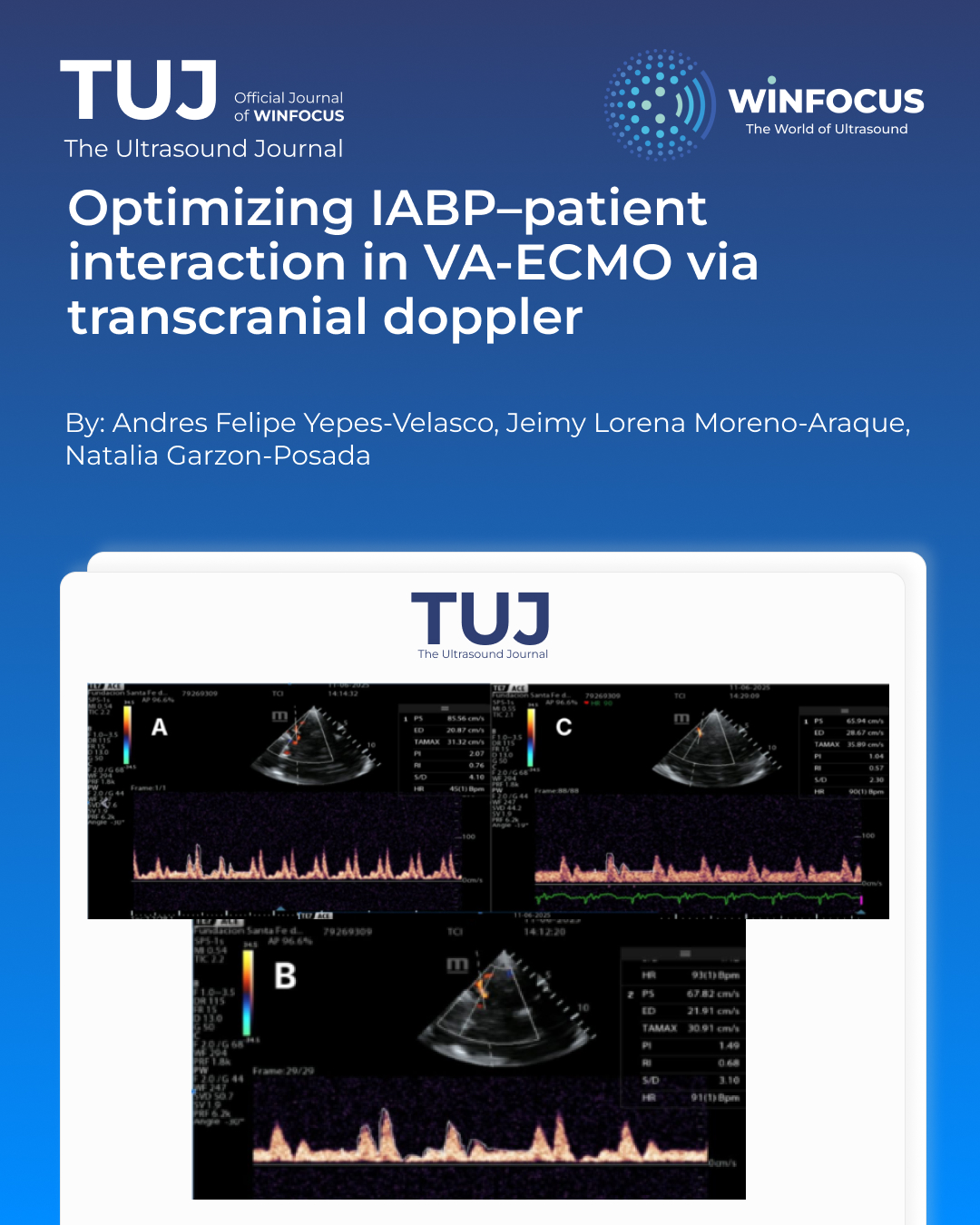
Case presentation: We describe a postcardiotomy adult patient on peripheral veno-arterial extracorporeal membrane oxygenation with concomitant intra-aortic balloon pump assistance (1:1) who developed a reduction in cerebral oximetry. Transcranial Doppler of the middle cerebral artery showed increased pulsatility and reduced diastolic velocity, findings consistent with a transient decrease in cerebral perfusion pressure and compatible with balloon deflation asynchrony. Temporary suspension of balloon assistance improved the waveform. Deflation was then synchronized with the electrocardiogram so that it was completed at the onset of systole. Repeat transcranial Doppler performed minutes later showed restoration of diastolic flow and a lower pulsatility index, while extracorporeal support was maintained unchanged and the patient remained hemodynamically stable.
Conclusions: In patients receiving veno-arterial extracorporeal membrane oxygenation and intra-aortic balloon pump support, cerebral blood flow may deteriorate if balloon timing is not aligned with the native cardiac cycle. Transcranial Doppler can detect these timing-related neurohemodynamic alterations at the bedside and can confirm their reversibility after simple, ECG-guided optimization of deflation. Integrating transcranial Doppler into multiparametric monitoring may help personalize mechanical circulatory support and protect cerebral perfusion in this high-risk population.
References
1. Rao P, Khalpey Z, Smith R, Burkhoff D, Kociol RD (2018) Venoarterial extracorporeal membrane oxygenation for cardiogenic shock and cardiac arrest: cardinal considerations for initiation and management. Circ Heart Fail 11(9):e004905
2. Keebler ME, Haddad EV, Choi CW, McGrane S, Zalawadiya S, Schlendorf KH et al (2018) Venoarterial extracorporeal membrane oxygenation in cardiogenic shock. JACC: Heart Failure 6(6):503–516
3. Grandin EW, Nunez JI, Willar B, Kennedy K, Rycus P, Tonna JE et al (2022) Mechanical left ventricular unloading in patients undergoing venoarterial extracorporeal membrane oxygenation. J Am Coll Cardiol 79(13):1239–1250
4. Ezad SM, Ryan M, Donker DW, Pappalardo F, Barrett N, Camporota L et al (2023) Unloading the left ventricle in venoarterial ECMO: in whom, when, and how? Circulation 147(16):1237–1250
5. Pfluecke C, Christoph M, Kolschmann S, Tarnowski D, Forkmann M, Jellinghaus S et al (2014) Intra-aortic balloon pump (IABP) counterpulsation improves cerebral perfusion in patients with decreased left ventricular function. Perfusion 29(6):511–516
6. Schachtrupp A, Wrigge H, Busch T, Buhre W, Weyland A (2005) Influence of intra-aortic balloon pumping on cerebral blood flow pattern in patients after cardiac surgery. Eur J Anaesthesiol 22(3):165–170
7. Douflé G, Dragoi L, Morales Castro D, Sato K, Donker DW, Aissaoui N et al (2024) Head-to-toe bedside ultrasound for adult patients on extracorporeal membrane oxygenation. Intensive Care Med 50(5):632–645
8. Caturegli G, Zhang LQ, Mayasi Y, Gusdon AM, Ergin B, Ponomarev V et al (2023) Characterization of cerebral hemodynamics with TCD in patients undergoing VA-ECMO and VV-ECMO: a prospective observational study. Neurocrit Care 38(2):407–413
9. Cestari M, Gobatto ALN, Hoshino M (2018) Role and limitations of transcranial doppler and brain death of patients on veno-arterial extracorporeal membrane oxygenation. ASAIO J 64(4):e78–e78
10. Robba C, Vetrugno L, Orso D et al (2021) Basic ultrasound head-to-toe skills for intensivists: an expert consensus. Intensive Care Med 47(10):1217–1229. https://doi.org/10.1007/s00134-021-06486-z
11. Le Roux P, Menon DK, Citerio G et al (2014) The international multidisciplinary consensus conference on multimodality monitoring in neurocritical care: A list of recommendations and additional conclusions. Neurocrit Care 21(Suppl 2):S1–26. https://doi.org/10.1007/s12028-014-0041-5
12. Pisano DV, Ortoleva JP, Wieruszewski PM (2024) Short-term neurologic complications in patients undergoing extracorporeal membrane oxygenation support: a review on pathophysiology, incidence, risk factors, and outcomes. Pulm Ther 10(3):267–278
13. Hwang J, Kalra A, Shou BL, Whitman G, Wilcox C, Brodie D et al (2023) Epidemiology of ischemic stroke and hemorrhagic stroke in venoarterial extracorporeal membrane oxygenation. Crit Care 27(1):433
14. Cavayas YA, Munshi L, Del Sorbo L, Fan E (2020) The early change in Pa CO2 after extracorporeal membrane oxygenation initiation is associated with neurological complications. Am J Respir Crit Care Med 201(12):1525–1535
15. Yang F, Jia Z, shen, Xing J, Wang Z, Liu Y, Hao X et al (2014) Effects of intra-aortic balloon pump on cerebral blood flow during peripheral venoarterial extracorporeal membrane oxygenation support. J Transl Med 12(1):106
16. Gruhn N, Larsen FS, Boesgaard S, Knudsen GM, Mortensen SA, Thomsen G et al (2001) Cerebral blood flow in patients with chronic heart failure before and after heart transplantation. Stroke 32(11):2530–2533
17. De Riva N, Budohoski KP, Smielewski P, Kasprowicz M, Zweifel C, Steiner LA et al (2012) Transcranial doppler pulsatility index: what it is and what it isn’t. Neurocrit Care 17(1):58–66
18. Caldas JR, Panerai RB, Passos R et al (2020) Is there still a place for transcranial doppler in patients with IABP? Crit Care 24:625. https://doi.org/10.1186/s13054-020-03324-4
Downloads
Published
Issue
Section
License
Copyright (c) 2025 Andres Felipe Yepes-Velasco, Jeimy Lorena Moreno-Araque, Natalia Garzon-Posada (Author)

This work is licensed under a Creative Commons Attribution-NonCommercial 4.0 International License.
This is an Open Access article distributed under the terms of the Creative Commons Attribution License (https://creativecommons.org/licenses/by-nc/4.0) which permits unrestricted use, distribution, and reproduction in any medium, provided the original work is properly cited.
Authors retain the copyright for their published work. No formal permission will be required to reproduce parts (tables or illustrations) of published papers, provided the source is quoted appropriately and reproduction has no commercial intent.
How to Cite