Predicting neonatal RDS with fetal pulmonary artery doppler: a diagnostic performance and ROC curve analysis
Keywords:
Respiratory distress syndrome, Newborn, Doppler ultrasonography, Pulmonary artery, Prenatal diagnosisAbstract
Study design: Prospective observational diagnostic accuracy study.
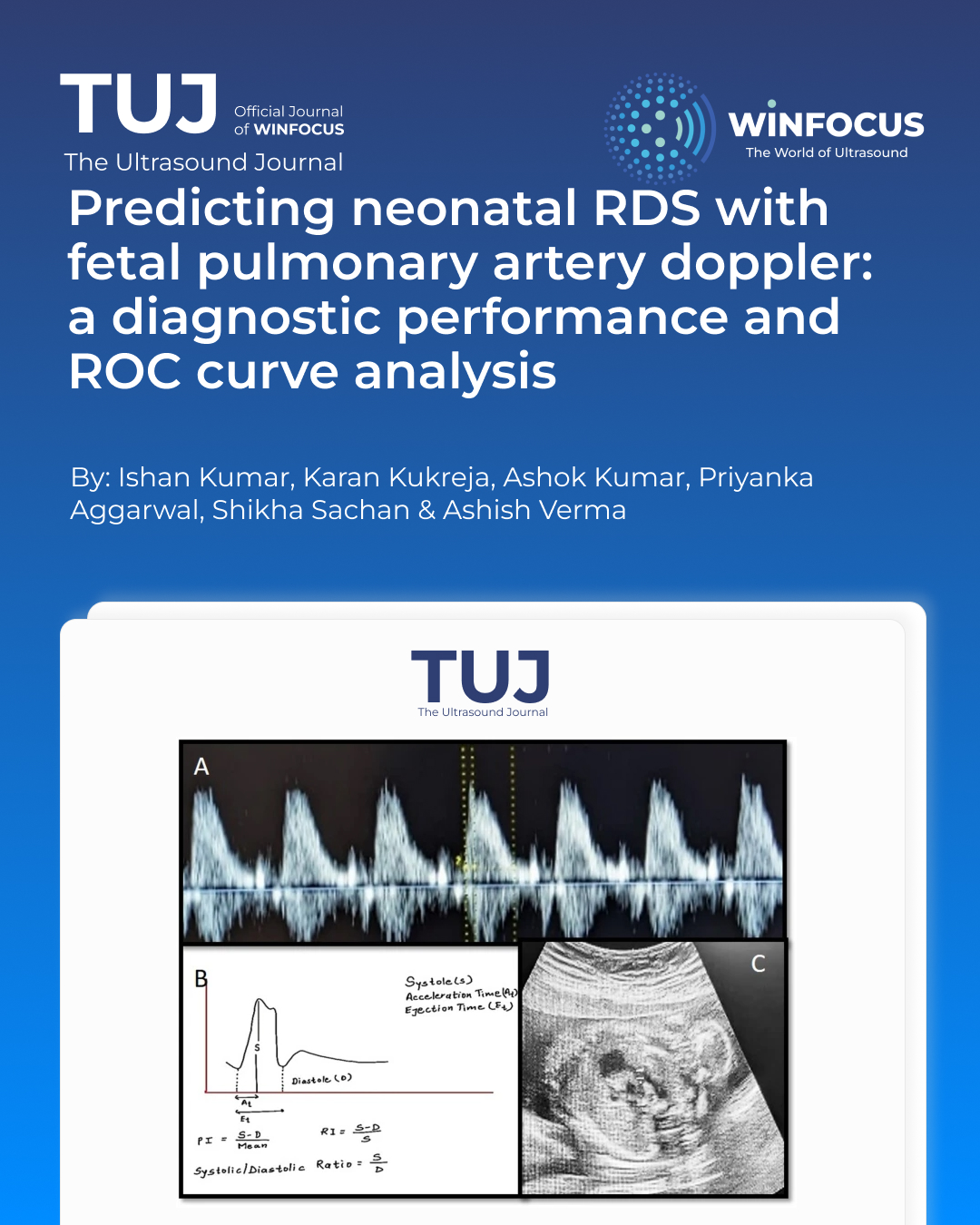
Methods: This study evaluated Doppler parameters of the fetal main pulmonary artery (MPA) as potential noninvasive predictors of RDS and to assess their relationship with gestational age and postnatal respiratory outcomes. Pulsed-wave Doppler of the fetal MPA was performed and Doppler indices—pulsatility index (PI), resistance index (RI), peak systolic velocity (PSV), and acceleration time/ejection time ratio (At/Et)—were recorded over three cardiac cycles and averaged. Values were compared after delivery between neonates with and without RDS.
Results: In normally developing fetuses, PI and RI decreased while At/Et increased with advancing gestational age. In contrast, fetuses who developed RDS showed persistently low At/Et and elevated PI and RI values. Cutoff values of At/Et < 0.24, RI > 0.8, and PI > 2.16 were effective in predicting RDS. The severity of RDS was associated with greater deviations from these values. Altered Doppler indices were found to be independent predictors of RDS in preterm neonates.
Conclusion: Fetal MPA Doppler parameters serve as reliable, non-invasive predictors of RDS and the severity of RDS in preterm neonates.
References
1. Moety GA, Gaafar HM, El Rifai NM (2015) Can fetal pulmonary artery doppler indices predict neonatal respiratory distress syndrome? J Perinatol 35(12):1015–1019
2. Gordon MC, Narula K, O’Shaughnessy R, Barth WH Jr (2002) Complications of thirdtrimester amniocentesis using continuous ultrasound guidance. Obstet Gynecol 99:255–259
3. Chaoui R, Taddei F, Rizzo G (1998) Doppler echocardiography of the main stems of the pulmonary arteries in the normal human fetus. Ultrasound Obstet Gynecol 11(3):173–179
4. Hassan HGEMA, Nagi MAMA, Salama AMM, Dawoud MOAEA, Elgendy GG, Abdelrahman AS (2023) Sonographic prediction of fetal main pulmonary artery (MPA) doppler indices of lung maturity and neonatal respiratory distress syndrome (RDS) development. J Ultrasound 26(2):525–533
5. Hedstrom AB, Gove NE, Mayock DE, Batra M (2018) Performance of the Silverman Andersen respiratory severity score in predicting PCO2 and respiratory support in newborns: a prospective cohort study. J Perinatol 38(5):505–511
6. Chaoui R, Kalache K, Tennstedt C, Lenz F, Vogel M (1999) Pulmonary arterial doppler velocimetry in fetuses with lung hypoplasia. Eur J Obstet Gynecol Reprod Biol 84:179–185
7. Mitchell JM, Roberts AB, Lee A (1998) Doppler waveforms from the pulmonary arterial system in normal fetuses and those with pulmonary hypoplasia. Ultrasound Obstet Gynecol 11(3):167–172
8. St John Sutton M, Groves A, MacNeill A, Sharland G, Allan L (1994) Assessment of changes in blood flow through the lungs and foramen ovale in the normal human fetus with gestational age: a prospective doppler echocardiographic study. Br Heart J 71:232–237
9. Levin D, Rudolph A, Heymann M, Phibbs R (1976) Morphological development of the pulmonary vascular bed in fetal lambs. Circulation 53:144–151
10. Kitabatake A, Inoue M, Asao M, Masuyama T, Tanouchi J, Morita T, Mishima M, Uematsu M, Shimazu T, Hori M, Abe H (1983) Noninvasive evaluation of pulmonary hypertension by a pulsed doppler technique. Circulation 68:302–309
11. Wilson N, Reed K, Allen HD, Marx GR, Goldberg SJ (1987) Doppler echocardiographic observations of pulmonary and transvalvular velocity changes after birth and during the early neonatal period. Am Heart J 113:750–758
12. Laudy JA, de Ridder MA, Wladimiroff JW (1997) Doppler velocimetry in branch pulmonary arteries of normal human fetuses during the second half of gestation. Pediatr Res 41(6):897–901
13. Laudy JAM (2001) Doppler ultrasonography of the human fetal pulmonary circulation. Eur J Obstet Gynecol Reprod Biol 99(1):3–5
14. Büke B, Destegül E, Akkaya H, Şimşek D, Kazandi M (2019) Prediction of neonatal respiratory distress syndrome via pulmonary artery doppler examination. J Matern Fetal Neonatal Med 32(10):1640–1645
15. Yadav K, Jain A, Narula H, Vohra A, Rameshti RV, Yadav K (2022) Role of fetal pulmonary artery doppler in predicting risk of neonatal respiratory distress syndrome. Int J Med Rev Case Rep 6(14):19–23
16. Khalifa YEA, Aboulghar MM, Hamed ST, Tomerak RH, Asfour AM, Kamal EF (2021) Prenatal prediction of respiratory distress syndrome by multimodality approach using 3D lung ultrasound, lung-to-liver intensity ratio tissue histogram and pulmonary artery doppler assessment of fetal lung maturity. Br J Radiol 94(1128):20210577
17. Kandil SA, Elshafey RA, Eltokhi HM, Eldeeb BS. Fetal main pulmonary artery doppler and prediction of lung maturity. Tanta Med J. 2023;51(1):p 48–54
18. Kim SM, Park JS, Norwitz ER, Hwang EJ, Kang HS, Park C et al (2013) Acceleration timeto-ejection time ratio in fetal pulmonary artery predicts the development of neonatal respiratory distress syndrome: a prospective cohort study. Am J Perinatol 30:805–811
19. Azpurua H, Norwitz ER, Campbell KH, Funai EF, Pettker CM, Kleine M et al (2010) Acceleration/ejection time ratio in the fetal pulmonary artery predicts fetal lung maturity. Am J Obstet Gynecol 203(40):e1–e8
20. Schenone MH, Samson JE, Jenkins L, Suhag A, Mari G (2014) Predicting fetal lung maturity using the fetal pulmonary artery doppler wave acceleration/ ejection time ratio. Fetal Diagn Ther 36:208–214
21. Keshuraj V, Prakash A, Boruah DK et al (2022) Validity of foetal doppler indices in predicting postnatal respiratory distress syndrome: a prospective study. Egypt J Radiol Nucl Med 53:183
22. Guan Y, Li S, Luo G et al (2015) The role of doppler waveforms in the fetal main pulmonary artery in the prediction of neonatal respiratory distress syndrome. J Clin Ultrasound 43(6):375–383
Downloads
Published
Issue
Section
License
Copyright (c) 2025 Ishan Kumar, Karan Kukreja, Ashok Kumar, Priyanka Aggarwal, Shikha Sachan, Ashish Verma (Author)

This work is licensed under a Creative Commons Attribution-NonCommercial 4.0 International License.
This is an Open Access article distributed under the terms of the Creative Commons Attribution License (https://creativecommons.org/licenses/by-nc/4.0) which permits unrestricted use, distribution, and reproduction in any medium, provided the original work is properly cited.
Authors retain the copyright for their published work. No formal permission will be required to reproduce parts (tables or illustrations) of published papers, provided the source is quoted appropriately and reproduction has no commercial intent.
How to Cite