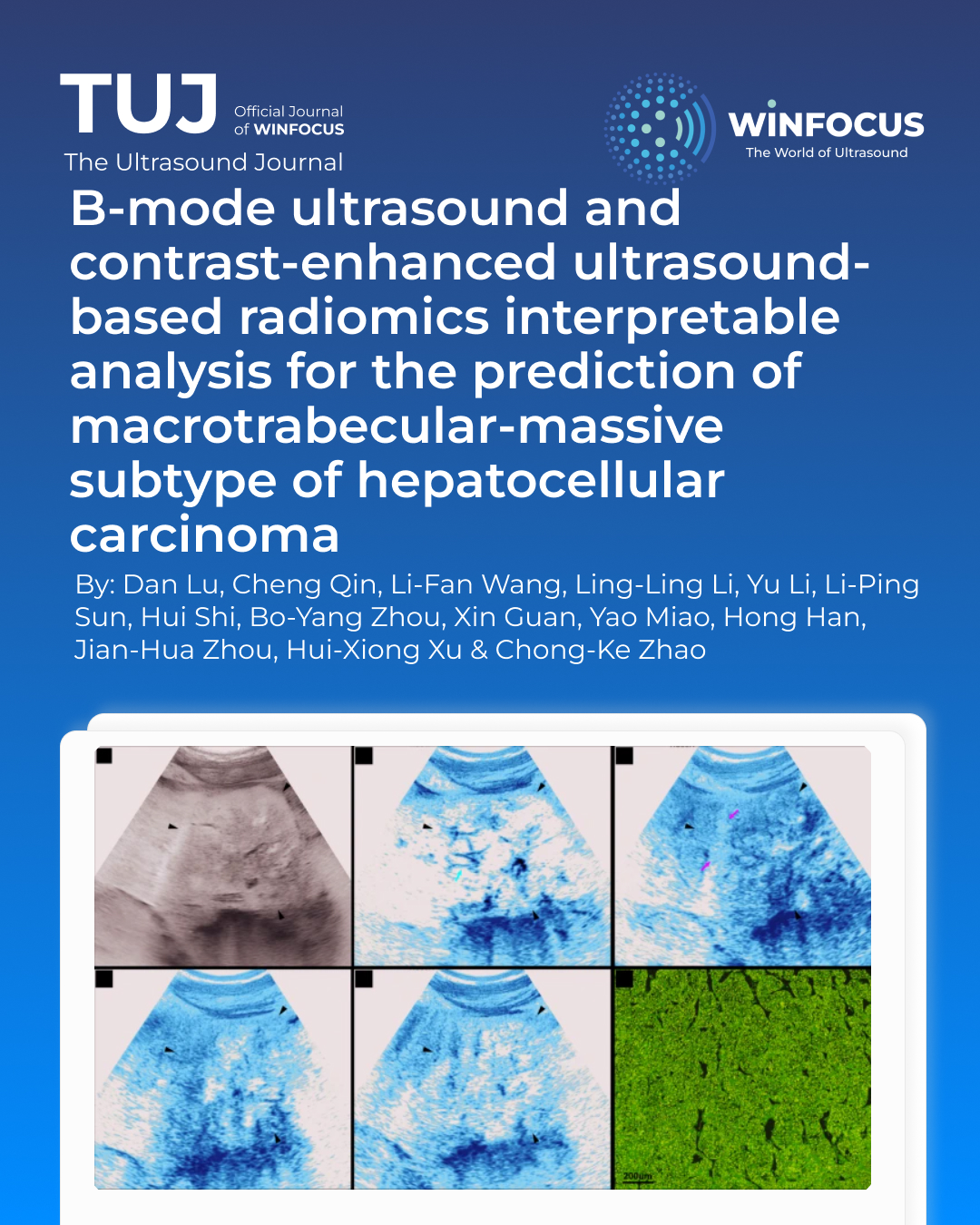
B-mode ultrasound and contrast-enhanced ultrasound-based radiomics interpretable analysis for the prediction of macrotrabecular-massive subtype of hepatocellular carcinoma
Keywords:
Macrotrabecular-massive hepatocellular carcinoma, Contrast enhanced ultrasound, Radiomics, SHapley additive explanations, PrognosisAbstract
Background: This study aimed to develop and validate an interpretable radiomics model using quantitative features from B-mode ultrasound (BMUS) and contrast-enhanced ultrasound (CEUS) for predicting macrotrabecular-massive (MTM) hepatocellular carcinoma (HCC).
Methods: From October 2020 to September 2023, 344 patients (mean age: 58.20 ± 10.70 years; 275 men) with surgically resected HCC were retrospectively enrolled from three medical centers. Radiomics features were extracted from BMUS and CEUS, followed by a multiple-step feature selection process. BMUSR model (based on BMUS radiomics features), BM + CEUSR model (based on BMUS and CEUS radiomics features) and hybridR+C model (integrated clinical indicators and radiomic features) were established. These radiomics models’ performance was compared with conventional clinic-radiological (CC+R) model using area under the receiver operating characteristic curve (AUC). SHapley Additive exPlanations (SHAP) method was used to interpret model performance. The model’s potential for predicting recurrence-free survival (RFS) was further analyzed.
Results: Among ten distinct machine learning classifiers evaluated, the AdaBoost algorithm demonstrated the highest classification performance. The AUCs of the BM + CEUSR model for identifying MTM-HCC were higher than the BMUSR model and the conventional clinic-radiological model in both validation (0.880 vs. 0.720 and 0.658, both p < 0.05) and test sets (0.878 vs. 0.605 and 0.594, both p < 0.05). No statistical differences were observed between the BM + CEUSR model and the hybridR+C model in either set (p > 0.05). Additionally, the AdaBoost-based BM + CEUSR model showed promising in stratifying early recurrence-free survival, with p < 0.001.
Conclusion: The AdaBoost-based BM + CEUSR model shows promise as a tool for preoperatively identifying MTM-HCC and may also be beneficial in predicting prognosis.
References
1. Vogel A, Meyer T, Sapisochin G et al (2022) Hepatocellular carcinoma. Lancet 400:1345–1362
2. Torbenson M, Washington K (2020) Pathology of liver disease: advances in the last 50 years. Hum Pathol 95:78–98
3. Dong LQ, Peng LH, Ma LJ et al (2020) Heterogeneous Immunogenomic features and distinct escape mechanisms in multifocal hepatocellular carcinoma. J Hepatol 72:896–908
4. Torbenson MS (2021) Hepatocellular carcinoma: making sense of morphological heterogeneity, growth patterns, and subtypes. Hum Pathol 112:86–101
5. Nagtegaal ID, Odze RD, Klimstra D et al (2020) The 2019 WHO classification of tumours of the digestive system. Histopathology 76:182–188
6. Calderaro J, Ziol M, Paradis V, Zucman-Rossi J (2019) Molecular and histological correlations in liver cancer. J Hepatol 71:616–630
7. Ziol M, Pote N, Amaddeo G et al (2018) Macrotrabecular-massive hepatocellular carcinoma: A distinctive histological subtype with clinical relevance. Hepatology 68:103–112
8. An C, Kim MJ (2019) Imaging features related with prognosis of hepatocellular carcinoma. Abdom Radiol (NY) 44:509–516
9. Mule S, Pirgliasco AG, Tenenhaus A et al (2020) Multiphase liver MRI for identifying the Macrotrabecular-Massive subtype of hepatocellular carcinoma. Radiology 295:562–571
10. Chen J, Xia C, Duan T et al (2021) Macrotrabecular-massive hepatocellular carcinoma: imaging identification and prediction based on Gadoxetic acid-enhanced magnetic resonance imaging. Eur Radiol 31:7696–7704
11. Feng Z, Li H, Zhao H et al (2021) Preoperative CT for characterization of aggressive Macrotrabecular-Massive subtype and vessels that encapsulate tumor clusters pattern in hepatocellular carcinoma. Radiology 300:219–229
12. Cha H, Choi J-Y, Park YN et al (2023) Comparison of imaging findings of macrotrabecular-massive hepatocellular carcinoma using CT and Gadoxetic acid-enhanced MRI. Eur Radiol 33:1364–1377
13. Cannella R, Burgio MD, Beaufrere A et al (2021) Imaging features of histological subtypes of hepatocellular carcinoma: implication for LI-RADS. Jhep Rep 3:100380
14. Lambin P, Leijenaar RTH, Deist TM et al (2017) Radiomics: the Bridge between medical imaging and personalized medicine. Nat Reviews Clin Oncol 14:749–762
15. Zhao CK, Ren TT, Yin YF et al (2021) A comparative analysis of two machine Learning-Based diagnostic patterns with thyroid imaging reporting and data system for thyroid nodules: diagnostic performance and unnecessary biopsy rate. Thyroid 31:470–481
16. Peeken JC, Spraker MB, Knebel C et al (2019) Tumor grading of soft tissue sarcomas using MRI-based radiomics. Ebiomedicine 48:332–340
17. Wang W, Wu SS, Zhang JC et al (2021) Preoperative pathological grading of hepatocellular carcinoma using ultrasomics of Contrast-Enhanced ultrasound. Acad Radiol 28:1094–1101
18. Tomaszewski MR, Gillies RJ (2021) The biological meaning of. Radiomic Features Radiol 299:E256–E256
19. Wang LF, Wang Q, Mao F et al (2023) Risk stratification of gallbladder masses by machine learning-based ultrasound radiomics models: a prospective and multi-institutional study. Eur Radiol 33:8899–8911
20. Fernández-Delgado M, Cernadas E, Barro S, Amorim D (2014) Do we need hundreds of classifiers to solve real world classification problems?? J Mach Learn Res 15:3133–3181
21. Abdollahi A, Pradhan B (2023) Explainable artificial intelligence (XAI) for interpreting the contributing factors feed into the wildfire susceptibility prediction model. Sci Total Environ 879:163004
22. Brito LC, Susto GA, Brito JN, Duarte MAV (2022) An explainable artificial intelligence approach for unsupervised fault detection and diagnosis in rotating machinery. Mech Syst Signal Process 163:108105
23. Teneggi J, Luster A, Sulam J (2023) Fast hierarchical games for image explanations. IEEE Trans Pattern Anal Mach Intell 45:4494–4503
24. Luo M, Liu X, Yong J et al (2023) Preoperative prediction of macrotrabecular-massive hepatocellular carcinoma based on B-Mode US and CEUS. Eur Radiol 33:4024–4033
25. Li M, Fan Y, You H et al (2023) Dual-Energy CT deep learning radiomics to predict Macrotrabecular-Massive hepatocellular carcinoma. Radiology 308:e230255
26. Feng Z, Li H, Liu Q et al (2023) CT radiomics to predict Macrotrabecular-Massive subtype and immune status in hepatocellular carcinoma. Radiology 307:e221291
27. He X, Li K, Wei R et al (2023) A multitask deep learning radiomics model for predicting the macrotrabecular-massive subtype and prognosis of hepatocellular carcinoma after hepatic arterial infusion chemotherapy. Radiol Med 128:1508–1520
28. Zhang Y, He D, Liu J, Wei YG, Shi LL (2023) Preoperative prediction of macrotrabecular-massive hepatocellular carcinoma through dynamic contrast-enhanced magnetic resonance imaging-based radiomics. World J Gastroenterol 29:2001–2014
29. Chernyak V, Fowler KJ, Kamaya A et al (2018) Liver Imaging Reporting and Data System (LI-RADS) Version 2018: Imaging of Hepatocellular Carcinoma in At-Risk Patients. Radiology 289:816–830
30. Quaia E (2019) State of the art: LI-RADS for Contrast-enhanced US. Radiology 293:4–14
31. Renne SL, Woo HY, Allegra S et al (2020) Vessels encapsulating tumor clusters (VETC) is a powerful predictor of aggressive hepatocellular carcinoma. Hepatology 71:183–195
32. Fang JH, Zhou HC, Zhang C et al (2015) A novel vascular pattern promotes metastasis of hepatocellular carcinoma in an epithelial-mesenchymal transition-independent manner. Hepatology 62:452–465
33. Liu K, Dennis C, Prince DS et al (2023) Vessels that encapsulate tumour clusters vascular pattern in hepatocellular carcinoma. JHEP Rep 5:100792
34. Rizzo S, Botta F, Raimondi S et al (2018) Radiomics of high-grade serous ovarian cancer: association between quantitative CT features, residual tumour and disease progression within 12 months. Eur Radiol 28:4849–4859
35. Ji GW, Zhu FP, Xu Q et al (2020) Radiomic features at Contrast-enhanced CT predict recurrence in early stage hepatocellular carcinoma: A Multi-Institutional study. Radiology 294:568–579
36. Mayerhoefer ME, Materka A, Langs G et al (2020) Introduction to radiomics. J Nucl Med 61:488–495
37. Moon SH, Kim J, Joung JG et al (2019) Correlations between metabolic texture features, genetic heterogeneity, and mutation burden in patients with lung cancer. Eur J Nucl Med Mol Imaging 46:446–454
38. Dastmalchian S, Kilinc O, Onyewadume L et al (2021) Radiomic analysis of magnetic resonance fingerprinting in adult brain tumors. Eur J Nucl Med Mol Imaging 48:683–693
39. Su GH, Xiao Y, You C et al (2023) Radiogenomic-based multiomic analysis reveals imaging intratumor heterogeneity phenotypes and therapeutic targets. Sci Adv 9:eadf0837
40. Jiang L, You C, Xiao Y et al (2022) Radiogenomic analysis reveals tumor heterogeneity of triple-negative breast cancer. Cell Rep Med 3:100694
41. Vos M, Starmans MPA, Timbergen MJM et al (2019) Radiomics approach to distinguish between well differentiated liposarcomas and lipomas on MRI. Br J Surg 106:1800–1809
42. Rhee H, An C, Kim HY, Yoo JE, Park YN, Kim MJ (2019) Hepatocellular carcinoma with irregular Rim-Like arterial phase hyperenhancement: more aggressive pathologic features. Liver Cancer 8:24–40
43. Calderaro J, Meunier L, Nguyen CT et al (2019) ESM1 as a marker of Macrotrabecular-Massive hepatocellular carcinoma. Clin Cancer Res 25:5859–5865
44. Rhee H, Cho ES, Nahm JH et al (2021) Gadoxetic acid-enhanced MRI of macrotrabecular-massive hepatocellular carcinoma and its prognostic implications. J Hepatol 74:109–121
45. Jeon Y, Benedict M, Taddei T, Jain D, Zhang X (2019) Macrotrabecular hepatocellular carcinoma: an aggressive subtype of hepatocellular carcinoma. Am J Surg Pathol 43:938–943
46. Witjes CD, Willemssen FE, Verheij J et al (2012) Histological differentiation grade and microvascular invasion of hepatocellular carcinoma predicted by dynamic contrast-enhanced MRI. J Magn Reson Imaging 36:641–647
47. Yang Q, Zhou J, Luo B et al (2024) Non-radiomics imaging (US-CEUS) features and clinical text features: correlation with microvascular invasion and tumor grading in hepatocellular carcinoma. Abdom Radiol (NY). https://doi.org/10.1007/s00261-024-04659-0
Downloads
Published
Issue
Section
License
Copyright (c) 2025 Dan Lu, Cheng Qin, Li-Fan Wang, Ling-Ling Li, Yu Li, Li-Ping Sun, Hui Shi, Bo-Yang Zhou, Xin Guan, Yao Miao, Hong Han, Jian-Hua Zhou, Hui-Xiong Xu, Chong-Ke Zhao (Author)

This work is licensed under a Creative Commons Attribution-NonCommercial 4.0 International License.
This is an Open Access article distributed under the terms of the Creative Commons Attribution License (https://creativecommons.org/licenses/by-nc/4.0) which permits unrestricted use, distribution, and reproduction in any medium, provided the original work is properly cited.
Authors retain the copyright for their published work. No formal permission will be required to reproduce parts (tables or illustrations) of published papers, provided the source is quoted appropriately and reproduction has no commercial intent.
How to Cite