Assess, improve, detect, guide: a narrative review and proposal for a standardized protocol for prehospital transesophageal echocardiography during out-of-hospital cardiac arrest
Keywords:
Transoesophageal echocardiography, Out-of-hospital cardiac arrest, Advanced life support, Prehospital, Emergency medical serviceAbstract
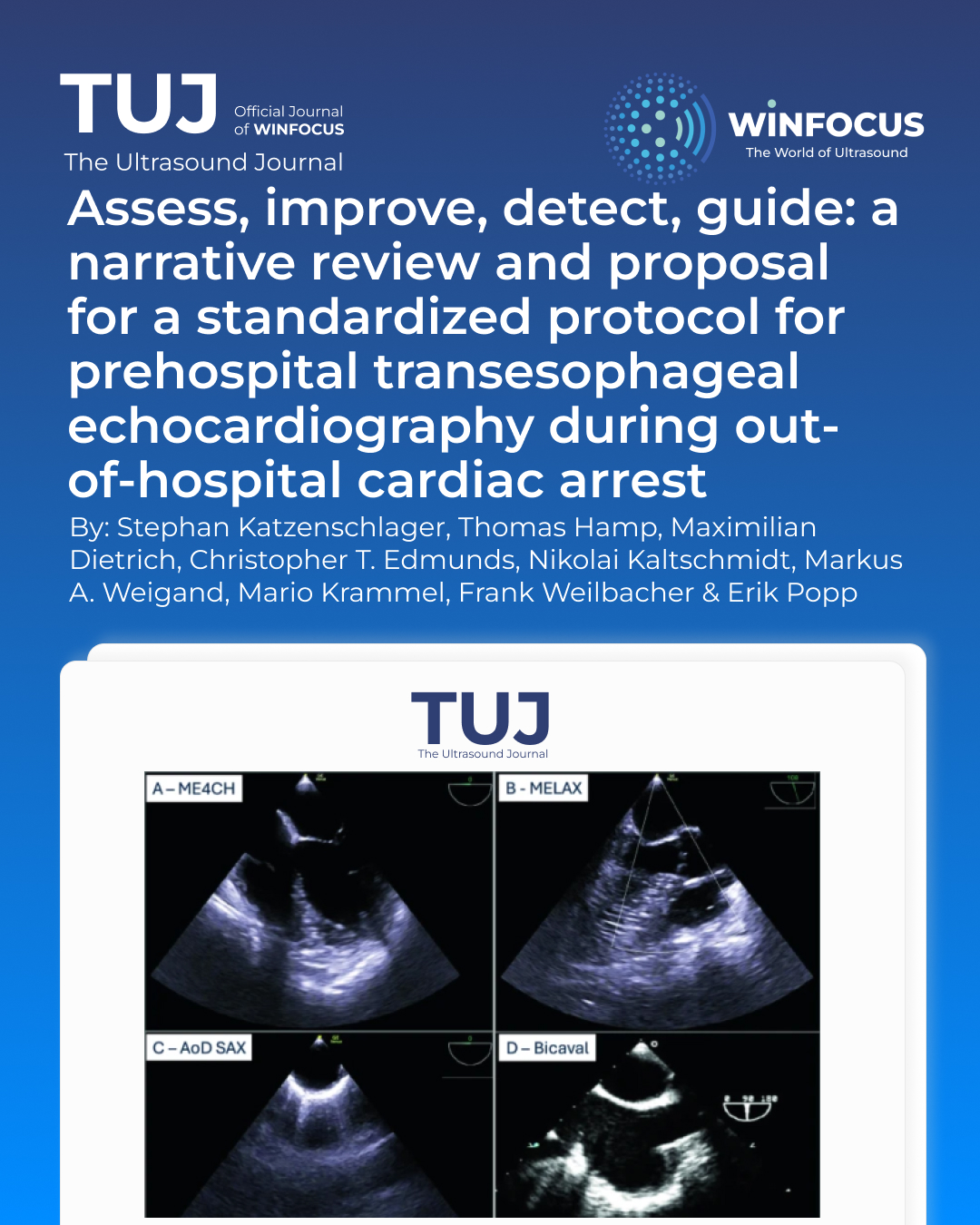
While there are different protocols for in-hospital transesophageal echocardiography, there is no existing protocol for prehospital usage during out-of-hospital cardiac arrest. Herein, the “assess-improve-detect-guide” protocol is described. This protocol includes four mid-esophageal views to address the most time-sensitive aspects during outof-hospital cardiac arrest. This protocol can be used in services with and without the capability for eCPR, with the benefit of profiting from additional diagnostic and personal resources. This protocol provides a standardized approach for performing transesophageal echocardiography during out-of-hospital cardiac arrest and reporting the results.
References
1. Soar J, Böttiger BW, Carli P et al (2021) European resuscitation council guidelines 2021: adult advanced life support. Resuscitation. https:// doi. org/ 10. 1016/ s0025- 7753(02) 72420-2
2. Gardner KF, Clattenburg EJ, Wroe P et al (2018) The cardiac arrest sonographic assessment (CASA) exam—a standardized approach to the use of ultrasound in PEA. Am J Emerg Med 36:729–731. https:// doi. org/ 10. 1016/j. ajem. 2017. 08. 052
3. Clattenburg EJ, Wroe PC, Gardner K et al (2018) Implementation of the cardiac arrest sonographic assessment (CASA) protocol for patients with cardiac arrest is associated with shorter CPR pulse checks. Resuscitation 131:69–73. https:// doi. org/ 10. 1016/j. resus citat ion. 2018.0 7.03 0
4. Teran F, Dean AJ, Centeno C et al (2019) Evaluation of out-of-hospital cardiac arrest using transesophageal echocardiography in the emergency department. Resuscitation 137:140–147. https:// doi. org/ 10. 1016/j. resus citat ion. 2019. 02. 013
5. Catena E, Ottolina D, Fossali T et al (2019) Association between left ventricular outflow tract opening and successful resuscitation after cardiac arrest. Resuscitation 138:8–14. https:// doi. org/ 10. 1016/j. resus citat ion. 2019. 02. 027
6. Hwang SO, Zhao PG, Choi HJ et al (2009) Compression of the left ventricular outflow tract during cardiopulmonary resuscitation. Acad Emerg Med 16:928–933. https:// doi. org/ 10. 1111/j. 1553- 2712. 2009. 00497.x
7. Teran F, Prats MI, Nelson BP et al (2020) Focused transesophageal echocardiography during cardiac arrest resuscitation. J Am Coll Cardiol 76:745–754. https:// doi. org/ 10. 1016/j. jacc. 2020. 05. 074
8. Fair J, Mallin M, Mallemat H et al (2018) Transesophageal echocardiography: guidelines for point-of-care applications in cardiac arrest resuscitation. Ann Emerg Med 71:201–207. https:// doi. org/ 10. 1016/j. annem ergmed. 2017. 09. 003
9. Kegel F, Chenkin J (2023) Resuscitative transesophageal echocardiography in the emergency department: a single-centre case series. Scand J Trauma Resusc Emerg Med 31:24. https:// doi. org/ 10. 1186/ s13049- 023- 01077-x
10. Fair J, Tonna J, Ockerse P et al (2016) Emergency physician–performed transesophageal echocardiography for extracorporeal life support vascular cannula placement. Am J Emerg Med 34:1637–1639. https:// doi. org/ 10. 1016/j. ajem. 2016. 06. 038
11. Merlin MA, Joseph J, Hohbein J et al (2020) Out-of-hospital transesophageal echocardiogram for cardiac arrest resuscitation: the initial case. Prehosp Emerg Care 24:90–93. https:// doi. org/ 10. 1080/ 10903 127. 2019. 16049 26
12. Katzenschlager S, Heck R, Popp E et al (2023) Out-of-hospital cardiac arrest treated with prehospital double sequential external defibrillation during eCPR in refractory VF—a case report. Int J Emerg Med 16:71. https:// doi. org/ 10. 1186/ s12245- 023- 00546-5
13. Krammel M, Hamp T, Hafner C et al (2023) Feasibility of resuscitative transesophageal echocardiography at out-of-hospital emergency scenes of cardiac arrest. Sci Rep 13:20085. https:// doi. org/ 10. 1038/ s41598- 023- 46684-x
14. Flachskampf FA, Badano L, Daniel WG et al (2010) Recommendations for transoesophageal echocardiography: update 2010. Eur J Echocardiogr 11:557–576. https:// doi. org/ 10. 1093/ ejech ocard/ jeq057
15. Memtsoudis SG, Rosenberger P, Loffler M et al (2006) The usefulness of transesophageal echocardiography during intraoperative cardiac arrest in noncardiac surgery. Anesth Analg 102:1653–1657. https:// doi. org/ 10. 1213/ 01. ane. 00002 16412. 83790. 29
16. Arntfield R, Pace J, Hewak M, Thompson D (2016) Focused transesophageal echocardiography by emergency physicians is feasible and clinically influential: observational results from a novel ultrasound program. J Emerg Med 50:286–294. https:// doi. org/ 10. 1016/j. jemer med. 2015. 09. 018
17. Hussein L, Rehman MA, Jelic T et al (2021) Transoesophageal echocardiography in cardiac arrest: a systematic review. Resuscitation 168:167–175. https:// doi. org/ 10. 1016/j. resus citat ion. 2021. 08. 001
18. Kaltschmidt N, Katzenschlager S, Kaltschmidt L et al (2024) Materielle Ausstattung des Heidelberger Medical Intervention Car. Notfall + Rettungsmedizin. https:// doi. org/ 10. 1007/ s10049- 024- 01370-x
19. Teran F, West FM, Jelic T et al (2024) Resuscitative transesophageal echocardiography in emergency departments in the United States and Canada: a cross-sectional survey. Am J Emerg Med 76:164–172. https:// doi. org/ 10. 1016/j. ajem. 2023. 11. 041
20. Braude D, White J, Wray T (2020) Other approaches to prehospital transesophageal echocardiography. Prehosp Emerg Care 24:305–306. https:// doi. org/ 10. 1080/ 10903 127. 2019. 16330 00
21. Mueller M, Losert H, Sterz F et al (2023) Prehospital emergency medicine research by additional teams on scene—concepts and lessons learned. Resusc Plus 16:100494. https:// doi. org/ 10. 1016/j. resplu. 2023. 100494
22. Richardson SAC, Anderson D, Burrell AJC et al (2023) Pre-hospital ECPR in an Australian metropolitan setting: a single-arm feasibility assessment—the CPR, pre-hospital ECPR and early reperfusion (CHEER3) study. Scand J Trauma Resusc Emerg Med 31:100. https:// doi. org/ 10. 1186/ s13049- 023- 01163-0
23. Wray TC, Johnson M, Cluff S et al (2022) Transesophageal echocardiography performed by intensivist and emergency physicians—a 5-year, single-center experience. J Intensive Care Med 37:917–924. https:// doi. org/ 10. 1177/ 08850 66621 10425 22
24. Wray TC, Schmid K, Braude D et al (2019) Safety of transesophageal echocardiography performed by intensivists and emergency physicians in critically ill patients with coagulopathy and thrombocytopenia: a single-center experience. J Intensive Care Med. https:// doi. org/ 10. 1177/ 08850 66619 887693
25. Hahn RT, Abraham T, Adams MS et al (2013) Guidelines for performing a comprehensive transesophageal echocardiographic examination: recommendations from the American society of echocardiography and the society of cardiovascular anesthesiologists. J Am Soc Echocardiogr 26:921–964. https:// doi. org/ 10. 1016/j. echo. 2013. 07. 009
26. Ruiz de Gauna S, González-Otero DM, Ruiz J, Russell JK (2016) Feedback on the rate and depth of chest compressions during cardiopulmonary resuscitation using only accelerometers. PLoS ONE 11:e0150139. https:// doi. org/ 10. 1371/ journ al. pone. 01501 39
27. Teran F, Owyang CG, Martin-Flores M et al (2023) Hemodynamic impact of chest compression location during cardiopulmonary resuscitation guided by transesophageal echocardiography. Crit Care 27:319. https:// doi. org/ 10. 1186/ s13054- 023- 04575-7
28. Sandroni C, De Santis P, D’Arrigo S (2018) Capnography during cardiac arrest. Resuscitation 132:73–77. https:// doi. org/ 10. 1016/j. resus citat ion. 2018. 08. 018
29. Levine RL, Wayne MA, Miller CC (1997) End-tidal carbon dioxide and outcome of out-of-hospital cardiac arrest. N Engl J Med 337:301–306. https:// doi. org/ 10. 1056/ NEJM1 99707 31337 0503
30. Paiva EF, Paxton JH, O’Neil BJ (2018) The use of end-tidal carbon dioxide (etCO2) measurement to guide management of cardiac arrest: a system-atic review. Resuscitation 123:1–7. https:// doi. org/ 10. 1016/j. resus citat ion. 2017. 12. 003
31. Hussein L, Rehman MA, Sajid R et al (2019) Bedside ultrasound in cardiac standstill: a clinical review. Ultrasound J 11:35. https:// doi. org/ 10. 1186/ s13089- 019- 0150-7
32. Aagaard R, Granfeldt A, Bøtker MT et al (2017) The right ventricle is dilated during resuscitation from cardiac arrest caused by hypovolemia: a porcine ultrasound study*. Crit Care Med 45:e963–e970. https:// doi. org/ 10. 1097/ CCM. 00000 00000 002464
33. Jobs A, Eitel C, Pöss J et al (2015) Effect of pericardial effusion complicating ST-elevation myocardial infarction as predictor of extensive myocardial damage and prognosis. Am J Cardiol 116:1010–1016. https:// doi. org/ 10. 1016/j. amjca rd. 2015. 07. 007
34. Gouveia Melo R, Machado C, Caldeira D et al (2022) Incidence of acute aortic dissections in patients with out of hospital cardiac arrest: a systematic review and meta-analysis of observational studies. IJC Heart Vasculature. 38:100934. https:// doi. org/ 10. 1016/j. ijcha. 2021. 100934
35. Tavazzi G, Price S, Beitnes JO et al (2024) Imaging in acute percutaneous mechanical circulatory support in adults: a clinical consensus statement of the Association for acute cardiovascular care (ACVC) of the ESC, the European association of cardiovascular imaging (EACVI) of the ESC and the European branch of the extracorporeal life support organization (EuroELSO). Eur Heart J Cardiovasc Imaging 25:e296–e311. https:// doi. org/ 10. 1093/ ehjci/ jeae2 19
36. Rosseel T, Van Puyvelde T, Voigt J-U et al (2022) How to perform focused transoesophageal echocardiography during extracorporeal cardiopulmonary resuscitation? Eur Heart J Cardiovasc Imaging 24:12–14. https:// doi. org/ 10. 1093/ ehjci/ jeac2 05
37. Kim YW, Jung WJ, Cha K-C et al (2021) Diagnosis of aortic dissection by transesophageal echocardiography during cardiopulmonary resuscitation. Am J Emerg Med 39:92–95. https:// doi. org/ 10. 1016/j. ajem. 2020. 01. 026
38. Ross CE, Parker MJ, Mentzelopoulos SD et al (2024) Emergency research without prior consent in the United States, Canada, European Union and United Kingdom: how regulatory differences affect study design and implementation in cardiac arrest trials. Resusc Plus 17:100565. https:// doi. org/ 10. 1016/j. resplu. 2024. 100565
39. Gräsner JT, Wnent J, Herlitz J et al (2020) Survival after out-of-hospital cardiac arrest in Europe—results of the EuReCa TWO study. Resuscitation 148:218–226. https:// doi. org/ 10. 1016/j. resus citat ion. 2019.1 2. 042
40. Diehl A, Read AC, Southwood T et al (2023) The effect of restrictive versus liberal selection criteria on survival in ECPR: a retrospective analysis of a multi-regional dataset. Scand J Trauma Resusc Emerg Med 31:89. https:// doi. org/ 10. 1186/ s13049- 023- 01154-1
41. Warren SA, Prince DK, Huszti E et al (2015) Volume versus outcome: More emergency medical services personnel on-scene and increased survival after out-of-hospital cardiac arrest. Resuscitation 94:40–48. https:// doi. org/ 10. 1016/j. resus citat ion. 2015. 02. 019
42. Rupprecht L, Lunz D, Philipp A et al (2015) Pitfalls in percutaneous ECMO cannulation. Heart Lung Vessel 7:320–326
43. Inoue A, Hifumi T, Sakamoto T et al (2022) Extracorporeal cardiopulmonary resuscitation in adult patients with out-of-hospital cardiac arrest: a retrospective large cohort multicenter study in Japan. Crit Care 26:129. https:// doi. org/ 10. 1186/ s13054- 022- 03998-y
Downloads
Published
Issue
Section
License
Copyright (c) 2025 Stephan Katzenschlager, Thomas Hamp, Maximilian Dietrich, Christopher T. Edmunds, Nikolai Kaltschmidt, Markus A. Weigand, Mario Krammel, Frank Weilbacher, Erik Popp (Author)

This work is licensed under a Creative Commons Attribution-NonCommercial 4.0 International License.
This is an Open Access article distributed under the terms of the Creative Commons Attribution License (https://creativecommons.org/licenses/by-nc/4.0) which permits unrestricted use, distribution, and reproduction in any medium, provided the original work is properly cited.
Authors retain the copyright for their published work. No formal permission will be required to reproduce parts (tables or illustrations) of published papers, provided the source is quoted appropriately and reproduction has no commercial intent.
How to Cite