Quantitative valve motion assessment in adolescents using point-of-care ultrasound: short communication
Abstract
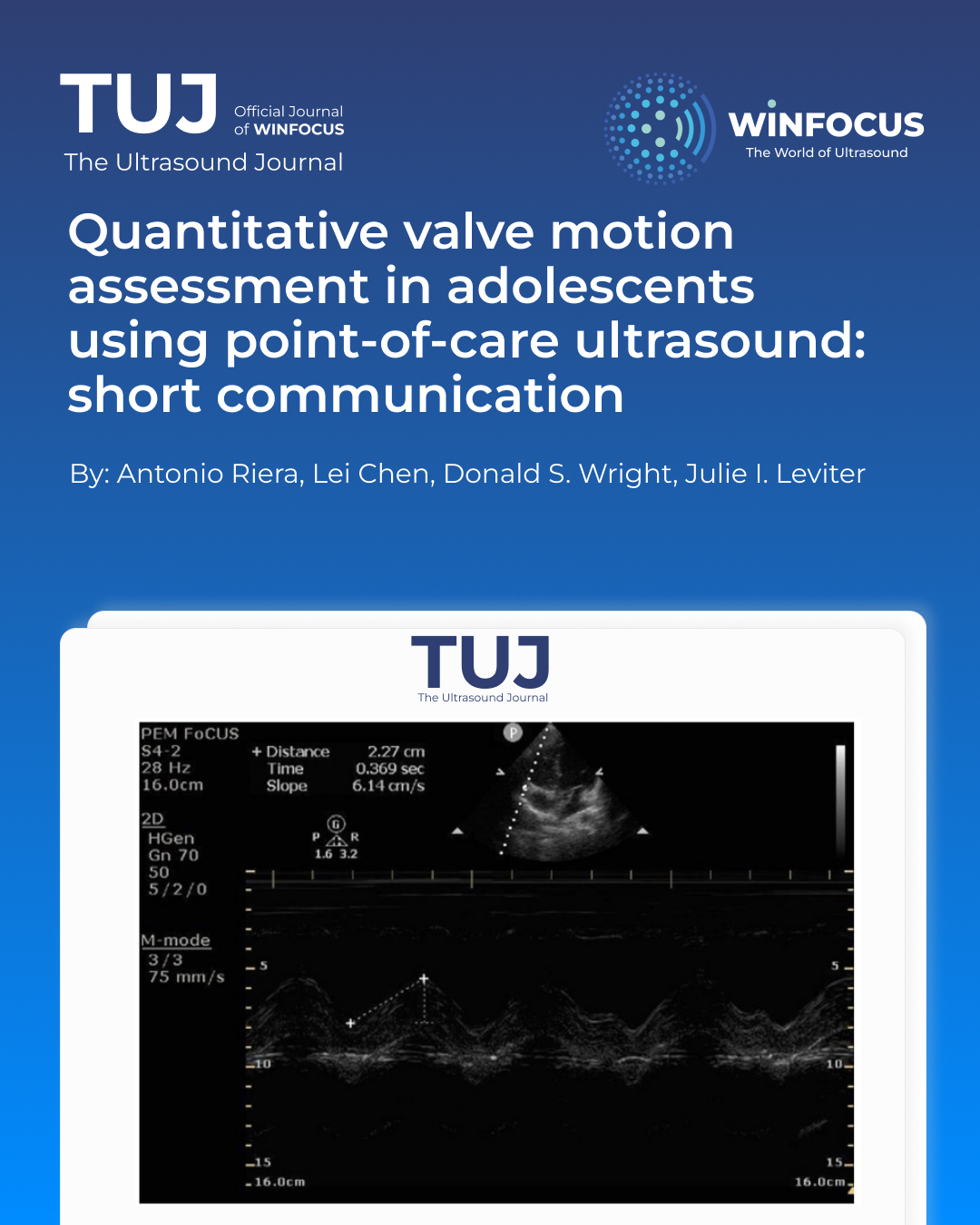
E-point septal separation (EPSS) and tricuspid annular plane systolic excursion (TAPSE) are M-mode measures of left and right ventricular systolic function, with limited pediatric point-of-care ultrasound (POCUS) research. We conducted a cross-sectional study in a pediatric emergency department, enrolling 12–17-year-olds without cardiopulmonary complaints. Exclusion criteria included abnormal vital signs, fever, altered mental status, or psychiatric illness. POCUS faculty performed the measurements, while blinded to pediatric echocardiography reference values. Data was analyzed using unpaired t-tests and Pearson’s correlation. Correlations with age, height, weight, body mass index, and heart rate were examined. Twenty subjects were enrolled. The mean EPSS was 2.5 mm (SD 1.9 mm), and the mean TAPSE was 2.6 cm (SD 0.4 cm), aligning with pediatric echocardiography reference values. No significant correlations were found between EPSS or TAPSE and anthropometric data.
References
1. Navanandan N, Stein J, Mistry RD (2019) Pulmonary embolism in children. Pediatr Emerg Care 35(2):143–151
2. Romer AJ, Rajagopal SK, Kameny RJ (2018) Initial presentation and management of pediatric heart failure. Curr Opin Pediatr 30(3):319–325
3. Satilmis Siliv N, Yamanoglu A, Pinar P, Celebi Yamanoglu NG, Torlak F, Parlak I (2019) Estimation of cardiac systolic function based on mitral valve movements: an accurate bedside tool for emergency physicians in dyspneic patients. J Ultrasound Med 38(4):1027–1038
4. Daley J, Grotberg J, Pare J, Medoro A, Liu R, Hall MK et al (2017) Emergency physician performed tricuspid annular plane systolic excursion in the evaluation of suspected pulmonary embolism. Am J Emerg Med 35(1):106–111
5. Fields JM, Davis J, Girson L, Au A, Potts J, Morgan CJ et al (2017) Transthoracic echocardiography for diagnosing pulmonary embolism: a systematic review and meta-analysis. J Am Soc Echocardiog 30(7):714-U277
6. Secko MA, Lazar JM, Salciccioli LA, Stone MB (2011) Can junior emergency physicians use E-point septal separation to accurately estimate left ventricular function in acutely dyspneic patients? Acad Emerg Med 18(11):1223–1226
7. Lobo JL, Holley A, Tapson V, Moores L, Oribe M, Barron M et al (2014) Prognostic significance of tricuspid annular displacement in normotensive patients with acute symptomatic pulmonary embolism. J Thromb Haemost 12(7):1020–1027
8. McKaigney CJ, Krantz MJ, La Rocque CL, Hurst ND, Buchanan MS, Kendall JL (2014) E-point septal separation: a bedside tool for emergency physician assessment of left ventricular ejection fraction. Am J Emerg Med 32(6):493–497
9. Matzer L, Cortada X, Ferrer P, De Armendi F, Kinney EL (1985) Widened E point septal separation in a normal pediatric population. Chest 87(1):73–75
10. Engle SJ, DiSessa TG, Perloff JK, Isabel-Jones J, Leighton J, Gross K et al (1983) Mitral valve E point to ventricular septal separation in infants and children. Am J Cardiol 52(8):1084–1087
11. Alerhand S, Hickey SM (2020) Tricuspid Annular Plane Systolic Excursion (TAPSE) for Risk Stratification and Prognostication of Patients with Pulmonary Embolism. J Emerg Med 58(3):449–456
12. Uysal F, Bostan OM, Cil E (2016) Determination of reference values for tricuspid annular plane systolic excursion in healthy Turkish children. Anatol J Cardiol 16(5):354–359
13. Lu JC, Riley A, Conlon T, Levine JC, Kwan C, Miller-Hance WC et al (2023) Recommendations for cardiac point-of-care ultrasound in children: a report from the american society of echocardiography. J Am Soc Echocardiogr 36(3):265–277
Downloads
Published
Issue
Section
License
Copyright (c) 2025 Antonio Riera, Lei Chen, Donald S. Wright, Julie I. Leviter (Author)

This work is licensed under a Creative Commons Attribution-NonCommercial 4.0 International License.
This is an Open Access article distributed under the terms of the Creative Commons Attribution License (https://creativecommons.org/licenses/by-nc/4.0) which permits unrestricted use, distribution, and reproduction in any medium, provided the original work is properly cited.
Authors retain the copyright for their published work. No formal permission will be required to reproduce parts (tables or illustrations) of published papers, provided the source is quoted appropriately and reproduction has no commercial intent.
How to Cite