Real-time ultrasound for umbilical venous catheter insertion in neonates- a systematic review and meta-analysis
Keywords:
Malposition, Procedure duration, Sepsis, Mortality, Certainty of evidenceAbstract
Objective: There has been an increase in real-time ultrasonography use in central venous catheterisation. This systematic review and meta-analysis aimed to assess the role of real-time ultrasound use in umbilical venous catheterisation in neonates.
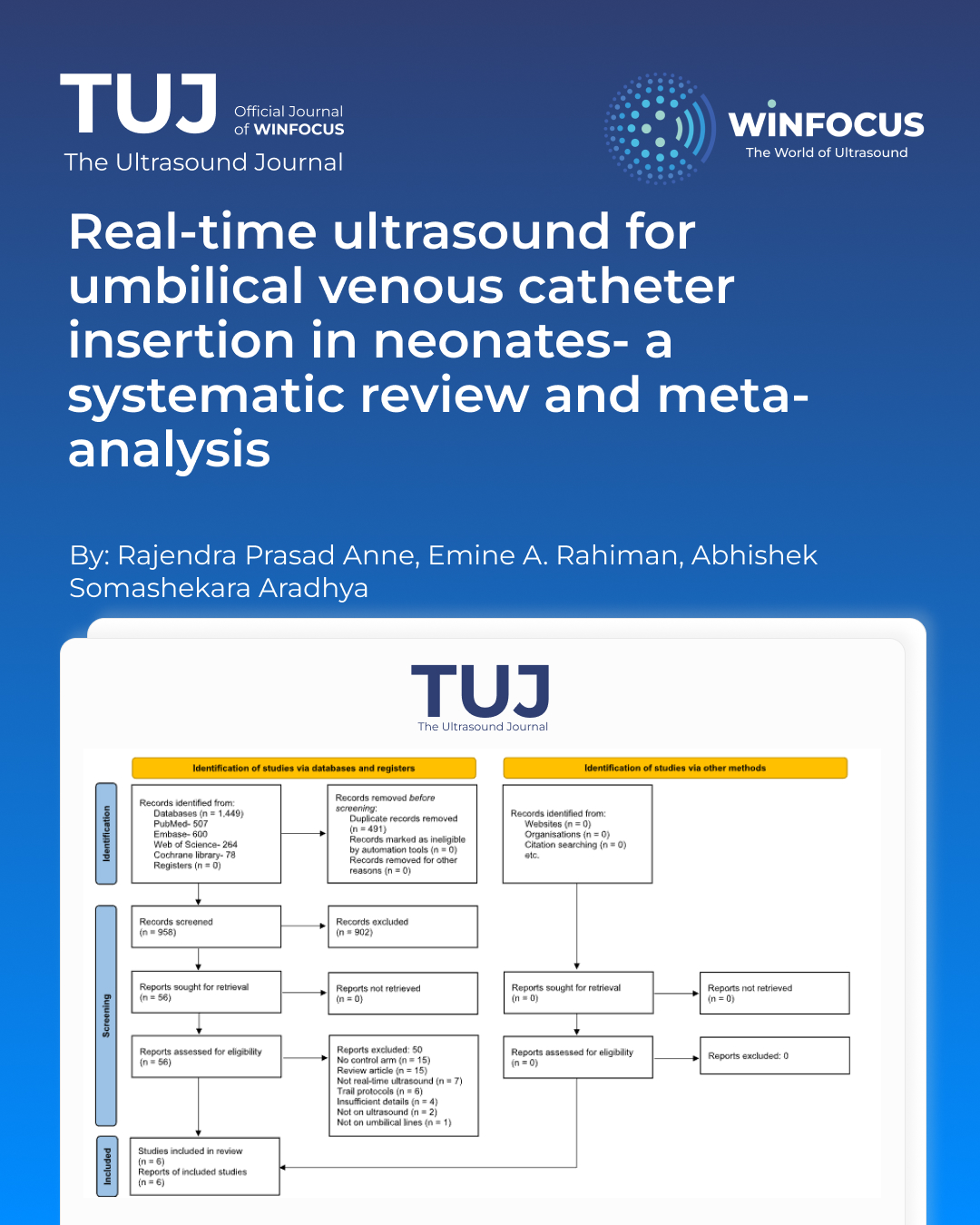
Data sources: PubMed, Embase, Web of Science and Cochrane Library were searched on July 11, 2024. We followed the Cochrane Handbook for Systematic Reviews of Interventions (for study conduct), GRADE methodology (for certainty of evidence), and PRISMA guidelines (for reporting).
Study selection: All randomised controlled trials/RCTs and non-randomised studies of interventions/NRSIs comparing real-time ultrasound with the conventional technique of umbilical venous catheterisation were included.
Data extraction: The outcomes of interest were malposition rates, procedure duration, mortality, sepsis, and cost. Data extraction and quality assessment were done in duplicate.
Data synthesis: Six studies (three RCTs and three NRSI), including 863 participants, were included. Data were analysed separately for RCTs and NRSIs. The RCTs were at low risk of bias, but NRSIs were at moderate to serious risk. The pooled estimates from RCTs showed a decrease in malposition rates (2 studies, 165 participants, risk ratio/RR 0.45, 95% confidence interval/CI 0.23, 0.90) and procedure duration (3 studies, 196 participants, mean difference −6.1 min, 95% CI −8.4, −3.8 min) with real-time ultrasound use. There was no reduction in sepsis. Mortality was not reported. The certainty of evidence was low for malposition rates and procedure duration. The data from NRSIs showed a reduction in malposition rates (3 studies, 667 participants, risk ratio/RR 0.10, 95% confidence interval/CI 0.07, 0.14) without an impact on procedure duration and sepsis. However, these findings did not improve the evidence.
Conclusions: Low certainty evidence suggests that using real-time ultrasound for umbilical venous catheterisation reduces malposition rates. There is a clinically insignificant reduction in procedure duration. There is no sufficient data to come to a conclusion on the critical outcomes of sepsis and mortality.
References
1. Shukla H, Ferrara A (1986) Rapid estimation of insertional length of umbilical catheters in newborns. Am J Dis Child 140:786–788. https:// doi. org/ 10. 1001/ archp edi. 1986. 02140 22006 8034
2. Dunn PM (1966) Localization of the umbilical catheter by post-mortem measurement. Arch Dis Child 41:69–75. https:// doi. org/ 10. 1136/ adc. 41. 215. 69
3. Gibson K, Sharp R, Ullman A et al (2021) Adverse events associated with umbilical catheters: a systematic review and meta-analysis. J Perinatol 41:2505–2512. https:// doi. org/ 10. 1038/ s41372- 021- 01147-x
4. Grizelj R, Vukovic J, Bojanic K et al (2014) Severe liver injury while using umbilical venous catheter: case series and literature review. Am J Perinatol 31:965–974. https:// doi. org/ 10. 1055/s- 0034- 13703 46
5. Torres Del Pino M, Gómez Santos E, Domínguez Quintero ML et al (2023) Steps to improve umbilical vein catheterization in neonatal care. An Pediatr 99:155–161. https:// doi. org/ 10. 1016/j. anpede. 2023. 08. 006
6. Rajaraman N, Gowda H (2024) Does the use of point of care ultrasound (POCUS) improve umbilical venous catheter (UVC) positioning in neonates? Arch Dis Child 109:598–601. https:// doi. org/ 10. 1136/ archd ischi ld- 2023- 326653
7. Cao J, Zhang Y, Yin Y, Liu Y (2023) Accuracy of chest radiography compared to ultrasound for positioning the umbilical venous catheter in neonates: a meta-analysis and systematic review. J Vasc Access 24:1051–1060. https:// doi. org/ 10. 1177/ 11297 29821 10467 55
8. Franta J, Harabor A, Soraisham AS (2017) Ultrasound assessment of umbilical venous catheter migration in preterm infants: a prospective study. Arch Dis Child Fetal Neonatal Ed 102:F251–F255. https:// doi. org/ 10. 1136/ archd ischi ld- 2016- 311202
9. Doyle SC, Bergin NM, Young R et al (2022) Diagnostic accuracy of ultrasound for localising peripherally inserted central catheter tips in infants in the neonatal intensive care unit: a systematic review and meta-analysis. Pediatr Radiol 52:2421–2430. https:// doi. org/ 10. 1007/ s00247- 022- 05379-7
10. Lau CSM, Chamberlain RS (2016) Ultrasound-guided central venous catheter placement increases success rates in pediatric patients: a metaanalysis. Pediatr Res 80:178–184. https:// doi. org/ 10. 1038/ pr. 2016. 74
11. Higgins J, Thomas J, Chandler J et al (2023) Cochrane Handbook for Systematic Reviews of Interventions version 6.4 (updated August 2023). Cochrane
12. Page MJ, McKenzie JE, Bossuyt PM et al (2021) The PRISMA 2020 statement: an updated guideline for reporting systematic reviews. BMJ 372:n71. https:// doi. org/ 10. 1136/ bmj. n71
13. Brooke BS, Schwartz TA, Pawlik TM (2021) MOOSE reporting guidelines for meta-analyses of observational studies. JAMA Surg 156:787–788. https:// doi. org/ 10. 1001/ jamas urg. 2021. 0522
14. Hoellering AB, Koorts PJ, Cartwright DW, Davies MW (2014) Determination of umbilical venous catheter tip position with radiograph. Pediatr Crit Care Med 15:56. https:// doi. org/ 10. 1097/ PCC. 0b013 e3182 9f5efa
15. Rubortone SA, Costa S, Perri A et al (2021) Real-time ultrasound for tip location of umbilical venous catheter in neonates: a pre/ post intervention study. Ital J Pediatr 47:68. https:// doi. org/ 10. 1186/ s13052- 021- 01014-7
16. Xie H-Q, Xie C-X, Liao J-F et al (2023) Point-of-care ultrasound for monitoring catheter tip location during umbilical vein catheterization in neonates: a prospective study. Front Pediatr 11:1225087. https:// doi. org/ 10. 3389/ fped. 2023. 12250 87
17. Centres for Disease Control and Prevention (CDC); National Healthcare
Safety Network (NHSN). Chapter 4—Bloodstream Infection Event (Central Line-Associated Bloodstream Infection and Non-Central Line Associated Bloodstream Infection). In Patient Safety Component Manual; CDC; NHSN: Atlanta, GA, USA, 2022.
18. Sterne JAC, Savović J, Page MJ et al (2019) RoB 2: a revised tool for assessing risk of bias in randomised trials. BMJ 366:l4898. https:// doi. org/ 10. 1136/ bmj. l4898
19. Sterne JA, Hernán MA, Reeves BC et al (2016) ROBINS-I: a tool for assessing risk of bias in non-randomised studies of interventions. BMJ 355:i4919. https:// doi. org/ 10. 1136/ bmj. i4919
20. Guyatt GH, Oxman AD, Vist GE et al (2008) GRADE: an emerging consensus on rating quality of evidence and strength of recommendations. BMJ 336:924–926. https:// doi. org/ 10. 1136/ bmj. 39489. 470347. AD
21. Mishra P, Mohanty PK, Som TK et al (2024) Comparison of ultrasoundguided umbilical venous catheter insertion with blind method: a randomized controlled trial. Biomed Hub 9:1–8. https:// doi. org/ 10. 1159/ 00053 5096
22. Kaur A, Manerkar S, Patra S et al (2022) Ultrasound-guided umbilical venous catheter insertion to reduce rate of catheter tip malposition in neonates: a randomized, controlled trial. Indian J Pediatr 89:1093–1098. https:// doi. org/ 10. 1007/ s12098- 022- 04295-w
23. Fleming SE, Kim JH (2011) Ultrasound-guided umbilical catheter insertion in neonates. J Perinatol 31:344–349. https:// doi. org/ 10. 1038/ jp. 2010. 128
24. Rossi S, Jogeesvaran KH, Matu E et al (2022) Point-of-care ultrasound for neonatal central catheter positioning: impact on X-rays and line tip position accuracy. Eur J Pediatr 181:2097–2108. https:// doi. org/ 10. 1007/ s00431- 022- 04412-z
25. D’Andrea V, Prontera G, Cota F et al (2024) Real-time ultrasound tip location reduces malposition and radiation exposure during umbilical venous catheter placement in neonates: a retrospective, observational study. Neonatology. https:// doi. org/ 10. 1159/ 00053 8905
26. Guzmán-de la Garza FJ, Laredo-Flores AD, Cárdenas-Del Castillo B et al (2020) Ultrasound-guided umbilical venous catheterisation: a cost-effectiveness analysis. An Pediatr 92:215–221. https:// doi. org/ 10. 1016/j. anpedi. 2019. 04. 005
27. TCTR20230906002 (2023) Comparison of Point of Care Ultrasound (POCUS) and X-ray in confirmation the position of central line and endotracheal tube in the neonatal intensive care unit (NICU). https:// trial search. who. int/ Trial2. aspx? Trial ID= TCTR2 02309 06002. https:// doi. org/ 10. 1002/ centr al/ CN- 02599 599. Accessed 10 Oct 2024
28. CTRI/2023/03/050673 (2023) Study comparing how good an ultrasound scan guided long catheter insertion technique is in guiding the catheter to the correct position, when compared to the usual technique. https:// trial search. who. int/ Trial2. aspx? Trial ID= CTRI/ 2023/ 03/ 050673. https:// doi. org/ 10. 1002/ centr al/ CN- 02540 666. Accessed 10 Oct 2024
29. CTRI/2020/09/027600 (2020) A study to evaluate the use of Echocardiography for fixing the umbilical venous catheter at appropriate position in new born babies. https:// trial search. who. int/ Trial2. aspx? Trial ID= CTRI/ 2020/ 09/ 027600. https:// doi. org/ 10. 1002/ centr al/ CN- 02185 855. Accessed 10 Oct 2024
30. CTRI/2018/04/013126 (2019) Ultrasound guided insertion of umbilical catheters in neonates. https:// trial search. who. int/ Trial2. aspx? Trial ID= CTRI/ 2018/ 04/ 013126. https:// doi. org/ 10. 1002/ centr al/ CN- 01903 242. Accessed 10 Oct 2024
31. D’Andrea V, Prontera G, Rubortone SA et al (2022) Umbilical venous catheter update: a narrative review including ultrasound and training. Front Pediatr. https:// doi. org/ 10. 3389/ fped. 2021. 774705
32. Barone G, Pittiruti M, Biasucci DG et al (2022) Neo-ECHOTIP: a structured protocol for ultrasound-based tip navigation and tip location during placement of central venous access devices in neonates. J Vasc Access 23:679–688. https:// doi. org/ 10. 1177/ 11297 29821 10077 03
33. Saugel B, Scheeren TWL, Teboul J-L (2017) Ultrasound-guided central venous catheter placement: a structured review and recommendations for clinical practice. Crit Care 21:225. https:// doi. org/ 10. 1186/ s13054- 017- 1814-y
34. Singh ND and M Sample Size Calculator for Comparing Two Independent Proportions. https:// statu lator. com/ Sampl eSize/ ss2P. html. Accessed 5 Sep 2024.
Downloads
Published
Issue
Section
License
Copyright (c) 2025 Rajendra Prasad Anne, Emine A. Rahiman, Abhishek Somashekara Aradhya (Author)

This work is licensed under a Creative Commons Attribution-NonCommercial 4.0 International License.
This is an Open Access article distributed under the terms of the Creative Commons Attribution License (https://creativecommons.org/licenses/by-nc/4.0) which permits unrestricted use, distribution, and reproduction in any medium, provided the original work is properly cited.
Authors retain the copyright for their published work. No formal permission will be required to reproduce parts (tables or illustrations) of published papers, provided the source is quoted appropriately and reproduction has no commercial intent.
How to Cite