Ultrasound versus magnetic resonance imaging for calculating total kidney volume in patients with ADPKD: a real‑world data analysis
Keywords:
ADPKD, Kidney volume, Ultrasonography, Magnetic resonance imaging, Glomerular filtration rate, Disease progressionAbstract
Background and objectives: This study aimed to compare Total kidney volume (TKV) measurements using US-ellipsoid (US-EL) and MRI-ellipsoid (MRI-EL) in patients with autosomal-dominant-polycystic-kidney-disease (ADPKD). It also evaluated whether the agreement between right (RKV) and left (LKV) kidney volume measurements differed.
Methods: Retrospective analysis of a prospective data-base that included consecutive patients diagnosed with ADPKD. Total kidney volumes by 3D-US-EL were compared with those by MRI-EL. Bland–Altman-plots, Passing–Bablok-regression, and the concordance-correlation-coefficient (CCC) were used to compare right (RKV), left (LKV), and TKV measurements.
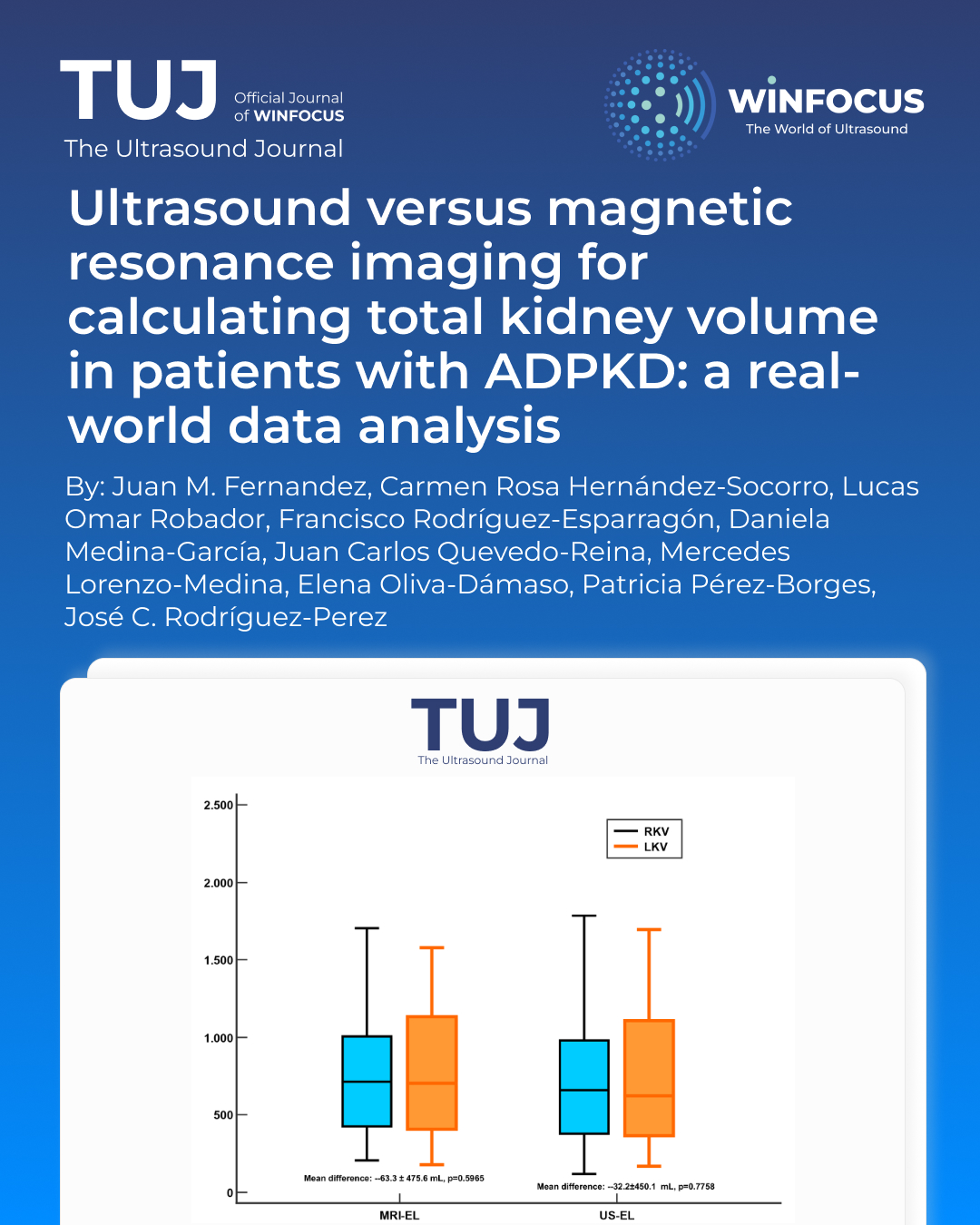
Results: Thirty-two ADPKD patients, 14(43.7%) women, were included. Mean measured (mGFR) and estimated (eGFR) glomerular-filtration-rate (GFR) were 86.5 ± 23.9 mL/min and 78.9 ± 23.6 mL/min, respectively. Compared with MRI-EL, TKV (Mean difference: − 85.9 ± 825.6 mL; 95%CI − 498.5 to 326.7 mL; p = 0.6787), RKV (Mean difference: − 58.5 ± 507.7 mL; 95%CI − 312.2 to 195.2 mL; p = 0.6466), and LKV (Mean difference: − 27.4 ± 413.5 mL; 95%CI − 234.1 to 179.2 mL; p = 0.7918) were lower with US-EL than with MRI-EL, although without significant differences. According to Passing and Bablok-regression analysis, the Spearman correlation-coefficient was 0.96 (95%CI 0.92 to 0.98); 0.91 (95%CI 0.82 to 0.96), and 0.94 (95%CI 0.87 to 0.97) in the RKV, LKV, and TKV, respectively; p < 0.0001 each, respectively. CCC of RKV, LKV, and TKV measurements were 0.95, 0.89, and 0.94, respectively. The mGFR and eGFR showed statistically significant negative correlations with TKV measured by both MRI-EL (p = 0.0281 and p = 0.0054, respectively) and US-EL (p = p = 0.0332 and p = 0.0040, respectively).
Conclusions: This study found that ultrasound-based ellipsoid kidney volume measurements strongly correlated with MRI-based measurements, suggesting that ultrasound is a reliable, accessible alternative for assessing kidney volume, particularly when MRI is unavailable.
References
1. Lanktree MB, Haghighi A, Guiard E, Iliuta IA, Song X, Harris PC, Paterson AD, Pei Y (2018) Prevalence estimates of polycystic kidney and liver disease by population sequencing. J Am Soc Nephrol 29(10):2593–2600
2. Ponticelli C, Moroni G, Reggiani F (2023) Autosomal dominant polycystic kidney disease: is there a role for autophagy? Int J Mol Sci 24(19):14666
3. Chebib FT, Torres VE (2016) Autosomal dominant polycystic kidney disease: core curriculum 2016. Am J Kidney Dis 67:792–810
4. Lanktree MB, Haghighi A, di Bari I, Song X, Pei Y (2021) Insights into autosomal dominant polycystic kidney disease from genetic studies. Clin J Am Soc Nephrol 16(5):790–799
5. Cornec-Le Gall E, Audrézet MP, Renaudineau E, Hourmant M, Charasse C, Michez E et al (2017) PKD2-related autosomal dominant polycystic kidney disease: prevalence; clinical presentation; mutation spectrum; and prognosis. Am J Kidney Dis 70(4):476–485
6. Mahboob, M.; Rout, P.; Leslie, S.W.; Bokhari, S.RA. Autosomal Dominant Polycystic Kidney Disease. 2024 Mar 20. In: StatPearls. Treasure Island (FL): StatPearls Publishing; 2024. https://www.ncbi.nlm.nih.gov/books/NBK532934/. Accessed 23 Sept 2024.
7. Grantham JJ, Torres VE, Chapman AB, Guay-Woodford LM, Bae KT, King BF, CRISP Investigators et al (2006) Volume progression in polycystic kidney disease. N Engl J Med 354(20):2122–2130
8. Grantham JJ, Mulamalla S, Swenson-Fields KI (2011) Why kidneys fail in autosomal dominant polycystic kidney disease. Nat Rev Nephrol 7(10):556–566
9. Yu ASL, Shen C, Landsittel DP, Harris PC, Torres VE, Mrug M, Consortium for Radiologic Imaging Studies of Polycystic Kidney Disease (CRISP) et al (2018) Baseline total kidney volume and the rate of kidney growth are associated with chronic kidney disease progression in Autosomal Dominant Polycystic Kidney Disease. Kidney Int 93(3):691–699
10. Perrone RD, Mouksassi MS, Romero K, Czerwiec FS, Chapman AB, Gitomer BY et al. Total kidney volume is a prognostic biomarker of renal function decline and progression to end-stage renal disease in patients with autosomal dominant polycystic kidney disease. Kidney Int Rep. 2017;2(3):442–450. Erratum in: Kidney Int Rep. 2018;3(4):1015.
11. Irazabal MV, Rangel LJ, Bergstralh EJ, Osborn SL, Harmon AJ, Sundsbak JL, CRISP Investigators et al (2015) Imaging classification of autosomal dominant polycystic kidney disease: a simple model for selecting patients for clinical trials. J Am Soc Nephrol 26(1):160–172
12. Shi B, Akbari P, Pourafkari M, Iliuta IA, Guiard E, Quist CF et al (2019) Prognostic performance of kidney volume measurement for polycystic kidney disease: a comparative study of ellipsoid vs. manual segmentation. Sci Rep 9(1):10996
13. Alam A, Dahl NK, Lipschutz JH, Rossetti S, Smith P, Sapir D et al (2015) Total kidney volume in autosomal dominant polycystic kidney disease: a biomarker of disease progression and therapeutic efficacy. Am J Kidney Dis 66(4):564–576
14. O’Neill WC, Robbin ML, Bae KT, Grantham JJ, Chapman AB, Guay-Woodford LM et al (2005) Sonographic assessment of the severity and progression of autosomal dominant polycystic kidney disease: the Consortium of Renal Imaging Studies in Polycystic Kidney Disease (CRISP). Am J Kidney Dis 46(6):1058–1064
15. Brancaforte A, Serantoni S, Silva Barbosa F, Di Leo G, Sardanelli F, Cornalba GP (2011) Renal volume assessment with 3D ultrasound. Radiol Med 116(7):1095–1104
16. de Amorim Paiva CC, de Mello Junior CF, Guimarães Filho HA, de Brito Gomes CA, Junior LR, Junior GM et al (2014) Reproducibility of renal volume measurement in adults using 3-dimensional sonography. J Ultrasound Med 33(3):431–435
17. Pei Y, Obaji J, Dupuis A, Paterson AD, Magistroni R, Dicks E et al (2009) Unified criteria for ultrasonographic diagnosis of ADPKD. J Am Soc Nephrol 20(1):205–212
18. Pei Y, Hwang YH, Conklin J, Sundsbak JL, Heyer CM, Chan W et al (2015) Imaging-based diagnosis of autosomal dominant polycystic kidney disease. J Am Soc Nephrol 26(3):746–753
19. Grantham JJ (2008) Clinical practice. Autosomal dominant polycystic kidney disease. N Engl J Med 359(14):1477–1485
20. Luis-Lima S, Gaspari F, Negrín-Mena N, Carrara F, Díaz-Martín L, Jiménez-Sosa A et al (2018) Iohexol plasma clearance simplified by dried blood spot testing. Nephrol Dial Transplant 33:1597–1603
21. Krutzén E, Bäck SE, Nilsson-Ehle I, Nilsson-Ehle P (1984) Plasma clearance of a new contrast agent; iohexol: a method for the assessment of glomerular filtration rate. J Lab Clin Med 104:955–961
22. Levey AS, Stevens LA, Schmid CH, Zhang YL, Castro AF 3rd, Feldman HI et al. CKD-EPI (Chronic Kidney Disease Epidemiology Collaboration). A new equation to estimate glomerular filtration rate. Ann Intern Med. 2009;150:604–612. Erratum in: Ann Intern Med. 20;155:408.
23. Higashihara E, Nutahara K, Okegawa T, Tanbo M, Hara H, Miyazaki I et al (2015) Kidney volume estimations with ellipsoid equations by magnetic resonance imaging in autosomal dominant polycystic kidney disease. Nephron 129(4):253–262
24. Passing H, Bablok W (1983) A new biometrical procedure for testing the equality of measurements from two different analytical methods. Application of linear regression procedures for method comparison studies in clinical chemistry; Part I. J Clin Chem Clin Biochem 21(11):709–720
25. Passing H, Bablok W (1984) Comparison of several regression procedures for method comparison studies and determination of sample sizes. Application of linear regression procedures for method comparison studies in Clinical Chemistry; Part II. J Clin Chem Clin Biochem 22(6):431–445
26. Lin LI (1989) A concordance correlation coefficient to evaluate reproducibility. Biometrics 45(1):255–268
27. McBride GB. A proposal for strength-of-agreement criteria for Lin’s Concordance Correlation Coefficient. NIWA Client Report: HAM2005-062. Published in 2005. https://www.medcalc.org/download/pdf/McBride2005.pdf. Accessed 2 Sept 2024.
28. Bland JM, Altman DG (1999) Measuring agreement in method comparison studies. Stat Methods Med Res 8(2):135–160
29. Duijzer R, Boerrigter MM, Gevers TJG, Drenth JPH (2024) The pathophysiology of polycystic liver disease. J Hepatol 80(6):981–983
30. Di Martino M, Koryukova K, Bezzi M, Catalano C (2017) Imaging features of non-alcoholic fatty liver disease in children and adolescents. Children (Basel) 4(8):73
31. Hansen KL, Nielsen MB, Ewertsen C (2015) Ultrasonography of the kidney: a pictorial review. Diagnostics (Basel) 6(1):2
32. Sharma K, Caroli A, Quach LV, Petzold K, Bozzetto M, Serra AL et al (2017) Kidney volume measurement methods for clinical studies on autosomal dominant polycystic kidney disease. PLoS ONE 12(5):e0178488
33. Hammoud S, Tissier AM, Elie C, Pousset M, Knebelman B, Joly D et al (2015) Ultrasonographic renal volume measurements in early autosomal dominant polycystic disease: comparison with CT-scan renal volume calculations. Diagn Interv Imaging 96(1):65–71
34. Akbari P, Nasri F, Deng SX, Khowaja S, Lee SH, Warnica W et al (2022) Total kidney volume measurements in ADPKD by 3D and ellipsoid ultrasound in comparison with magnetic resonance imaging. Clin J Am Soc Nephrol 17(6):827–834
35. Jagtap JM, Gregory AV, Homes HL, Wright DE, Edwards ME, Akkus Z et al (2022) Automated measurement of total kidney volume from 3D ultrasound images of patients affected by polycystic kidney disease and comparison to MR measurements. Abdom Radiol (NY) 47:2408–2419
36. Breysem L, De Keyzer F, Schellekens P, Dachy A, De Rechter S, Janssens P, CRISP Consortium et al (2023) Risk severity model for pediatric autosomal dominant polycystic kidney disease using 3D ultrasound volumetry. Clin J Am Soc Nephrol 18(5):581–591
37. Magistroni R, Corsi C, Martí T, Torra R (2018) A review of the imaging techniques for measuring kidney and cyst volume in establishing autosomal dominant polycystic kidney disease progression. Am J Nephrol 48(1):67–78
38. Turco D, Busutti M, Mignani R, Magistroni R, Corsi C (2017) Comparison of total kidney volume quantification methods in autosomal dominant polycystic disease for a comprehensive disease assessment. Am J Nephrol 45(5):373–379
39. Breysem L, De Rechter S, De Keyzer F, Smet MH, Bammens B, Van Dyck M et al (2018) 3DUS as an alternative to MRI for measuring renal volume in children with autosomal dominant polycystic kidney disease. Pediatr Nephrol 33(5):827–835
40. Bhutani H, Smith V, Rahbari-Oskoui F, Mittal A, Grantham JJ, Torres VE et al (2015) A comparison of ultrasound and magnetic resonance imaging shows that kidney length predicts chronic kidney disease in autosomal dominant polycystic kidney disease. Kidney Int 88(1):146–151
41. Braconnier P, Piskunowicz M, Vakilzadeh N, Müller ME, Zürcher E, Burnier M et al (2020) How reliable is renal ultrasound to measure renal length and volume in patients with chronic kidney disease compared with magnetic resonance imaging? Acta Radiol 61(1):117–127
42. Chapman AB, Guay-Woodford LM, Grantham JJ, Torres VE, Bae KT, Baumgarten DA, Consortium for Radiologic Imaging Studies of Polycystic Kidney Disease cohort et al (2003) Renal structure in early autosomal-dominant polycystic kidney disease (ADPKD): the Consortium for Radiologic Imaging Studies of Polycystic Kidney Disease (CRISP) cohort. Kidney Int 64(3):1035–1045
43. Jo WR, Kim SH, Kim KW, Suh CH, Kim JK, Kim H et al (2017) Correlations between renal function and the total kidney volume measured on imaging for autosomal dominant polycystic kidney disease: a systematic review and meta-analysis. Eur J Radiol 95:56–65
44. Phakdeekitcharoen B, Treesinchai W, Wibulpolprasert P, Boongird S, Klytrayong P (2021) The correlation between kidney volume and measured glomerular filtration rate in an Asian ADPKD population: a prospective cohort study. BMC Nephrol 22(1):178
45. Katagiri D, Wang F, Gore JC, Harris RC, Takahashi T (2021) Clinical and experimental approaches for imaging of acute kidney injury. Clin Exp Nephrol 25(7):685–699
46. Bakker J, Olree M, Kaatee R, de Lange EE, Moons KG, Beutler JJ et al (1999) Renal volume measurements: accuracy and repeatability of US compared with that of MR imaging. Radiology 211(3):623–628
47. Bierig S, Jones A (2009) Accuracy and cost comparison of ultrasound versus alternative imaging modalities, including CT, MR, PET, and angiography. J Diagn Med Sonogr 25:138–144
Downloads
Published
Issue
Section
License
Copyright (c) 2025 Juan M. Fernandez, Carmen Rosa Hernández‑Socorro, Lucas Omar Robador, Francisco Rodríguez‑Esparragón, Daniela Medina‑García, Juan Carlos Quevedo‑Reina, Mercedes Lorenzo‑Medina, Elena Oliva‑Dámaso, Patricia Pérez‑Borges, José C. Rodríguez‑Perez (Author)

This work is licensed under a Creative Commons Attribution-NonCommercial 4.0 International License.
This is an Open Access article distributed under the terms of the Creative Commons Attribution License (https://creativecommons.org/licenses/by-nc/4.0) which permits unrestricted use, distribution, and reproduction in any medium, provided the original work is properly cited.
Authors retain the copyright for their published work. No formal permission will be required to reproduce parts (tables or illustrations) of published papers, provided the source is quoted appropriately and reproduction has no commercial intent.
How to Cite