Point-of-care ultrasound training using near-peer training and remote Supervision: A pilot randomized controlled trial
Keywords:
Point-of-care ultrasound, near-peer training, remote supervision, technology acceptance, entrustable professional activitiesAbstract
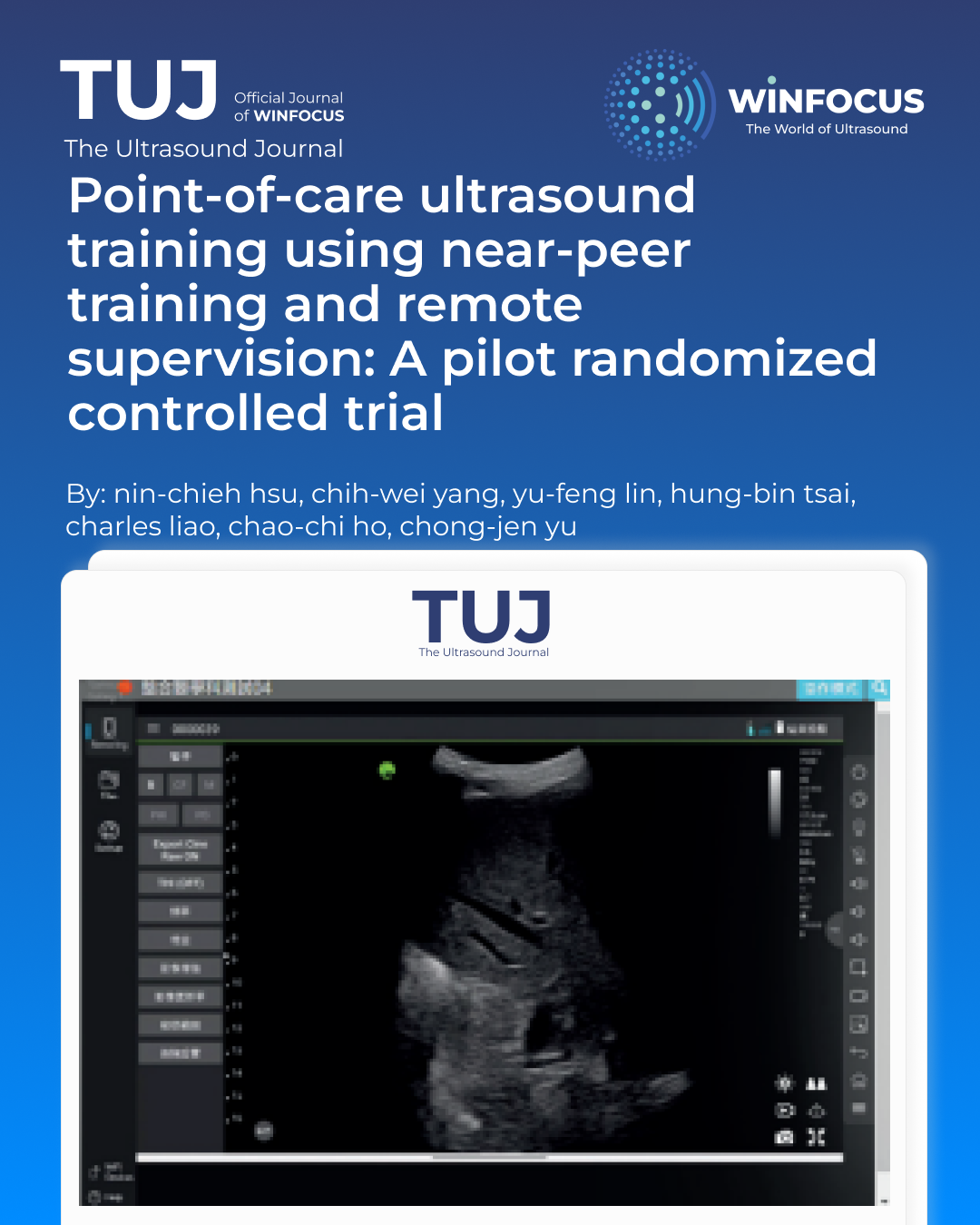
Background and objective: Traditional point-of-care ultrasound (PoCUS) teaching that relies on hands-on practice faces challenges of limited scale and infection-control constraints during pandemics. We designed a low-contact curriculum integrating near-peer teaching (NPT) with faculty remote supervision (RS) and evaluated its effectiveness versus on-site faculty-led teaching.
Methods: In this randomized controlled pilot trial, 69 senior medical students were assigned to NPT+RS (n=34) or faculty-led control group (n=35). Both groups received identical didactic and hands-on training, with the NPT+RS group incorporating multi-camara telemedicine supervision by the faculty to support NPT. The primary outcome was the Entrustable Professional Activity (EPA)–based Objective Structured Clinical Examination (OSCE) score with four major domains measured 1 month after training. The secondary outcomes included the technology acceptance model (TAM) survey and the OSCE feedback.
Results: Total OSCE scores (74.9 vs 76.8; p=0.614) and the Indication-Acquisition-Interpretation-Medical decision domain scores did not differ between two groups. For single items, only a lower interpretation performance at the posterolateral alveolar/pleural syndrome in NPT+RS group (4.6 vs 6.5; p=0.013) was found. The NPT+RS group reported higher perceived usefulness (efficiency, usefulness, performance, productivity; all p<0.05), with no between-group difference in perceived ease-of-use. The OSCE was more often perceived by the NPT+RS group as revealing weaknesses (p=0.002) and meriting routine post-training implementation (p=0.034).
Conclusions: A low-contact PoCUS curriculum integrating NPT with RS achieved overall EPA-based OSCE performance comparable to traditional faculty-led instruction while enhancing perceived usefulness and assessment acceptance. Implementation of this model allows for greater training capacity and decreased contact. The capacity of NPT for image-interpretation skills warrants investigation.
References
1. Lichtenstein D, Malbrain ML. Critical care ultrasound in cardiac arrest. Technological requirements for performing the SESAME-protocol--a holistic approach. Anaesthesiol Intensive Ther 2015;47:471-81. doi: 105603/AITa2015.0072
2. Lichtenstein DA, Mezière GA. Relevance of lung ultrasound in the diagnosis of acute respiratory failure: the BLUE protocol. Chest 2008;134:117-25. doi: 101378/chest07-2800.
3. Moore CL, Copel JA. Point-of-care ultrasonography. N Engl J Med 2011;364:749-57. doi: 101056/NEJMra0909487
4. Shokoohi H, Boniface KS, Zaragoza M, Pourmand A, Earls JP, Yadav K, et al. Point-of-care ultrasound leads to diagnostic shifts in patients with undifferentiated hypotension. Am J Emerg Med 2017;35:1984.e3-1984.e7. doi: 101016/jajem.2017.08.054
5. El Husseini K, Flament T, Laroumagne S, Cammilleri S, Dutau H, Astoul P, et al. Mapping bullous emphysema with lung ultrasound: a prospective multicentre study. Respirology 2025;30:633-43. doi: 101111/resp70021
6. Otaola M, Paulin F, Rosemffet M, Altabas K, Carrillo M, Schneeberger EE, et al. Lung ultrasound is a promising screening tool to rule out interstitial lung disease in patients with rheumatoid arthritis. Respirology 2024;29:588-95. doi: 101111/resp14679
7. Rinaldi L, Milione S, Fascione MC, Mercurio V, Vetrugno L, Santoro C, et al. Relevance of lung ultrasound in the diagnostic algorithm of respiratory diseases in a real-life setting: a multicentre prospective study. Respirology 2020;25:535-42. doi: 101111/resp13659
8. Kirkpatrick AW, Sirois M, Laupland KB, Liu D, Rowan K, Ball CG, et al. Hand-held thoracic sonography for detecting post-traumatic pneumothoraces: the extended focused assessment with sonography for trauma (EFAST). J Trauma Inj Infect Crit Care 2004;57:288-95. doi: 101097/01TA.0000133565.88871.E4
9. Yamada T, Soni NJ, Minami T, Kameda T, Kameda N, Noda E, et al. Facilitators, barriers, and changes in POCUS use: longitudinal follow-up after participation in a national point-of-care ultrasound training course in Japan. Ultrasound J 2024;16:34. doi: 101186/s13089-024-00384-3
10. Lin SD. A virtual point-of-care ultrasound course during the COVID-19 pandemic. AEM Educ Train 2021;5:102-4. doi: 101002/aet210545
11. Soni NJ, Boyd JS, Mints G, Koyfman A, Rziha M, Wright S, et al. Comparison of in-person versus tele-ultrasound point-of-care ultrasound training during the COVID-19 pandemic. Ultrasound J 2021;13:39. doi: 101186/s13089-021-00242-6
12. De Menezes S, Premnath D. Near-peer education: a novel teaching program. Int J Med Educ 2016;7:160-7. doi: 105116/ijme5738.3c28
13. Burgess A, McGregor D. Peer teacher training for health professional students: a systematic review of formal programs. BMC Med Educ 2018;18:263. doi: 101186/s12909-018-1356-2
14. Burgess A, McGregor D, Mellis C. Medical students as peer tutors: a systematic review. BMC Med Educ 2014;14:115. doi: 101186/1472-6920-14-115
15. Cash T, Brand E, Wong E, Hill B, Paterson Q, Thiruchelvam D, et al. Near-peer medical student simulation training. Clin Teach 2017;14:175-9. doi: 101111/tct12558
16. Khapre M, Deol R, Sharma A, Badyal D. Near-peer tutor: a solution for quality medical education in faculty constraint setting. Cureus 2021. doi: 107759/cureus16416
17. Hari R, Kälin K, Birrenbach T, Hautz WE, Greif R, Bernhard M, et al. Near-peer compared to faculty teaching of abdominal ultrasound for medical students – a randomized-controlled trial. Ultraschall Med 2024;45:77-83. doi: 101055/a-2103-4787
18. Rong K, Lee G, Herbst MK. Effectiveness of near-peer versus faculty point-of-care ultrasound instruction to third-year medical students. POCUS J 2022;7:239-44. doi: 1024908/pocusv7i2.15746
19. Cameron M, Ray R, Sabesan S. Remote supervision of medical training via videoconference in northern Australia: a qualitative study of the perspectives of supervisors and trainees. BMJ Open 2015;5:e006444. doi: 101136/bmjopen-2014-006444
20. Jensen SH, Duvald I, Aagaard R, Lindholt JS, Sloth E, Kirketerp-Møller K, et al. Remote real-time ultrasound supervision via commercially available and low-cost tele-ultrasound: a mixed methods study of the practical feasibility and users’ acceptability in an emergency department. J Digit Imaging 2019;32:841-8. doi: 101007/s10278-018-0157-9
21. Salame G, Holden M, Lucas BP, Portillo A. Change in economy of ultrasound probe motion among general medicine trainees. Ultrasound J 2024;16:5. doi: 101186/s13089-023-00345-2
22. ten Cate O. Entrustability of professional activities and competency-based training. Med Educ 2005;39:1176-7. doi: 101111/j1365-2929.2005.02341.x
23. Kruisselbrink R, Chan V, Cibinel GA, Abrahamson S, Goffi A, Mayo PH, et al. I-AIM (Indication, Acquisition, Interpretation, Medical Decision-making) framework for point of care lung ultrasound. Anesthesiology 2017;127:568-82. doi: 101097/ALN0000000000001779
24. Perlas A, Arzola C, Van de Putte P. Point-of-care gastric ultrasound and aspiration risk assessment: a narrative review. Can J Anaesth 2018;65:437-48. doi: 101007/s12630-017-1031-9
25. Li L, Yong RJ, Kaye AD, Urman RD. Perioperative point of care ultrasound (POCUS) for anesthesiologists: an overview. Curr Pain Headache Rep 2020;24:20. doi: 101007/s11916-020-0847-0
26. Davis FD. Perceived usefulness, perceived ease of use, and user acceptance of information technology. MIS Q 1989;13:319-40. doi: 102307/249008
27. Do DH, Lakhal S, Bernier M, Gagnon MP, Giroux I, Bédard JL, et al. Drivers of iPad use by undergraduate medical students: the Technology Acceptance Model perspective. BMC Med Educ 2022;22:87. doi: 101186/s12909-022-03152-w
28. Glogoza M, Urbach J, Rosborough TK, Finefrock D, Branzetti J, Babcock C, et al. Tablet vs. station-based laptop ultrasound devices increases internal medicine resident point-of-care ultrasound performance: a prospective cohort study. Ultrasound J 2020;12:18. doi: 101186/s13089-020-00165-8
29. Wong A, Roslan NL, McDonald R, Ryzynski A, Arntfield R, Ma IWY, et al. Clinical obstacles to machine-learning POCUS adoption and system-wide AI implementation (the COMPASS-AI survey). Ultrasound J 2025;17:32. doi: 101186/s13089-025-00436-2
30. Frenk J, Chen L, Bhutta ZA, Cohen J, Crisp N, Evans T, et al. Health professionals for a new century: transforming education to strengthen health systems in an interdependent world. Lancet 2010;376:1923-58. doi: 101016/S0140-6736(10)61854-5
31. Suzuki R, Riley WJ, Bushman MS, Soni NJ, Kameda T, Minami T, et al. Tele-education in point-of-care ultrasound training. Ultrasound J 2024;16:47. doi: 101186/s13089-024-00394-1
Downloads
Published
Issue
Section
License
Copyright (c) 2026 Nin-Chieh Hsu, Chih-Wei Yang, Yu-Feng Lin, Hung-Bin Tsai, Charles Liao, Chao-Chi Ho, Chong-Jen Yu (Author)

This work is licensed under a Creative Commons Attribution-NonCommercial 4.0 International License.
This is an Open Access article distributed under the terms of the Creative Commons Attribution License (https://creativecommons.org/licenses/by-nc/4.0) which permits unrestricted use, distribution, and reproduction in any medium, provided the original work is properly cited.
Authors retain the copyright for their published work. No formal permission will be required to reproduce parts (tables or illustrations) of published papers, provided the source is quoted appropriately and reproduction has no commercial intent.
How to Cite