Intrarenal venous flow patterns and their association with successful fluid removal in critically ill patients: a prospective observational exploratory study
Keywords:
De-escalation, Doppler ultrasound, Fluid removal, Intensive care unit, Intrarenal venous flow, Venous excess ultrasoundAbstract
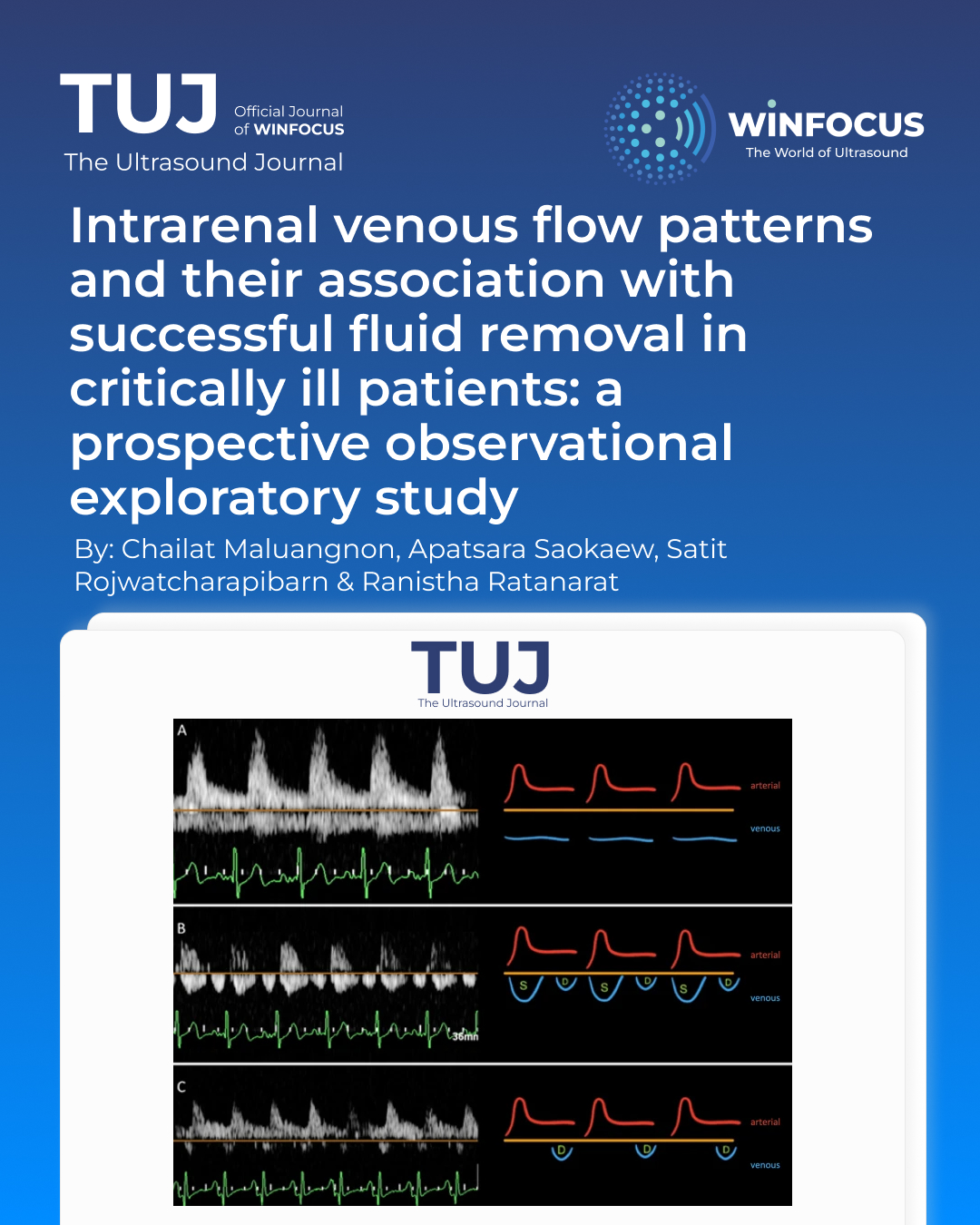
Background: Determining the optimal timing for fluid removal in critically ill patients remains a challenge. This study evaluated the utility of Doppler ultrasound, specifically intrarenal venous flow (IRVF) patterns and venous excess ultrasound (VExUS) scores, and their associations with fluid removal outcomes, hemodynamic parameters, and clinical endpoints.
Methods: In this prospective observational exploratory study, 52 intensive care unit (ICU) patients who underwent fluid removal were enrolled. Baseline IRVF patterns and VExUS scores were assessed, with follow-up evaluations performed daily for three days. The primary outcome was to evaluate whether IRVF patterns were associated with successful fluid removal, defined as achieving a negative fluid balance for at least two consecutive days. Secondary outcomes included associations with central venous pressure (CVP), NT-proBNP, cumulative fluid balance, and clinical outcomes.
Results: Thirty-one patients (59.6%) achieved successful fluid removal. A discontinuous baseline IRVF pattern was independently associated with successful fluid removal (adjusted odds ratio 4.31, 95% CI 1.02–18.18; P = 0.047). This pattern demonstrated high sensitivity of 87.1% (95% CI 70.2–96.4), moderate specificity of 42.9% (95% CI 21.8–66.0), and accuracy of 69.2% (95% CI 54.9–81.3). VExUS scores grades 2–3 demonstrated high specificity of 85.7% (95% CI 63.7–97.0) but low sensitivity of 29.0% (95% CI 14.2–48.0), with an accuracy of 51.9% (95% CI 37.6–66.0). An improvement in the IRVF pattern was significantly correlated with a reduction in NT-proBNP levels (P = 0.048). However, neither IRVF patterns nor VExUS scores improvements were associated with changes in fluid balance, CVP, or clinical outcomes such as 28-day mortality, ventilator-free days, or ICU length of stay.
Conclusions: Discontinuous IRVF patterns at baseline were significantly associated with fluid removal success, representing a physiologically based marker for deresuscitation readiness. More large-scale studies are warranted to validate these findings and explore long-term implications.
Trial registration ClinicalTrials.gov identifier NCT06216119. Registered 22 January 2024, https://clinicaltrials.gov/study/NCT06216119
References
1. Hoste EA, Maitland K, Brudney CS, Mehta R, Vincent JL, Yates D et al (2014) Four phases of intravenous fluid therapy: a conceptual model. Br J Anaesth 113(5):740–747. https://doi.org/10.1093/bja/aeu300
2. Zhang L, Chen Z, Diao Y, Yang Y, Fu P (2015) Associations of fluid overload with mortality and kidney recovery in patients with acute kidney injury: a systematic review and meta-analysis. J Crit Care 30(4):860.e867–813. https://doi.org/10.1016/j.jcrc.2015.03.025
3. Malbrain M, Martin G, Ostermann M (2022) Everything you need to know about deresuscitation. Intensive Care Med 48(12):1781–1786. https://doi.org/10.1007/s00134-022-06761-7
4. Koratala A, Ronco C, Kazory A (2022) Diagnosis of fluid overload: from conventional to contemporary concepts. Cardiorenal Med 12(4):141–154. https://doi.org/10.1159/000526902
5. Claure-Del Granado R, Mehta RL (2016) Fluid overload in the ICU: evaluation and management. BMC Nephrol 17(1):109. https://doi.org/10.1186/s12882-016-0323-6
6. Malbrain M, Van Regenmortel N, Saugel B, De Tavernier B, Van Gaal PJ, Joannes-Boyau O et al (2018) Principles of fluid management and stewardship in septic shock: it is time to consider the four D’s and the four phases of fluid therapy. Ann Intensive Care 8(1):66. https://doi.org/10.1186/s13613-018-0402-x
7. Beaubien-Souligny W, Rola P, Haycock K, Bouchard J, Lamarche Y, Spiegel R et al (2020) Quantifying systemic congestion with point-of-care ultrasound: development of the venous excess ultrasound grading system. Ultrasound J 12(1):16. https://doi.org/10.1186/s13089-020-00163-w
8. Assavapokee T, Rola P, Assavapokee N, Koratala A (2024) Decoding VExUS: a practical guide for excelling in point-of-care ultrasound assessment of venous congestion. Ultrasound J 16(1):48. https://doi.org/10.1186/s13089-024-00396-z
9. Yamamoto M, Seo Y, Iida N, Ishizu T, Yamada Y, Nakatsukasa T et al (2021) Prognostic impact of changes in intrarenal venous flow pattern in patients with heart failure. J Card Fail 27(1):20–28. https://doi.org/10.1016/j.cardfail.2020.06.016
10. Iida N, Seo Y, Sai S, Machino-Ohtsuka T, Yamamoto M, Ishizu T et al (2016) Clinical implications of intrarenal hemodynamic evaluation by Doppler ultrasonography in heart failure. JACC Heart Fail 4(8):674–682. https://doi.org/10.1016/j.jchf.2016.03.016
11. Ter Maaten JM, Dauw J, Martens P, Somers F, Damman K, Metalidis C et al (2021) The effect of decongestion on intrarenal venous flow patterns in patients with acute heart failure. J Card Fail 27(1):29–34. https://doi.org/10.1016/j.cardfail.2020.09.003
12. Fujii K, Nakayama I, Izawa J, Iida N, Seo Y, Yamamoto M et al (2023) Association between intrarenal venous flow from Doppler ultrasonography and acute kidney injury in patients with sepsis in critical care: a prospective, exploratory observational study. Crit Care 27(1):278. https://doi.org/10.1186/s13054-023-04557-9
13. Qian X, Zhen J, Meng Q, Li L, Yan J (2022) Intrarenal doppler approaches in hemodynamics: a major application in critical care. Front Physiol 13:951307. https://doi.org/10.3389/fphys.2022.951307
14. Rola P, Miralles-Aguiar F, Argaiz E, Beaubien-Souligny W, Haycock K, Karimov T et al (2021) Clinical applications of the venous excess ultrasound (VExUS) score: conceptual review and case series. Ultrasound J 13(1):32. https://doi.org/10.1186/s13089-021-00232-8
15. Kim JA, Wu L, Rodriguez M, Lentine KL, Virk HUH, Hachem KE et al (2023) Recent developments in the evaluation and management of cardiorenal syndrome: a comprehensive review. Curr Probl Cardiol 48(3):101509. https://doi.org/10.1016/j.cpcardiol.2022.101509
16. Husain-Syed F, Birk HW, Ronco C, Schörmann T, Tello K, Richter MJ et al (2019) Doppler-Derived Renal Venous Stasis Index in the Prognosis of Right Heart Failure. J Am Heart Assoc 8(21):e013584. https://doi.org/10.1161/jaha.119.013584
17. Nishikimi T, Nakagawa Y (2021) Potential pitfalls when interpreting plasma BNP levels in heart failure practice. J Cardiol 78(4):269–274. https://doi.org/10.1016/j.jjcc.2021.05.003
18. Abu-Naeima E, Fatthy M, Shalaby MAA, Ayeldeen G, Verbrugge FH, Rola P et al (2025) Venous excess doppler ultrasound assessment and loop diuretic efficiency in acute cardiorenal syndrome. BMC Nephrol 26(1):157. https://doi.org/10.1186/s12882-025-04060-z
19. Andrei S, Bahr PA, Nguyen M, Bouhemad B, Guinot PG (2023) Prevalence of systemic venous congestion assessed by venous excess ultrasound grading system (VExUS) and association with acute kidney injury in a general ICU cohort: a prospective multicentric study. Crit Care 27(1):224. https://doi.org/10.1186/s13054-023-04524-4
20. Beaubien-Souligny W, Galarza L, Buchannan B, Lau VI, Adhikari NKJ, Deschamps J et al (2024) Prospective study of ultrasound markers of organ congestion in critically ill patients with acute kidney injury. Kidney Int Rep 9(3):694–702. https://doi.org/10.1016/j.ekir.2023.12.018
21. Prager R, Arntfield R, Wong MYS, Ball I, Lewis K, Rochwerg B et al (2024) Venous congestion in septic shock quantified with point-of-care ultrasound: a pilot prospective multicentre cohort study. Can J Anaesth 71(5):640–649. https://doi.org/10.1007/s12630-024-02717-1
22. Rihl MF, Pellegrini JAS, Boniatti MM (2023) VExUS score in the management of patients with acute kidney injury in the intensive care unit: AKIVEX study. J Ultrasound Med 42(11):2547–2556. https://doi.org/10.1002/jum.16288
Downloads
Published
Issue
Section
License
Copyright (c) 2025 Chailat Maluangnon, Apatsara Saokaew, Satit Rojwatcharapibarn, Ranistha Ratanarat (Author)

This work is licensed under a Creative Commons Attribution-NonCommercial 4.0 International License.
This is an Open Access article distributed under the terms of the Creative Commons Attribution License (https://creativecommons.org/licenses/by-nc/4.0) which permits unrestricted use, distribution, and reproduction in any medium, provided the original work is properly cited.
Authors retain the copyright for their published work. No formal permission will be required to reproduce parts (tables or illustrations) of published papers, provided the source is quoted appropriately and reproduction has no commercial intent.
How to Cite