Knowledge and utilization of obstetric ultrasound and associated factors among pregnant mother in Africa: a systematic review and meta-analysis
Keywords:
Obstetric ultrasound, Knowledge, Pregnant women, Utilization, AfricaAbstract
Background: Obstetric ultrasound (US) is a non-invasive imaging method that employs sound waves to explore the abdominal and pelvic areas of a pregnant woman. It is recommended to have at least two ultrasound scans during pregnancy, one in the first trimester and another in the second trimester, to identify potential complications and improve perinatal outcomes. While this practice is widely implemented in developed nations, its utilization in many African countries remains suboptimal. This systematic review and meta-analysis aims to examine the level of knowledge and utilization of obstetric ultrasound among pregnant women in Africa, providing insights into its awareness and utilization across the continent.
Method: A systematic review and meta-analysis were conducted following PRISMA guidelines. Extensive literature searches were carried out across various databases, including PubMed, Google Scholar, ScienceDirect, Web of Science, Scopus, and African Online Journal databases. The pooled prevalence was estimated using a weighted inverse variance random-effects model. Heterogeneity among studies was assessed using the Cochrane Q-test and I 2 statistics, while publication bias was evaluated through a funnel plot and Egger’s test. Stata v17 software was employed to analyze factors associated with the utilization of obstetric ultrasound among pregnant women in Africa.
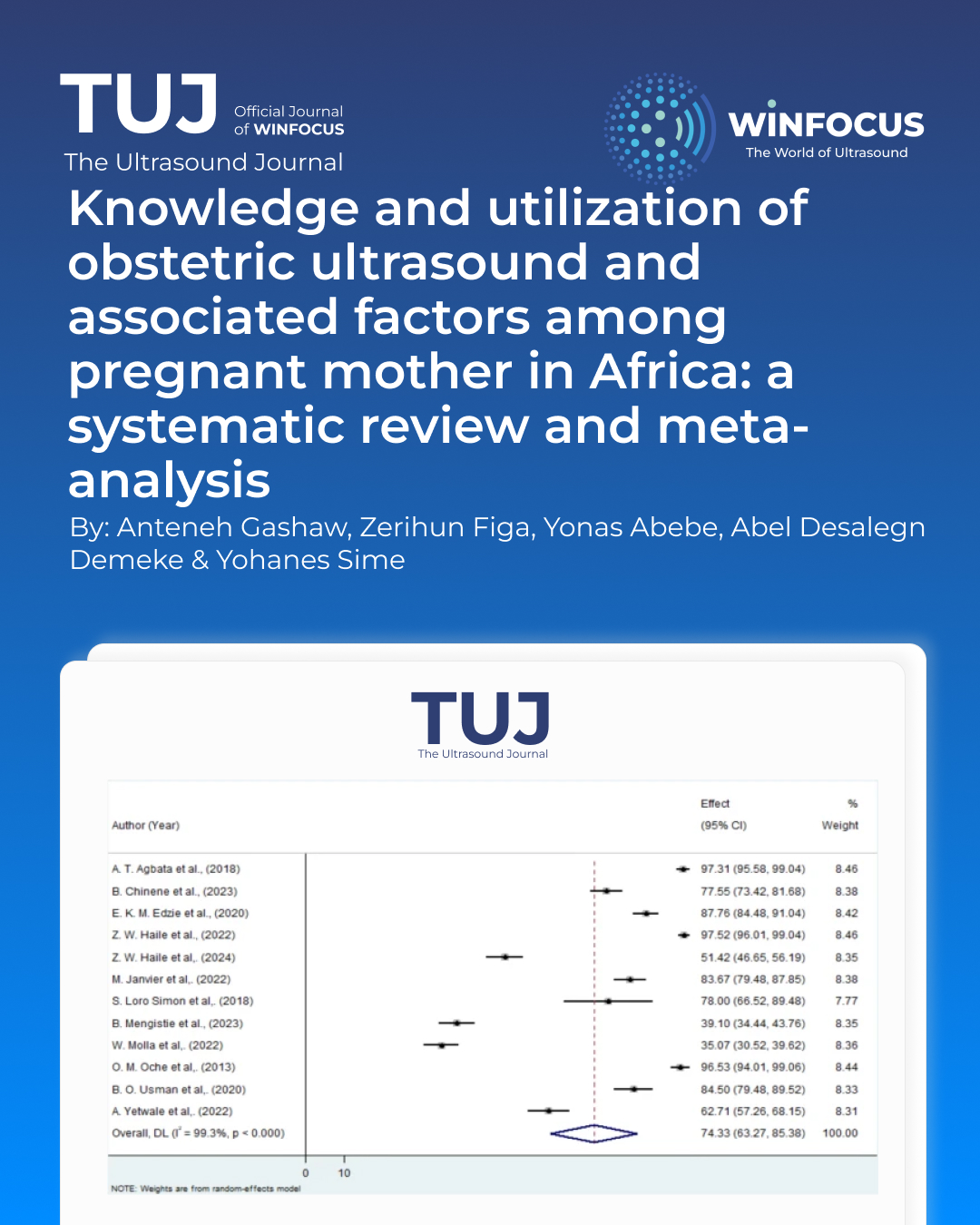
Result: A total of 622 articles were initially identified, with 23 ultimately meeting the inclusion criteria for this review, including five studies that addressed both knowledge and utilization of obstetric ultrasound. The overall knowledge level among pregnant women in Africa regarding obstetric ultrasound was estimated at 74.33% (95% CI 63.27–85.38%), while the pooled proportion of utilization was 63.3% (95% CI 51.59–75.02%). Subgroup analysis revealed that both knowledge and utilization levels were highest in Western Africa, whereas knowledge was lowest among pregnant women in Eastern Africa. Pregnant women with good knowledge of obstetric ultrasound were significantly more likely to utilize the service, with a pooled odds ratio (POR) of 8.41 (95% CI 4.66–12.16).
Conclusion: This systematic review and meta-analysis revealed a moderate utilization of obstetric ultrasound among pregnant mothers in Africa, with an increasing trend over time, particularly after 2020. The overall level of knowledge about obstetric ultrasound among mothers was 74.33%, and knowledge was identified as the key factor significantly associated with ultrasound utilization.
References
1. World Health Organization (2018) WHO recommendations on intrapartum care for a positive childbirth experience. World Health Organization, Geneva
2. World Health Organization (2023) WHO recommendations on antenatal care for a positive pregnancy experience: screening, diagnosis and treatment of tuberculosis disease in pregnant women. World Health Organization, Geneva
3. Verbeek P-P (2008) Obstetric ultrasound and the technological mediation of morality: a postphenomenological analysis. Hum Stud 31(1):11–26
4. Kasap B, Yeniçeri EN, Akın MN, Akbaba E, Küçük M, Turhan NÖ et al (2016) Ultrasound in pregnancy: a cross-sectional study of knowledge and expectations among pregnant women in Southwest Turkey. Haseki Tıp Bülteni. https:// doi. org/ 10. 4274/ haseki. 3234
5. Yadav JU, Yadav DJ (2017) Ultrasonography awareness among pregnant women attending medical college hospital in Kolhapur District of Maharashtra, India. Int J Res Med Sci 5(6):2612
6. Andersen HF (1991) Transvaginal and transabdominal ultrasonography of the uterine cervix during pregnancy. J Clin Ultrasound 19(2):77–83 7. Akombi BJ, Renzaho AM (2019) Perinatal mortality in sub-Saharan Africa: a meta-analysis of demographic and health surveys. Ann Global Health. https:// doi. org/ 10. 5334/ aogh. 2348
8. Mahran M, Omram M (1988) The impact of diagnostic ultrasound on the prediction of intrauterine growth retardation in developing countries. Int J Gynecol Obstet 26(3):375–378
9. Dasan TA, Singh S, Koratagere RS, Raja B, Rangaswamy NB (2016) Knowledge and attitude of antenatal women towards routine ultrasound screening in pregnancy at a tertiary institution in Bengaluru. Int J Anat 5(4):11–14
10. Wanyonyi SZ, Mariara CM, Vinayak S, Stones W (2017) Opportunities and challenges in realizing universal access to obstetric ultrasound in sub-Saharan Africa. Ultrasound Int Open 3(02):E52–E59
11. Petersson K, Lindkvist M, Persson M, Conner P, Åhman A, Mogren I (2016) Prenatal diagnosis in Sweden 2011 to 2013—a register-based study. BMC Pregnancy Childbirth 16:1–13
12. Haile ZW, Gurmu AG (2024) Knowledge, attitude, barriers, and associated factors of obstetric ultrasound among pregnant women in public hospitals, Ethiopia, 2022: a cross-sectional study. J Ultrasound 27(1):31–40
13. Dar-Odeh O, Illa M, Abdeljawad S, Abu-Hammad O, Abdeljawad R, Abdeljawad R et al (2022) Ultrasonography knowledge and practices among obstetrics/gynecology practitioners; a nationwide survey in Jordan. Open Health 3(1):34–43
14. Krishnamoorthy N, Kasinathan A (2016) Knowledge and attitude regarding obstetric ultrasound among pregnant women: a cross sectional study. Int J Reprod Contracept Obstet Gynecol 5(7):2192–2196
15. Abduljabbar HS, Jabal NAB, Hussain FA, Alqabbaa RM, Marwani FA, Alghamdi SA et al (2020) Knowledge, attitudes and practice about obstetric ultrasonography among women attending a university hospital: a cross-sectional study. Open J Obst Gynecol 10(12):1763–1775
16. Molla W, Mengistu N, Wudneh A (2022) Pregnant women’s knowledge, attitude, and associated factors toward obstetric ultrasound in public hospitals, Ethiopia, 2021: Multi-centered cross-sectional study. Womens Health 18:17455057221091356
17. Moher D, Liberati A, Tetzlaff J, Altman DG (2009) Preferred reporting items for systematic reviews and meta-analyses: the PRISMA statement. Ann Internal Med 151(4):264–269
18. Bekele A, Lakew Y (2014) Projecting Ethiopian demographics from 2012–2050 using the spectrum suite of models. Ethiop Public Health Assoc 4:70
19. McPheeters ML, Kripalani S, Peterson NB, Idowu RT, Jerome RN, Potter SA et al (2012) Closing the quality gap: revisiting the state of the science. Evid Rep/Technol Asse 2083:1–475
20. Thorlund K, Imberger G, Johnston BC, Walsh M, Awad T, Thabane L et al (2012) Evolution of heterogeneity (I2) estimates and their 95% confidence intervals in large meta-analyses. PLoS ONE 7(7):e39471
21. Agbata AT, Ukaegbe CI, Lawani LO, Ekwedigwe KC, Ajah LO (2018) Women’s views on routine antenatal ultrasound scan in a low resource Nigerian setting. J Clin Diag Res 12(6):107860
22. Chinene B, Mudadi L-S (2023) Pregnant women’s knowledge and expectations about prenatal ultrasound: a cross-sectional study. Rwanda J Med Health Sci 6(3):346–354
23. Edzie EKM, Dzefi-Tettey K, Gorleku PN, Ampofo JW, Piersson AD, Asemah AR et al (2020) Perception of Ghanaian Primigravidas undergoing their first antenatal ultrasonography in cape coast. Radiol Res Pract 2020(1):4589120
24. Haile ZW, Goshu EM, Kumsa MJ, Getahun EB. Attitude, Practice, and Associated factors of pregnant women towards prenatal ultrasound in Addis Ababa, Ethiopia. A cross-sectional study. 2022.
25. Janvier M, Derrick K, Gonzaga MR, Eric MMJ (2022) Knowledge, attitudes and practices of pregnant women towards obstetric ultrasound at Mulago Hospital: a cross-sectional survey. J Gynecol Reprod Med 6(1):1–8
26. Loro Simon S. Utilization pattern of obstetric ultrasonography among mothers in Kiryandongo Hospital. 2018.
27. Mengistie B, Ayele S, Tsehaye W, Mazengia A, Wolde M (2023) Assessment of knowledge and attitude of pregnant women towards antenatal ultrasound in University of Gondar comprehensive specialized hospital at antenatal care clinic, Northwest Ethiopia. PLoS ONE 18(11):e0292496
28. Molla W, Mengistu N, Wudneh A (2022) Pregnant women’s knowledge, attitude, and associated factors toward obstetric ultrasound in public hospitals, Ethiopia, 2021: Multi-centered cross-sectional study. Womens Health (Lond) 18:17455057221091356
29. Oche OM, Umar AS, Raji MO, Kaoje AU, Godwin G, Ango JT et al (2013) Knowledge of the use and indications for obstetric ultrasound scan among women attending a main referral hospital, Sokoto. Nigeria Res Obstet Gynecol 2(5):55–62
30. Usman BO, Idris SH, Abdulaziz U (2020) Factors affecting utilization of obstetric ultrasound: a study of semi-urban pregnant women in a developing nation. Sahel Medical Journal 23(2):82–87
31. Yetwale A, Kabeto T, Biyazin T, Fenta B (2022) Prenatal ultrasound utilization and its associated factors among pregnant women in Jimma town public health institutions, Ethiopia. Health Serv Res Manage Epidemiol 9:23333928221085880
32. Haile ZW, Gadisa A, Belay E (2023) Obstetric ultrasound screening service utilization among pregnant women in public hospitals in Addis Ababa, Ethiopia: barriers and Enablers, 2022: a cross-sectional study. Ethiopian J Health Biomed Sci 13(2):45–54
33. Hangelbroek M, Omogi J. Barriers and Enablers That Influence Utilization of Ultrasound Screening Services among Antenatal Women in Kajiado and Kisii Counties Kenya. 2021.
34. Jagun O, Ogunlaja O, Odusoga O (2013) Routine diagnostic antenatal ultrasound scan: knowledge and perception of pregnant women. Trop J Obstet Gynaecol 30(2):34–39
35. Msuega CD, Teryima IJ, Aondoaseer UA, Ochekawo OI. Obstetric Ultrasonography Beliefs, Expectations, and Experiences among Women Attending a Tertiary Healthcare Center in North-Central Nigeria.
36. SAMUEL GK, Chinule PQ. Utilization Of Sonography Among Pregnant Women In Rivers State. 2023.
37. Ugwu A, Elugwu H, Onyegbule O (2016) Expectant mothers’ perception of prenatal sonography in a South-Eastern population in Nigeria. Trop J Obstet Gynaecol 33(2):190–195
38. Alghamdi SA, Dhahi NA, Gashash FA, Abuturboush GF, Hazzazi AA, Alhailiy AB et al (2024) Assessment of pregnant women’s knowledge and perceptions of antenatal ultrasound in Saudi Arabia. Healthcare. https:// doi. org/ 10. 3390/ healt hcare 12141 409
39. Komakech E (2023) Knowledge and practices of pregnant women towards sonography in Awach health centre 1v. Makerere university, Gulu district
40. Kozuki N, Katz J, Khatry SK, Tielsch JM, LeClerq SC, Mullany LC (2016) Community survey on awareness and use of obstetric ultrasonography in rural Sarlahi District. Nepal Int J Gynecol Obst 134(2):126–130
41. Huang K, Tao F, Raven J, Liu L, Wu X, Tang S (2012) Utilization of antenatal ultrasound scan and implications for caesarean section: a cross-sectional study in rural Eastern China. BMC Health Serv Res 12:1–10
42. Britton N, Miller MA, Safadi S, Siegel A, Levine AR, McCurdy MT (2019) Tele-ultrasound in resource-limited settings: a systematic review. Front Public Health 7:244
43. Aliyu LD, Kurjak A, Wataganara T, De Sá RAM, Pooh R, Sen C et al (2016) Ultrasound in Africa: what can really be done? J Perinat Med 44(2):119–123
Downloads
Published
Issue
Section
License
Copyright (c) 2025 Anteneh Gashaw, Zerihun Figa, Yonas Abebe, Abel Desalegn Demeke, Yohanes Sime (Author)

This work is licensed under a Creative Commons Attribution-NonCommercial 4.0 International License.
This is an Open Access article distributed under the terms of the Creative Commons Attribution License (https://creativecommons.org/licenses/by-nc/4.0) which permits unrestricted use, distribution, and reproduction in any medium, provided the original work is properly cited.
Authors retain the copyright for their published work. No formal permission will be required to reproduce parts (tables or illustrations) of published papers, provided the source is quoted appropriately and reproduction has no commercial intent.
How to Cite