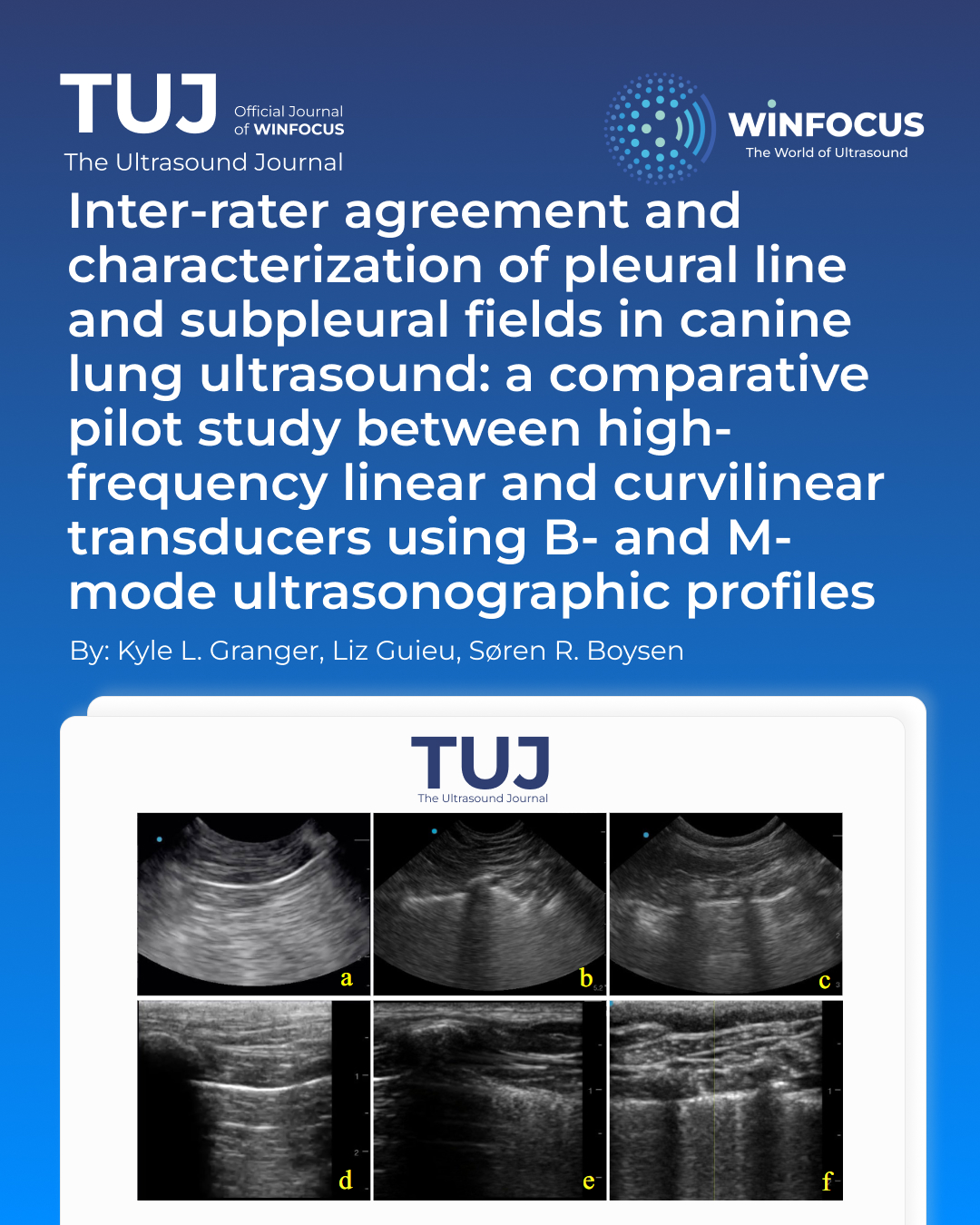
Inter-rater agreement and characterization of pleural line and subpleural fields in canine lung ultrasound: a comparative pilot study between high-frequency linear and curvilinear transducers using B- and M-mode ultrasonographic profiles
Keywords:
Lung ultrasound, Pleural line, Subpleural field, High-frequency linear transducer, Curvilinear transducer, Canine pulmonary diseaseAbstract
Background: Lung ultrasound (LUS) is increasingly utilized in veterinary medicine to assess pulmonary conditions. However, the characterization of pleural line and subpleural fields using different ultrasound transducers, specifically high-frequency linear ultrasound transducers (HFLUT) and curvilinear transducers (CUT), remains underexplored in canine patients. This study aimed to evaluate inter-rater agreement in the characterization of pleural line and subpleural fields using B- and M-mode ultrasonography in dogs with and without respiratory distress.
Results: Eighty-eight ultrasound clips from nine dogs were analyzed. HFLUT demonstrated strong inter-rater agreement in B-mode (κ = 0.89) and near-perfect agreement in M-mode (κ = 1.00) for pleural line homogeneity. In contrast, CUT showed minimal agreement in both B-mode (κ = 0.34) and M-mode (κ = 0.37). Homogeneous pleural lines were predominantly observed in control dogs or those with cardiogenic pulmonary edema (CPE), while non-homogeneous pleural lines were more common in dogs with non-cardiogenic alveolar-interstitial syndrome (NCAIS). Vertical subpleural fields identified in M-mode were associated with both CPE and NCAIS, whereas horizontal fields were more often observed in control dogs.
Conclusions: HFLUT offers superior inter-rater reliability for characterizing pleural and subpleural features in canine LUS compared to CUT, particularly in M-mode. These findings suggest HFLUT may enhance diagnostic accuracy for pulmonary conditions in dogs. Further studies are needed to explore the diagnostic potential of LUS in differentiating vertical artifact (e.g., B-lines) etiologies in veterinary patients.
References
1. Avila J, Smith B, Mead T, Jurma D, Dawson M, Mallin M, Dugan A (2018) Does the addition of M-Mode to B-Mode ultrasound increase the accuracy of identification of lung sliding in traumatic pneumothoraces? J Ultrasound Med 37(11):2681–2687
2. Bobbia X, Abou-Badra M, Hansel N, Pes P, Petrovic T, Claret PG, Lefrant J-Y, de La Coussaye J-E, Group WF (2018) Changes in the availability of bedside ultrasound practice in emergency rooms and prehospital settings in France. Anaesth Crit Care Pain Med 37 (3):201–205
3. Bobbia X, Chabannon M, Chevallier T, de La Coussaye JE, Lefrant JY, Pujol S, Claret P-G, Zieleskiewicz L, Roger C, Muller L (2018) Assessment of five different probes for lung ultrasound in critically ill patients: a pilot study. Am J Emerg Med 36(7):1265–1269
4. Boysen S, Madden V (2023) Point-of-care lung and pleural space ultrasound. Adv Monit Proc Small Anim Emerg Crit Care 2023:347–364
5. Boysen S, McMurray J, Gommeren K (2019) Abnormal curtain signs identified with a novel lung ultrasound protocol in six dogs with pneumothorax. Front Vet Sci 6:480103
6. Boysen SR (2021) Lung ultrasonography for pneumothorax in dogs and cats. Vet Clin Small Anim Pract 51(6):1153–1167
7. Corradi F, Vetrugno L, Isirdi A, Bignami E, Boccacci P, Forfori F (2022) Ten conditions where lung ultrasonography may fail: limits, pitfalls and lessons learned from a computer-aided algorithmic approach. Minerva Anestesiol 88(4):308–313
8. Demi L, Van Hoeve W, Van Sloun RJ, Soldati G, Demi M (2017) Determination of a potential quantitative measure of the state of the lung using lung ultrasound spectroscopy. Sci Rep 7(1):12746
9. Demi L, Wolfram F, Klersy C, De Silvestri A, Ferretti VV, Muller M, Miller D, Feletti F, Wełnicki M, Buda N (2023) New international guidelines and consensus on the use of lung ultrasound. J Ultrasound Med 42(2):309–344
10. Dicker SA, Lisciandro GR, Newell SM, Johnson JA (2020) Diagnosis of pulmonary contusions with point-of-care lung ultrasonography and thoracic radiography compared to thoracic computed tomography in dogs with motor vehicle trauma: 29 cases (2017–2018). J Vet Emerg Crit Care 30(6):638–646
11. Dietrich CF, Mathis G, Blaivas M, Volpicelli G, Seibel A, Wastl D, Atkinson NS, Cui X-W, Fan M, Yi D (2016) Lung B-line artefacts and their use. J Thorac Dis 8(6):1356
12. Doerschug KC, Schmidt GA (2013) Intensive care ultrasound: III. Lung and pleural ultrasound for the intensivist. Ann Am Thorac Soc 10(6):708–712 13. Duggan NM, Goldsmith AJ, Al Saud AA, Ma IW, Shokoohi H, Liteplo AS (2022) Optimizing lung ultrasound: the effect of depth, gain and focal position on sonographic B-lines. Ultrasound Med Biol 48(8):1509–1517 14. Fatima N, Mento F, Zanforlin A, Smargiassi A, Torri E, Perrone T, Demi L (2023) Human-to-Ai interrater agreement for lung ultrasound scoring in COVID-19 Patients. J Ultrasound Med 42(4):843–851
15. Fischer EA, Minami T, Ma IW, Yasukawa K (2022) Lung ultrasound for pleural line abnormalities, confluent B-Lines, and consolidation: expert reproducibility and a method of standardization. J Ultrasound Med 41(8):2097–2107
16. FUJIFILM Sonosite I (2015) Sonosite SII User Guide.
17. Gomond-Le Goff C, Vivalda L, Foligno S, Loi B, Yousef N, De Luca D (2020) Effect of different probes and expertise on the interpretation reliability of point-of-care lung ultrasound. Chest 157(4):924–931
18. Haaksma ME, Smit JM, Heldeweg MLA, Nooitgedacht JS, de Grooth HJ, Jonkman AH, Girbes ARJ, Heunks L, Tuinman PR (2022) Extended lung ultrasound to differentiate between pneumonia and atelectasis in critically Ill patients: a diagnostic accuracy study. Crit Care Med 50(5):750–759. https:// doi. org/ 10. 1097/ CCM. 00000 00000 005303
19. Heldeweg ML, Smit MR, Kramer-Elliott SR, Haaksma ME, Smit JM, Hagens LA, Heijnen NF, Jonkman AH, Paulus F, Schultz MJ (2022) Lung ultrasound signs to diagnose and discriminate interstitial syndromes in ICU patients: a diagnostic accuracy study in two cohorts. Crit Care Med 50(11):1607–1617
20. Heldeweg MLA, Lopez Matta JE, Pisani L, Slot S, Haaksma ME, Smit JM, Mousa A, Magnesa G, Massaro F, Touw HRW, Schouten V, Elzo Kraemer CV, van Westerloo DJ, Heunks LMA, Tuinman PR (2022) The impact of thoracic ultrasound on clinical management of critically Ill patients (UltraMan): an international prospective observational study. Crit Care Med. https:// doi. org/ 10. 1097/ CCM. 00000 00000 005760
21. Heldeweg MLA, Smit MR, Kramer-Elliott SR, Haaksma ME, Smit JM, Hagens LA, Heijnen NFL, Jonkman AH, Paulus F, Schultz MJ, Girbes ARJ, Heunks LMA, Bos LDJ, Tuinman PR (2022) Lung ultrasound signs to diagnose and discriminate interstitial syndromes in ICU patients: a diagnostic accuracy study in two cohorts. Crit Care Med 50(11):1607–1617. https:// doi. org/ 10. 1097/ CCM. 00000 00000 005620
22. Himebauch AS, Nishisaki A (2023) Basic lung ultrasound for the intensivist. In: Point-of-Care Ultrasound for the Neonatal and Pediatric Intensivist: a Practical Guide on the Use of POCUS. Springer, pp 133–140
23. Lichtenstein DA (2014) Lung ultrasound in the critically ill. Ann Intensive Care 4:1–12
24. Lisciandro GR, Fulton RM, Fosgate GT, Mann KA (2017) Frequency and number of B-lines using a regionally based lung ultrasound examination in cats with radiographically normal lungs compared to cats with leftsided congestive heart failure. J Vet Emerg Crit Care 27(5):499–505
25. Lisciandro GR, Lisciandro SC (2021) Lung ultrasound fundamentals, “wet versus dry” lung, signs of consolidation in dogs and cats. Vet Clin Small Anim Pract 51(6):1125–1140
26. Łobaczewski A, Czopowicz M, Moroz A, Mickiewicz M, Stabińska M, Petelicka H, Frymus T, Szaluś-Jordanow O (2021) Lung ultrasound for imaging of B-lines in dogs and cats—a prospective study investigating agreement between three types of transducers and the accuracy in diagnosing cardiogenic pulmonary edema, pneumonia and lung neoplasia. Animals 11(11):3279
27. Marini TJ, Rubens DJ, Zhao YT, Weis J, O’Connor TP, Novak WH, Kaproth-Joslin KA (2021) Lung ultrasound: the essentials. Radiol Cardioth Imag 3(2):e200564
28. Matthias I, Panebianco NL, Maltenfort MG, Dean AJ, Baston C (2021) Effect of machine settings on ultrasound assessment of B-lines. J Ultrasound Med 40(10):2039–2046
29. Rocca E, Zanza C, Longhitano Y, Piccolella F, Romenskaya T, Racca F, Savioli G, Saviano A, Piccioni A, Mongodi S (2023) Lung ultrasound in critical care and emergency medicine: clinical review. Adv Respir Med 91(3):203–223 30. Salamonsen MR, Lo AK, Ng AC, Bashirzadeh F, Wang WY, Fielding DI (2014) Novel use of pleural ultrasound can identify malignant entrapped lung prior to effusion drainage. Chest 146(5):1286–1293
31. Saul T, Siadecki SD, Berkowitz R, Rose G, Matilsky D, Sauler A (2015) M-mode ultrasound applications for the emergency medicine physician. J Emerg Med 49(5):686–692
32. Singh AK, Mayo PH, Koenig S, Talwar A, Narasimhan M (2018) The use of M-mode ultrasonography to differentiate the causes of B lines. Chest 153(3):689–696
33. Smargiassi A, Zanforlin A, Perrone T, Buonsenso D, Torri E, Limoli G, Mossolani EE, Tursi F, Soldati G, Inchingolo R (2023) Vertical artifacts as lung ultrasound signs: Trick or Trap? Part 2-an accademia di ecografia toracica position paper on B-lines and sonographic interstitial syndrome. J Ultrasound Med 42(2):279–292
34. Vezzosi T, Mannucci T, Pistoresi A, Toma F, Tognetti R, Zini E, Domenech O, Auriemma E, Citi S (2017) Assessment of lung ultrasound B-lines in dogs with different stages of chronic valvular heart disease. J Vet Intern Med 31(3):700–704
35. Walters AM, O’Brien MA, Selmic LE, Hartman S, McMichael M, O’Brien RT (2018) Evaluation of the agreement between focused assessment with sonography for trauma (AFAST/TFAST) and computed tomography in dogs and cats with recent trauma. J Vet Emerg Crit Care 28(5):429–435
36. Ward JL, Lisciandro GR, DeFrancesco TC (2018) Distribution of alveolarinterstitial syndrome in dogs and cats with respiratory distress as assessed by lung ultrasound versus thoracic radiographs. J Vet Emerg Crit Care 28(5):415–428
37. Ward JL, Murphy SD, Lisciandro GR, Tropf MA, Viall AK, DeFrancesco TC (2021) Comparison of curvilinear-array (microconvex) and phased-array transducers for ultrasonography of the lungs in dogs. Am J Vet Res 82(8):619–628
Downloads
Published
Issue
Section
License
Copyright (c) 2025 Kyle L. Granger, Liz Guieu, Søren R. Boysen (Author)

This work is licensed under a Creative Commons Attribution-NonCommercial 4.0 International License.
This is an Open Access article distributed under the terms of the Creative Commons Attribution License (https://creativecommons.org/licenses/by-nc/4.0) which permits unrestricted use, distribution, and reproduction in any medium, provided the original work is properly cited.
Authors retain the copyright for their published work. No formal permission will be required to reproduce parts (tables or illustrations) of published papers, provided the source is quoted appropriately and reproduction has no commercial intent.
How to Cite